Red Lory
The Red Lory (Trichoglossus borneus) is a vibrant species of parrot belonging to the family Psittaculidae. Known for its striking plumage and playful demeanor, it is the second-most common lory kept in captivity, surpassed only by the rainbow lorikeet. These birds are celebrated for their intelligence and theatrical personalities, making them a favorite among avian enthusiasts.
Key Facts
- Scientific Name: Trichoglossus borneus
- Conservation Status: Least Concern (IUCN 3.1)
- Native Range: Endemic to the Moluccas and surrounding islands in Indonesia
- Defining Feature: Specialized brush tongues for feeding on nectar and pollen
- Average Length: Approximately 31 cm (12 in)
- Weight: Ranges from 30 to 300 grams
Taxonomy and Naming History
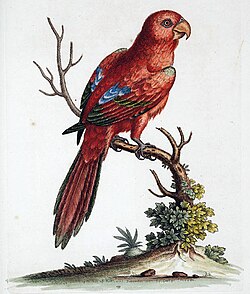
The taxonomic history of the Red Lory is marked by early curiosity and some geographical confusion. In 1751, English naturalist George Edwards described the bird as "The long-tailed scarlet lory" in his work A Natural History of Uncommon Birds. Edwards based his description on a stuffed specimen purchased from a London toyshop; while its origin was initially unknown, a visitor to collector Hans Sloane later suggested it came from Borneo.
In 1758, Carl Linnaeus formally named the species Psittacus borneus. Later, in 1826, James Francis Stephens introduced the genus Trichoglossus, where the species is placed today. Interestingly, the specific epithet borneus (meaning "from Borneo") is a toponymic error, as the species does not actually occur on the island of Borneo.
The term "lory" itself is derived from the Malay word lūri, used to describe various colorful parrots. This term was documented by Dutch writer Johan Nieuhof in 1682 and later adopted by English naturalists like Eleazar Albin and George Edwards.
Currently, two primary subspecies are recognized:
- T. b. cyanonothus: Found in Buru (central Maluku Islands).
- T. b. borneus: Found in the south Maluku Islands and Kai Islands.
Physical Description
The Red Lory is a visually stunning bird, measuring roughly 31 cm in length. Its plumage is predominantly red across the upper body, with accents of blue and black on the wings and back. The tail is reddish-brown, complemented by blue under-tail coverts. Physical identifiers include an orange beak, grey legs, and red irises (though the subspecies E. b. bernsteini possesses brown irises).
Males and females are identical in appearance. Juveniles are distinguished by duller plumage, brown irises, and a brownish beak. Anatomically, their bills are narrower and less powerful than those of other parrots, and their gizzards are typically thin-walled. A defining biological characteristic of the lory is the brush tongue, which features papillae at the tips to efficiently collect pollen and nectar.
Distribution and Habitat
While lories and lorikeets are found across Australia, New Guinea, the Pacific, and Indonesia, the Red Lory is specifically endemic to the Moluccas and surrounding Indonesian islands. They primarily inhabit tropical mangrove forests and tropical moist lowland forests. Additionally, the species has been introduced to Taiwan.
Aviculture and Behavior
In captivity, Red Lories are described as flamboyant, theatrical, and sometimes pugnacious. They are highly intelligent, curious, and affectionate, often displaying unique behaviors such as sleeping on their backs or wrapping themselves in washcloths.
Proper care for a pet Red Lory requires significant attention. Key care requirements include:
- Environmental Enrichment: Provision of toys such as bells, ropes, swings, and balls, as well as branches for chewing.
- Hygiene: Frequent bathing in showers or bird baths.
- Socialization: Young birds must be exposed to new people and environments to ensure they remain social.
- Housing: Large cages that are cleaned often, though outdoor housing is preferred.
Owners should be aware that mated pairs can be forcefully territorial. Furthermore, because the Buru red lory (Eos bornea cyanonothus) is darker and maroon-colored, it is often confused with the nominate subspecies; inadvertent interbreeding in captivity has led to the existence of hybrids.
Dietary Needs
In their natural habitat, Red Lories consume a diet of nectar, pollen, fruits, and the occasional insect. In a domestic setting, a formulated diet is essential. Smaller lories require daily fresh nectar, while larger birds can be fed pellets and a variety of fresh produce, including:
- Fruits: Apples, pomegranates, papaya, grapes, cantaloupe, pineapple, figs, and kiwi.
- Vegetables: Corn-on-the-cob.
Fresh, clean water must be provided daily, and treats can be used to reinforce positive behavior.
| Feature | Details |
|---|---|
| Scientific Name | Trichoglossus borneus |
| Family | Psittaculidae |
| Native Region | Moluccas, Indonesia |
| Primary Diet | Nectar, Pollen, Fruit |
| Conservation Status | Least Concern |
| Key Physical Trait | Brush tongue with papillae |
Frequently Asked Questions
Why is the Red Lory named "borneus" if it is not from Borneo?
The name is a result of a historical error. George Edwards based his early description on a specimen from a London toyshop, and a visitor to Hans Sloane's house suggested the bird originated from Borneo, leading Carl Linnaeus to use the name Psittacus borneus.
What is a brush tongue and why is it important?
A brush tongue is a specialized tongue with papillae at the tips. This adaptation allows lories to efficiently feed on nectar and pollen, which are primary components of their diet.
How do you distinguish between male and female Red Lories?
Male and female Red Lories have an identical external appearance, making it impossible to distinguish them by sight alone.
What are the dietary requirements for a pet Red Lory?
They require a formulated diet including fresh nectar (especially for smaller birds), pellets, and a variety of fruits and vegetables such as papaya, pomegranate, and corn-on-the-cob.
Are Red Lories easy to keep as pets?
While intelligent and affectionate, they require significant attention, frequent bathing, and environmental enrichment to stay healthy and happy. They can also be pugnacious and territorial, especially when mated.