Red-breasted Parakeet
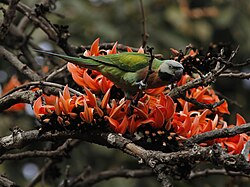
The red-breasted parakeet (Psittacula alexandri) is a vibrant parrot native to Southeast Asia. Known for its striking appearance and wide geographical range, it is one of the most varied species within its genus. The bird is most easily identified by the prominent red patch located on its breast. Depending on the specific subspecies, it is also frequently referred to as the moustached parakeet.
While the species is widespread, its distribution is highly fragmented. Many subspecies are restricted to small clusters of islands or single minuscule islands in Indonesia. Other populations are found in the Andaman Islands, as well as across continental Southeast Asia, extending into the northeastern foothills of the Himalayas in South Asia.
Key Facts
- Scientific Name: Psittacula alexandri
- Conservation Status: Near Threatened (IUCN 3.1)
- Trade Regulation: Listed under CITES Appendix II
- Distinguishing Feature: A large red patch on the breast
- Native Range: Southeast Asia, including Indonesia and the Andaman Islands
- Feral Populations: Established in cities such as Mumbai and Singapore, with smaller numbers in Chennai and Bangalore
Taxonomy and Nomenclature
The red-breasted parakeet was first formally described in 1758 by the Swedish naturalist Carl Linnaeus in the tenth edition of Systema Naturae. Linnaeus originally classified the bird under the genus Psittacus, giving it the binomial name Psittacus alexandri, with the type locality identified as the island of Java.
In 1800, the French naturalist Georges Cuvier introduced the genus Psittacula, which is a diminutive of the Latin word psittacus, meaning "parrot." The specific epithet alexandri honors Alexander the Great, whose soldiers are credited with introducing parakeets to Greece.
Recognized Subspecies
Due to its wide distribution across various islands and continents, eight distinct subspecies are recognized:
- P. a. fasciata: Found from north India to south China and Indochina.
- P. a. abbotti: Native to the Andaman Islands.
- P. a. cala: Found in Simeulue (west of north Sumatra).
- P. a. major: Found in the Lasia and Babi Islands (west of north Sumatra).
- P. a. perionca: Native to Nias (west of north Sumatra).
- P. a. alexandri: The nominate race, found in Java, Bali, and south Borneo.
- P. a. dammermani: Found in the Karimunjawa Islands (north of central Java).
- P. a. kangeanensis: Native to the Kangean Islands (north of Bali).
Conservation Status
The red-breasted parakeet is currently classified as Near Threatened by the IUCN. The species faces various pressures, particularly the wild bird trade, which threatens several of the island-dwelling races. Of particular concern is the nominate race (P. a. alexandri) found in Java, which is considered close to extinction.
To regulate international trade and protect the species, it is listed under CITES Appendix II (the Convention on International Trade in Endangered Species of Wild Fauna and Flora), which monitors trade to ensure it does not threaten the survival of the species in the wild.
| Category | Details |
|---|---|
| Kingdom | Animalia |
| Order | Psittaciformes |
| Family | Psittaculidae |
| Genus | Psittacula |
| IUCN Status | Near Threatened |
| CITES Listing | Appendix II |
Frequently Asked Questions
What is the red-breasted parakeet's other common name?
Depending on the subspecies, the red-breasted parakeet is also known as the moustached parakeet.
Where can feral populations of this parakeet be found?
Feral populations have established themselves in major cities including Mumbai and Singapore, with smaller numbers present in Bangalore and Chennai, India.
Which subspecies is most at risk of extinction?
The nominate race, Psittacula alexandri, which is native to Java, is considered to be close to extinction.
Why is the species named "alexandri"?
The name is derived from Alexander the Great, as his soldiers were responsible for introducing parakeets to Greece.
What is the primary identifying feature of this bird?
The most distinguishing characteristic of the red-breasted parakeet is the large red patch located on its breast.