Rainbow Gathering: Challenges, Legal Conflicts, and Controversies
The Rainbow Gathering is a large-scale, decentralized assembly of people seeking peace and spiritual connection. While these events are rooted in ideals of cooperation and harmony, they have frequently been marked by significant logistical difficulties, legal battles with federal authorities, and internal social tensions. From environmental concerns to complex disputes over civil liberties, the history of these gatherings reveals a persistent friction between a nomadic, anti-authoritarian culture and the structured laws of the land.
Key Facts
- Legal Status: Gatherings typically occur on National Forest land under the jurisdiction of the U.S. Forest Service (USFS).
- Permit Disputes: Organizers generally refuse permits, citing the First Amendment right to peaceably assemble.
- Environmental Impact: Issues include human waste, trash, and damage to forest facilities.
- Financial Burden: Local governments often bear the cost of emergency medical services and law enforcement.
- Cultural Misconceptions: The "Rainbow Warrior" prophecy is widely considered "fakelore" and not a genuine Hopi legend.
Internal Social and Logistical Difficulties
Despite the community's egalitarian goals, the Rainbow Family faces internal struggles. Critics point to unacknowledged class and power structures within the group. A recurring issue is the phenomenon of "Drainbows"—individuals who consume the social benefits of the gathering without contributing labor or resources, creating a classic cooperation problem.
Logistically, the gatherings are often chaotic. The Spring Council typically notifies the U.S. Forest Service of the event location only a few days before it begins. This lack of planning has occasionally led to split gatherings, such as in 1993, or very low attendance due to disputes over site legitimacy or global events like the COVID-19 pandemic.
In recent years, the community has struggled with the presence of drifters and vagrants. Reports have increased regarding theft, violence, hard drug use, and sexual assault. Notable criminal cases include the 2014 arrest of Leilani Novak-Garcia for stabbing a man in Utah, and the conviction of Jose Antonio Ramos for child molestation at a Pennsylvania gathering in the 1980s.
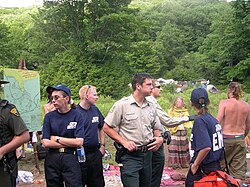
Conflicts with Law Enforcement and Government
Because gatherings take place on National Forest land, they fall under the jurisdiction of the U.S. Forest Service, often supported by county sheriffs, state police, and federal agencies like the FBI or DEA. The USFS frequently attempts to prevent these events or requires a group-use permit to protect public safety and the environment.
The Rainbow Family views permit requirements as a violation of the U.S. Constitution, arguing that assembly is a right, not a privilege to be regulated. This has led to decades of litigation. In 1986, a judge ruled a Forest Service regulation requiring permits for "expressive assemblies" to be unconstitutional due to selective enforcement.
Civil Liberties and Allegations of Harassment
The American Civil Liberties Union (ACLU) has repeatedly defended gathering attendees. In 2008 and 2016, the ACLU reported that the U.S. Forest Service systematically harassed participants and employed "overzealous" and "unconstitutional" law enforcement techniques. A 2008 incident in Wyoming saw reports of officers using pepper balls and rubber bullets against participants, though the USFS claimed the crowd had attacked officers with sticks and rocks.
Economic Costs
The financial burden of these events often falls on local taxpayers. For example, a 2013 gathering in Beaverhead County, Montana, resulted in approximately $175,000 in uncollectible emergency room charges. The federal government also incurred costs; the same 2013 event cost the USFS an estimated $573,000, with 850 incident reports and citations recorded.
Cultural and Ethical Controversies
The Hopi Prophecy Myth
For years, a rumor persisted that the gathering was the fulfillment of an ancient Hopi or Ojibwe prophecy known as the Legend of the Rainbow Warriors. However, researcher Michael Niman debunked this as "fakelore." Niman discovered that the myth was actually fabricated in 1962 by two Evangelical Christians, William Willoya and Vinson Brown, as a Christian tract regarding the Second Coming of Christ. Hopi elders have expressed confusion and disapproval regarding the appropriation of their identity for this myth.
Cultural Appropriation
In 2015, Native American academics and writers condemned the practice of "faux Native ceremonies" by attendees. They described this as cultural exploitation, arguing that treating indigenous beliefs as something "for the taking" dehumanizes Native Nations.
Safety and Fatalities
The remote nature of the gatherings and the presence of unstable individuals have led to several tragedies. These include natural deaths, such as heart attacks and drownings, as well as violent crimes.
| Year | Location | Incident Type | Details |
|---|---|---|---|
| 1980 | West Virginia | Homicide | Two women shot dead; killers remain at large. |
| 2011 | Washington | Missing Person | Marie Hanson's remains found near her campsite. |
| 2011 | Washington/Florida | Natural/Accidental | Two medical deaths in WA; one drowning in FL. |
| 2015 | Florida | Shooting | Jacob Cardwell killed while shielding another attendee. |
| 2018 | Georgia | Homicide | Amber Robinson beaten to death by Joseph Bryan Capstraw. |
| 2021 | Florida | Shooting | Larry "Frank" Dugger killed by an unknown assailant. |
Frequently Asked Questions
Why does the Rainbow Family refuse to get permits?
They believe that the U.S. Constitution and the Bill of Rights grant them the right to peaceably assemble on public land without government regulation, and that requiring a permit turns a basic right into a regulated privilege.
What is a "Drainbow"?
A "Drainbow" is a term used within the community to describe individuals who enjoy the social and resource benefits of a gathering but do not contribute their own labor or resources to the common good.
Is the Rainbow Gathering based on a Native American prophecy?
No. While often cited as a Hopi prophecy, the "Rainbow Warrior" legend was debunked as a fabrication created by two non-Native Evangelical Christians in a 1962 tract.
How does the community handle alcohol?
Public consumption of alcohol is generally discouraged. In U.S. gatherings, an "A-Camp" (often mistaken for "alcohol camp") is typically established near the entrance for those who wish to drink openly.
What environmental impacts are associated with the gatherings?
Common issues include the accumulation of trash, improper disposal of human waste, and damage to forest lands and existing campgrounds.