Raggiana Bird-of-Paradise
The Raggiana bird-of-paradise (Paradisaea raggiana), also known as Count Raggi's bird-of-paradise, is a striking member of the Paradisaeidae family. Found throughout the southern and northeastern regions of New Guinea, this bird is deeply woven into the cultural identity of the region. Locally, it is known as the kumul or cenderawasih.
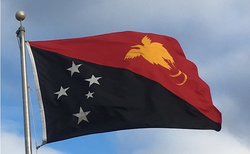
Beyond its biological fascination, the species holds immense national significance. It is the national bird of Papua New Guinea and has served as the national emblem since 1971, appearing prominently on the national flag. Its influence even extends to sports, as the country's national rugby league team is nicknamed "The Kumuls," which means "birds-of-paradise" in Tok Pisin.
Key Facts
- Scientific Name: Paradisaea raggiana
- National Status: National bird and emblem of Papua New Guinea.
- Conservation Status: Least Concern (IUCN 3.1).
- Primary Diet: Fruits and arthropods.
- Key Role: Essential seed disperser for mahogany and nutmeg trees.
- Breeding System: Polygamous, utilizing communal display areas called leks.
Physical Characteristics
Measuring approximately 34 centimeters (13 inches) in length, the Raggiana bird-of-paradise exhibits extreme sexual dimorphism, meaning males and females look significantly different.
Male Appearance
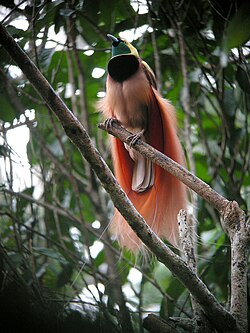
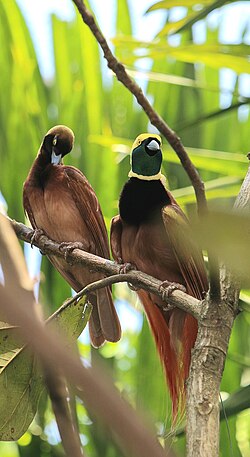
The male is renowned for its elaborate breeding plumage used to attract mates. It features a yellow crown, a dark emerald-green throat, and a yellow collar that separates the throat from the blackish upper breast. Most notably, the male possesses a pair of long black tail wires and large, ornamental flank plumes. Depending on the subspecies, these plumes range in color: the nominate P. r. raggiana has deep red plumes, while the P. r. augustavictoriae (the Empress of Germany's bird of paradise) features apricot-orange plumes.
Female Appearance
In contrast, the female is a comparatively drab maroonish-brown bird, lacking the long tail feathers and vibrant plumes of the male. Both sexes share a greyish-blue bill, yellow iris, and greyish-brown feet.
Behavior and Ecology
Diet and Environmental Impact
The Raggiana bird-of-paradise feeds primarily on fruits and arthropods. This diet makes the species a critical ecological agent; it serves as an important seed disperser for various fruiting trees in New Guinea, acting as the primary disperser for certain species of nutmeg and mahogany.
Breeding and Display
The species follows a polygamous breeding system. Males gather in leks—communal display arenas ranging from 30 to 100 meters in diameter. Within these leks, males compete for the most prominent perches on tall, slender trees. To impress visiting females, the males perform a complex display that involves shaking their heads and clapping their wings.
The female is solely responsible for nesting and incubation. She builds a bowl-shaped nest from stems, ferns, leaves, and other plant fibers, lining it with horsehair-like material. These nests are typically situated 2 to 11 meters above the ground, though they may be placed higher in areas with human disturbance. A clutch usually consists of two pinkish buff eggs, with an incubation period of 18 days in the wild and 20 days in captivity.
Conservation Status
The Raggiana bird-of-paradise is currently classified as Least Concern on the IUCN Red List of Threatened Species and is listed under Appendix II of CITES. While native populations frequently harvest the plumes for ceremonial headdresses, this practice is not considered a threat to the species' long-term survival. They remain widespread and common throughout the tropical forests of eastern New Guinea.
| Feature | Details |
|---|---|
| Average Length | 34 cm (13 in) |
| Plume Colors | Deep red to apricot-orange |
| Distribution | Southern and Northeastern New Guinea |
| Incubation Period | 18 days (wild) / 20 days (captivity) |
| IUCN Status | Least Concern |
Frequently Asked Questions
Why is the Raggiana bird-of-paradise important to Papua New Guinea?
It is the national bird and emblem of Papua New Guinea, appearing on the national flag and serving as the namesake for the national rugby league team, the Kumuls.
What is a lek?
A lek is a communal display arena where male birds gather to perform competitive courtship displays to attract females.
How does this bird help the rainforest?
The bird is a vital seed disperser, particularly for mahogany and nutmeg trees, helping these plant species propagate throughout the forest.
Do females have the same colorful feathers as males?
No, females are maroonish-brown and lack the elaborate plumes and long tail wires that characterize the males.
Is the species endangered?
No, it is listed as Least Concern by the IUCN, meaning it is widespread and common in its natural habitat.