Birds-of-Paradise: The Spectacular Avian Wonders of the Tropics
The birds-of-paradise, members of the family Paradisaeidae, are among the most visually stunning creatures in the animal kingdom. Found primarily in New Guinea, as well as the Moluccas and eastern Australia, these birds are celebrated for the extraordinary plumage of the males. Most species exhibit sexual dimorphism, a biological phenomenon where males and females of the same species possess different physical characteristics.
While the males are famous for their elaborate feathers extending from the head, wings, tail, or beak, these birds are more than just ornaments of nature. They are specialized inhabitants of dense rainforests, playing a vital role in their ecosystems through their diet and complex social behaviors.
Key Facts
- Species Diversity: 44 species distributed across 17 genera.
- Primary Habitat: Tropical rainforests, swamps, and moss forests, mostly in New Guinea.
- Diet: Primarily fruit, supplemented by arthropods (insects and spiders).
- Physical Range: Sizes vary from the 15 cm King bird-of-paradise to the 110 cm Black sicklebill.
- Evolutionary Age: Estimated to have emerged approximately 24 million years ago.
Taxonomy and Evolutionary History
The family Paradisaeidae was first introduced in 1825 by English naturalist William Swainson. For many years, these birds were thought to be closely related to bowerbirds. However, modern science places them within the Australasian lineage Corvida, identifying their closest evolutionary relatives as the crow and jay family (Corvidae), monarch flycatchers (Monarchidae), and Australian mudnesters (Struthideidae).
A 2009 mitochondrial DNA study revealed that the family emerged 24 million years ago. This research identified five distinct clades (evolutionary branches). The first split occurred 10 million years ago, separating the monogamous manucodes and paradise-crows from the rest of the family.
Taxonomic boundaries have shifted over time. For instance, satinbirds were once considered a subfamily of Paradisaeidae but were moved to a separate family in 2000. Similarly, Macgregor's bird-of-paradise was reclassified as a member of the Australasian honeyeater family.
Physical Characteristics and Diversity
The physical diversity within the family is striking. Weight ranges from the small 50 g King bird-of-paradise to the 430 g curl-crested manucode. The Black sicklebill holds the record for length, reaching up to 110 cm due to its extensive tail.
Bill shapes vary significantly based on diet and species. Some possess long, decurved (downward-curving) bills, such as the sicklebills and riflebirds, while others, like the astrapias, have smaller, slimmer bills. Interestingly, in insect-eating species, females often have larger bills than males.
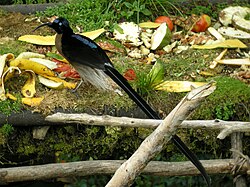
The wings of some males are structurally modified to produce sound during courtship displays, adding an auditory element to their visual spectacle.
Distribution and Habitat
Most birds-of-paradise are solitary tree dwellers inhabiting tropical environments. While rainforests and moss forests are common, some species inhabit coastal mangroves. The paradise riflebird of Australia is the southernmost representative, living in temperate and sub-tropical wet forests.
Altitude plays a significant role in their distribution; 30 of the 40 species are typically found in the mid-montane band between 1,000 and 2,000 meters. The manucodes are the most adaptable, with the glossy-mantled manucode inhabiting both forests and open savanna woodlands.
Behavior, Diet, and Breeding
The diet of all species is dominated by fruit, though they also consume arthropods. For example, fruits of the genus Heptapleurum are a critical food source for the ribbon-tailed astrapia.
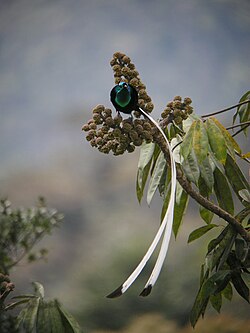
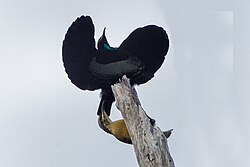
Breeding systems vary from monogamy to lek-type polygamy, where males gather in a common area to perform competitive displays to attract females.
Nests are constructed from soft materials like ferns, vine tendrils, and leaves, usually tucked into a tree fork. Clutch sizes are small; larger species typically lay a single egg, while smaller species may lay two to three. Eggs hatch in 16 to 22 days, and fledglings leave the nest within 16 to 30 days.
Cultural Impact and Human Interaction
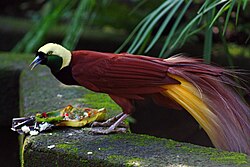
The allure of these birds has led to a complex history with humans. In the 19th century, explorers like Alfred Russel Wallace collected numerous specimens for scientific study. Historically, the long tail feathers of the Greater bird-of-paradise were used in the Shripech, the royal crown of Nepalese monarchs.
Today, the focus has shifted toward conservation. Birdwatching has become a sustainable alternative to hunting, providing economic incentives for local villagers to protect the birds rather than hunt them.
| Feature | Details |
|---|---|
| Scientific Family | Paradisaeidae |
| Primary Range | New Guinea, Moluccas, Eastern Australia |
| Key Diet | Fruit and Arthropods |
| Male Traits | Elaborate plumage, specialized display feathers |
| Breeding Styles | Monogamy to Lek-type polygamy |
Frequently Asked Questions
Why are male birds-of-paradise so colorful?
The elaborate plumage is a result of sexual selection. Males use their vibrant colors and complex feathers in courtship displays to attract females, who choose mates based on the quality of these signals.
Are all birds-of-paradise found in New Guinea?
While the vast majority are found in New Guinea, they are also present in the Moluccas and eastern Australia (such as the paradise riflebird).
What do birds-of-paradise eat?
Their diet is primarily frugivorous (fruit-eating), though they also consume arthropods like insects and spiders to supplement their nutrition.
How do they differ from bowerbirds?
Although once thought to be closely related, they are now considered distantly related. While both are part of the Corvida lineage, birds-of-paradise are more closely related to crows and jays.
What is a 'lek' in the context of these birds?
A lek is a communal display area where multiple males perform competitive courtship rituals to be evaluated and selected by visiting females.