Quotations in Linguistics: Direct Speech, Syntax, and Cross-Linguistic Markers
A quotation is a linguistic tool used to signify a specific phrase, passage, or utterance from speech or text. Whether used in a formal academic paper or a casual conversation, quotations allow a speaker or writer to represent the original form of a thought or statement. In written language, this is typically achieved through punctuation, while in oral speech, it relies on quotative markers—such as verbs of saying—and specific prosody (the rhythm and intonation of speech).
Beyond simple reporting, quotations serve as powerful literary devices to represent a character's point of view or to present information acquired via hearsay. In transcription, this is known as direct speech, where the text reports the original phrasing used by the speaker.
Key Facts
- Direct Speech: Reports speech or thought in its original form, often enclosed in quotation marks or guillemets (« »).
- Quotative Markers: Elements like verbs (e.g., "said") or particles that signal the start or end of a quote.
- Quotative Inversion: A syntactic phenomenon, primarily in written English, where the subject and verb are swapped (e.g., "said the man").
- Cross-Linguistic Variety: Different languages use diverse markers, including particles in Japanese and evidentials in Cusco Quechua.
- Brackets: Used in English quotes to provide clarification, adjust capitalization, or provide translations.
The Mechanics of Direct Speech
Direct speech is the most literal form of reporting. Unlike indirect speech, which paraphrases the content, direct speech preserves the original wording. In narrative writing, this is usually signaled by quotation marks, though the attribution (the "tag" identifying the speaker) may be explicitly mentioned or merely implied.
In spoken discourse, quotations are not limited to repeating words heard firsthand. Speakers use them to:
- Depict past events or stories, even if they were not participants.
- Express inner thoughts that were never spoken aloud.
- Propose hypothetical future dialogues.
When speaking, people often use "air quotes"—a hand gesture—to visually signal that they are quoting someone else or using a term ironically.
Syntax and Quotative Inversion
In English, the placement of the quotative verb (the verb used to introduce a quote) can vary. While the standard order is subject-verb (e.g., "Gabrielle asked"), quotative inversion allows the verb to precede the subject (e.g., "asked Gabrielle").
This inversion is most common in written works and is rare in spontaneous speech. However, certain syntactic constraints apply; for instance, inversion is unlikely if the sentence includes an additional noun phrase in a prepositional phrase (e.g., "'Why?' asked Gabrielle of the attendant" is acceptable, but adding further noun phrases can make the inversion feel unnatural).
English also permits both verb-subject ("warned Marcel") and subject-verb ("Swami demanded") orders depending on the stylistic choice of the author.
Cross-Linguistic Quotative Markers
Different languages employ various grammatical strategies to mark quotations. These are generally categorized into quotative verbs, particles, and evidentials.
Quotative Verbs
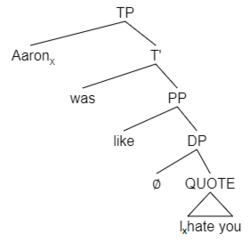
These are lexical verbs indicating speech or perception. In English, "say" is the primary quotative verb. Modern variations include "be like" (used exclusively for direct quotations) and "talkin' 'bout" in African American Vernacular English (AAVE). In some varieties, such as Indian or Hong Kong English, the complementizer "that" is used to introduce direct quotes, a usage that differs from Standard English.
Quotative Particles
Some languages use specific particles to act as "verbal quotation marks." Japanese, for example, uses the particle to or the more colloquial -tte alongside verbs of saying (itta) or thinking (omou). These particles typically appear after the quotation.

Quotative Evidentials
Quotative evidentials are markers that indicate the source of information is reported speech. This is found in languages such as Laal (Chad), Nanti, and Cusco Quechua (Peru). These markers signal that the speaker is relaying information they have been told rather than something they witnessed personally.

Summary of Quotation Types and Markers
| Marker Type | Primary Function | Example Language | Example/Feature |
|---|---|---|---|
| Quotative Verb | Lexical introduction of speech | English | "She said..." / "He be like..." |
| Quotative Particle | Grammatical signal of a quote | Japanese | to / -tte |
| Quotative Evidential | Indicates hearsay/reported source | Cusco Quechua | =si |
| Punctuation | Visual boundary for quotes | English/French | Quotation marks / Guillemets |
Frequently Asked Questions
What is the difference between direct and indirect speech?
Direct speech reports the exact words used by the original speaker, often enclosed in quotation marks. Indirect speech (or reported speech) conveys the content of what was said without necessarily using the original wording.
What is quotative inversion?
Quotative inversion is a syntactic structure where the verb of saying comes before the subject (e.g., "'I am leaving,' said the man"). This is more common in written literature than in spoken English.
How are brackets used within quotations in English?
Brackets are used to modify a quote for clarity without changing its meaning. They are commonly used for clarifying a pronoun (e.g., "She [Michelle] is an expert"), adjusting capitalization, or providing a translation of a foreign phrase.
What are quotative evidentials?
Quotative evidentials are specialized linguistic markers used in certain languages, such as Laal or Cusco Quechua, to explicitly indicate that the information being presented was acquired through hearsay or reported speech.
Can quotations be used for things that weren't actually said?
Yes. In spoken discourse, quotations are frequently used to represent inner thoughts that were never uttered aloud or to propose hypothetical dialogue for future situations.