Pythagorean Theorem: History, Proofs, and Mathematical Generalizations
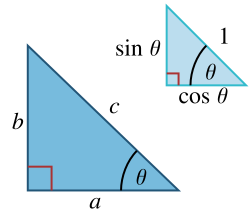
The Pythagorean theorem is a cornerstone of Euclidean geometry, establishing a fundamental relationship between the three sides of a right triangle. It states that the square of the hypotenuse (the side opposite the right angle) is equal to the sum of the squares of the other two sides. This principle is not merely a classroom exercise but a vital tool used in physics, engineering, and navigation to calculate distances and spatial relationships.
Key Facts
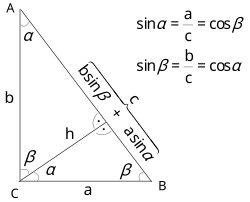
- Core Formula: a2 + b2 = c2, where c represents the hypotenuse.
- Ancient Origins: Evidence of the theorem exists in Babylonian and Egyptian texts long before Pythagoras was born.
- Pythagorean Triples: Sets of three integers (e.g., 3, 4, 5) that perfectly satisfy the theorem.
- Universal Application: The theorem serves as the basis for the distance formula in Cartesian coordinates and the Pythagorean trigonometric identity.
- Generalizations: The Law of Cosines extends this rule to all triangles, not just right-angled ones.
A Global History of Discovery
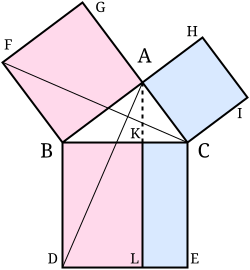
While named after the Greek philosopher Pythagoras (c. 570 – c. 495 BC), the mathematical relationship was known to several ancient civilizations centuries earlier. In Egypt, the Middle Kingdom Berlin Papyrus 6619 (c. 1800 BC) describes problems involving squares that sum to a third square, and tradition suggests the Egyptians used the 3:4:5 right triangle in their construction practices.
In Mesopotamia, the Old Babylonian period (20th to 16th centuries BC) saw widespread use of the rule. The Plimpton 322 tablet, dating to approximately 1800 BC, lists 15 different Pythagorean triples, demonstrating a sophisticated understanding of these numerical relationships.
![The Plimpton 322 tablet records Pythagorean triples from Babylonian times.[3]](/images/e5/31/e53194de0c0c12db4f0fc269d2fef36d32f9fe5a1f7831b1efc00b5e33d0841d.jpg)
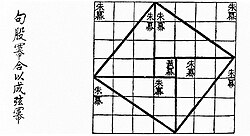
In China, the theorem is known as the Gougu theorem. The text Zhoubi Suanjing provides reasoning for the (3, 4, 5) triangle, and some historians suggest the principle was known as early as the 11th century BC as the Shang Gao theorem.
By around 300 BC, Euclid's Elements provided one of the first axiomatic proofs of the theorem, moving the concept from a practical rule of thumb to a formally proven mathematical certainty.
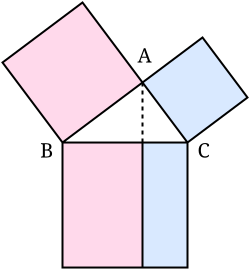
Methods of Proof
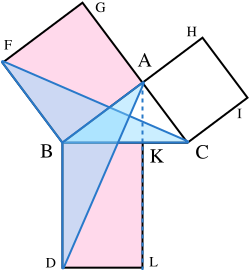
The Pythagorean theorem is one of the most proven theorems in history, with methods ranging from simple visual rearrangements to complex calculus.
Rearrangement and Algebraic Proofs
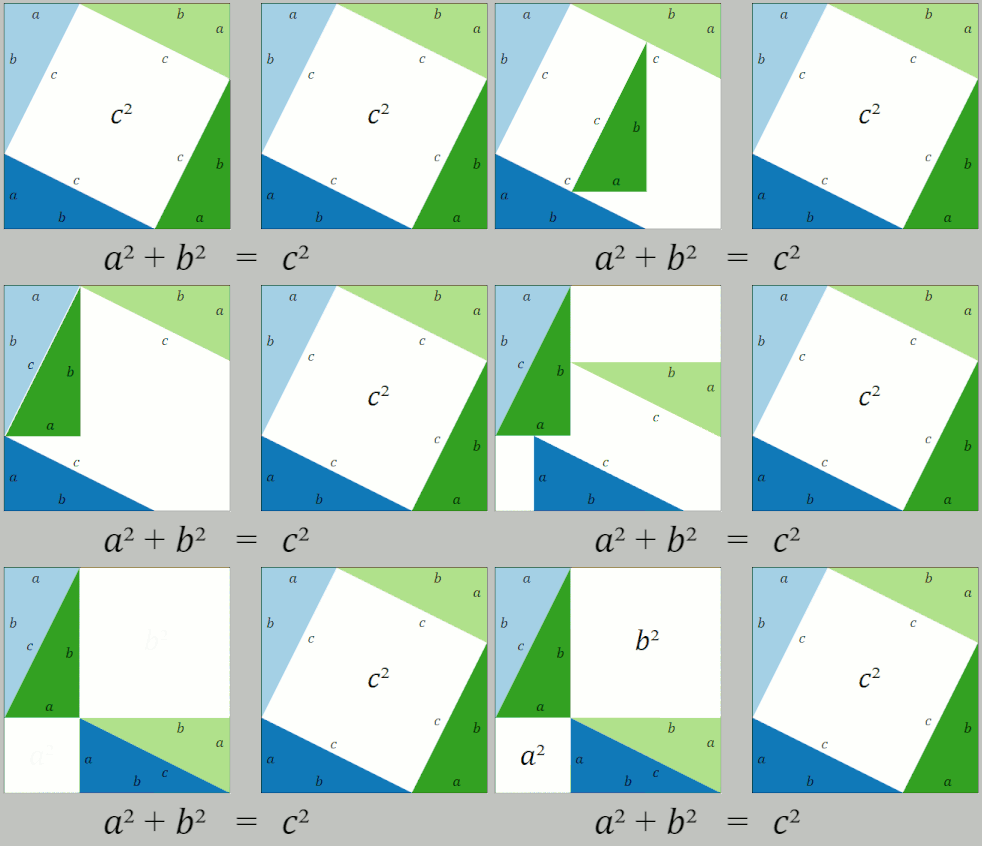
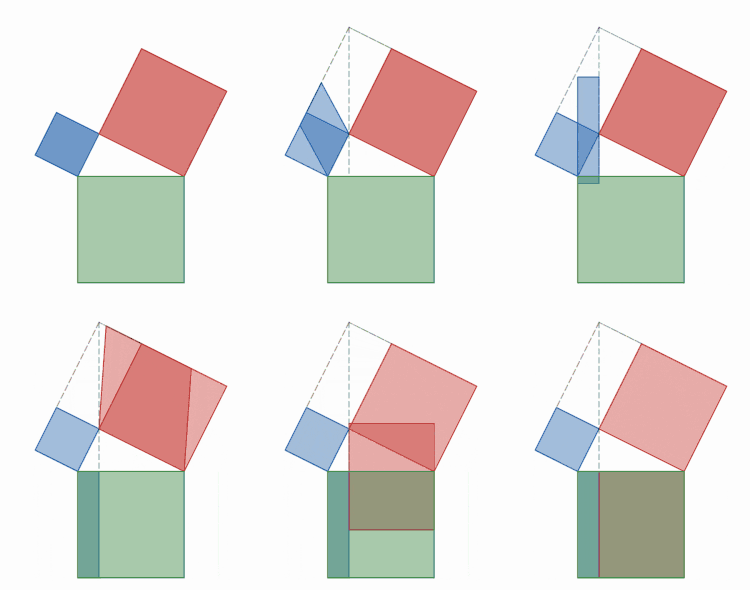
Rearrangement proofs demonstrate that the area of the square on the hypotenuse can be filled by the areas of the squares on the other two sides. By shifting triangles within a larger square, the constant area of the remaining space proves the equality.
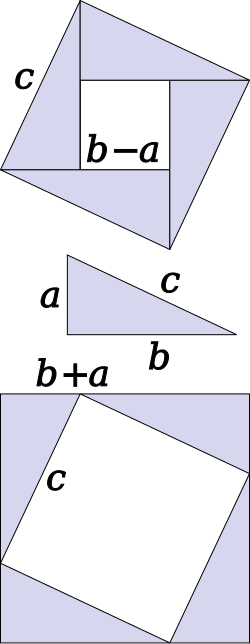
Algebraic proofs often use the area of a large square containing four identical right triangles. By calculating the area in two different ways—once as a single large square and once as the sum of the triangles and a smaller inner square—the formula a2 + b2 = c2 emerges.
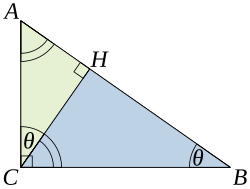
Geometric and Differential Proofs
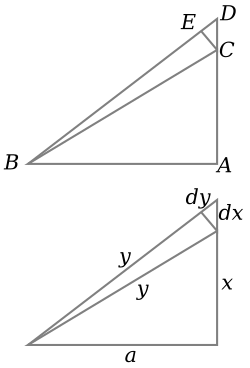
Other sophisticated methods include using similar triangles (triangles with the same shape but different sizes) to establish proportions between the sides. More modern approaches utilize differentials (calculus) to show how the hypotenuse changes as the legs are incrementally increased.
Consequences and Practical Applications
The theorem's influence extends far beyond simple triangles, impacting various fields of mathematics.
Pythagorean Triples
A Pythagorean triple consists of three positive integers a, b, and c, such that a2 + b2 = c2. A primitive triple is one where the three integers have no common divisor other than 1.
| Side a | Side b | Hypotenuse c |
|---|---|---|
| 3 | 4 | 5 |
| 5 | 12 | 13 |
| 8 | 15 | 17 |
| 7 | 24 | 25 |
| 20 | 21 | 29 |
Distance and Complex Numbers
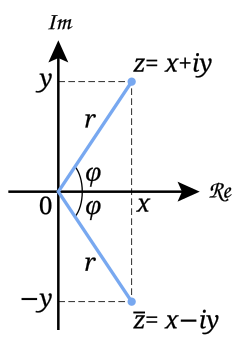
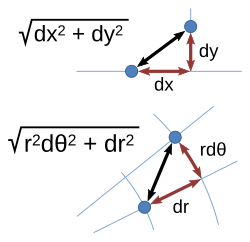
In a coordinate system, the Euclidean distance between two points is calculated using the Pythagorean theorem. This logic also extends to complex numbers, where the absolute value (or modulus) of a complex number z is the distance from the origin to the point in the complex plane.
Generalizations and Non-Euclidean Geometry
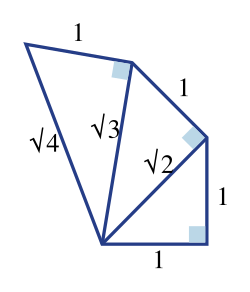
While the standard theorem only applies to right triangles in a flat plane, mathematicians have expanded it to other contexts.
- Law of Cosines: This generalizes the theorem for any triangle: c2 = a2 + b2 - 2ab cos(C).
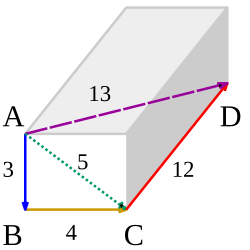
- Solid Geometry: In three dimensions, the diagonal of a rectangular box is related to its three sides by the formula d2 = x2 + y2 + z2.
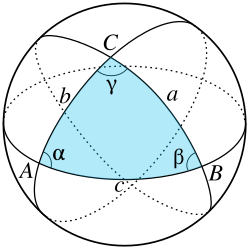
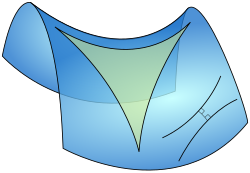
- Spherical and Hyperbolic Geometry: On curved surfaces, the theorem changes. In spherical geometry (like the surface of the Earth), the sum of the squares of the legs is not equal to the square of the hypotenuse due to the surface's curvature.
Frequently Asked Questions
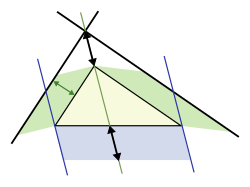
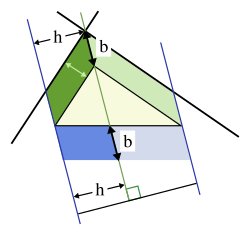
![Generalization of Pythagoras's theorem by Tâbit ibn Qorra.[72] Lower panel: reflection of triangle CAD (top) to form triangle DAC, similar to triangle ABC (top).](/images/90/db/90dbc668143ecb20de3d2541135ade7e1e76a85430381e6a6461f9f5fe55cbeb.webp)

Did Pythagoras actually discover the theorem?
While the theorem bears his name, historical evidence from Babylonian and Egyptian tablets shows that the relationship was known and used over a millennium before Pythagoras lived. He may have popularized it or provided an early Greek proof, but he was not the original discoverer.
What is a primitive Pythagorean triple?
A primitive Pythagorean triple is a set of three positive integers (a, b, c) that satisfy a2 + b2 = c2 and have no common factors other than 1. For example, (3, 4, 5) is primitive, whereas (6, 8, 10) is not because all numbers are divisible by 2.
How does the Law of Cosines relate to the Pythagorean theorem?
The Law of Cosines is a general version of the Pythagorean theorem. When the angle between sides a and b is exactly 90 degrees, the cosine term becomes zero, and the formula simplifies back to the standard a2 + b2 = c2.
Does the theorem work on a sphere?
No, the standard Pythagorean theorem only works in Euclidean (flat) geometry. On a sphere, the rules of spherical geometry apply, and the relationship between the sides of a right triangle is governed by a different formula involving trigonometric functions.