Pyli Monuments: A Journey Through Thessaly's Historic Landmarks
Due to its strategic location and unique landscape, the town of Pyli serves as a treasure trove of historic monuments. Despite its modest size, the area boasts a dense concentration of architectural and spiritual landmarks that span from the ancient world to the late Byzantine and Ottoman eras.
Key Facts
- Porta Panagia: A 13th-century basilica built atop an ancient temple.
- Monastery of St. Vissarion: A massive monastic complex on Mount Koziakas featuring 365 cells.
- Monastery of the Theotokos: A resilient women's monastery located at an altitude of 640m.
- Fortress of Athenaion: An ancient stronghold destroyed by Julius Caesar in 46 B.C.
- Portaikos Bridge: A 16th-century stone arch bridge that once served as the primary link to the Pindos villages.
Sacred Architecture and Monasteries
The Basilica of Porta Panagia
Located on the north bank of the Portaikos river, the Basilica of Porta Panagia dates back to 1264. It served as the katholikon (the main church of a monastery) for the monastery of the Irresistible Theotokos and is dedicated to the Dormition of the Theotokos. Commissioned in 1283 by John I Doukas, the ruler of Thessaly, the structure is divided into two distinct sections: a three-section cross-roofed main church and an outer cross-shaped section with an escribed dome.
While much of the original marble decoration from the ancient temple beneath the church was lost in an 1855 fire, some fragments remain. The interior icons, though damaged by a second fire in 1980, are still visible and await restoration.
The Monastery of St. Vissarion
Perched on Mount Koziakas, the Monastery of St. Vissarion was re-established between 1527 and 1535. The current church was constructed in 1557 by Archbishop Neophytos II of Larissa along with bishops Joseph of Demetrias, Joseph, Luke of Litzas, and Martyrios of Fanari. The iconography was completed in November 1557 by George of Constantinople.
Historically one of the region's most influential centers, the monastery featured 366 cells, dining halls, and land holdings in Romania. Its extensive library of important manuscripts is now largely housed in the National Library of Greece. The site has survived significant turmoil, including looting by Suldje Kordja in 1823 and dual bombings by Italian and German forces in 1943. Notably, women are not permitted to enter the monastery.
The Monastery of the Theotokos
Situated at Goura on Mount Itamos at an altitude of 640m, this women's monastery is dedicated to the Dormition of the Theotokos. Founded in 1743 with funding from the archon Dimakis, the monastery has a history of repeated destruction and rebirth. It was looted during the Orlov Revolt in 1770, burnt by Suldje Kordja in 1823, and destroyed again in 1854.
After being rebuilt in 1864, it was set ablaze by Turks on May 11, 1878, due to its use as a rebel stronghold. Meletios Karanikas rebuilt the site in 1893. Following further damage from German bombing in 1943 and a church collapse in 1960, nuns returned in 1961, leading to the picturesque monastery seen today.
Ancient Fortifications and Engineering
The Fortress of Athenaion
At an altitude of 1356m near the Monastery of the Theotokos, the ancient fortress of Athenaion stands as a testament to early military strategy. Built between the 5th and 1st century B.C., it was seized by King Philip V of Macedon in 189 B.C. during his campaign against the Athamanians. The fortress eventually met its end in 46 B.C. at the hands of Julius Caesar. Visitors can still reach the ruins via a mountain path.
The Portaikos Bridge at Pouri
The arched bridge at Pouri, built in 1514 by St. Vissarion, is a masterpiece of period stonemasonry. For centuries, until 1936, it provided the sole connection between the plains of Thessaly and the villages of Pindos.
The bridge measures 67 meters in length, 2.05 meters in width, and reaches a center height of 30.5 meters, with a 0.7-meter parapet.
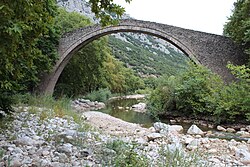
Local tradition adds a mystical element to its construction, claiming that when funds ran out, a bear helped transport materials and led the chief craftsman to a hidden treasure. Legend also says that St. Vissarion determined the location of his monastery by throwing the craftsman's mallet across the bridge; where the tool landed, the monastery was built (now the settlement of Dousiko).
Summary of Pyli's Historic Sites
| Monument | Date/Period | Key Feature | Location |
|---|---|---|---|
| Porta Panagia | 1264 / 1283 | Cross-roofed basilica | North bank of Portaikos |
| Monastery of St. Vissarion | 1527–1557 | 365 monk cells | Mount Koziakas |
| Monastery of the Theotokos | 1743 | Women's monastery | Mount Itamos (Goura) |
| Fortress of Athenaion | 5th–1st Century B.C. | Ancient stronghold | Altitude 1356m |
| Portaikos Bridge | 1514 | 67m stone arch | Pouri |
Frequently Asked Questions
Who built the Basilica of Porta Panagia?
The basilica was built in 1283 by John I Doukas, the ruler of Thessaly, on the site of an original ancient temple.
What is unique about the Monastery of St. Vissarion?
The monastery is known for its size, featuring 365 cells for monks, and its strict rule that women are not allowed to enter.
How did the Fortress of Athenaion come to an end?
After being held by King Philip V of Macedon, the fortress was destroyed by Julius Caesar in 46 B.C.
What is the legend behind the Portaikos Bridge?
Tradition states that a bear helped carry materials and led workers to a treasure to fund the project, and that the location of St. Vissarion's monastery was decided by a thrown mallet.
Why was the Monastery of the Theotokos destroyed multiple times?
The monastery suffered from various conflicts, including the Orlov Revolt, attacks by Suldje Kordja, and its use as a rebel stronghold during a Greek rebellion in 1878, as well as WWII bombings.