Church of the Dormition of the Theotokos: A Legacy of Megale Porta
Nestled on the northern bank of the Portaikos river lies a poignant reminder of Byzantine spiritual and political power. The Church of the Dormition of the Theotokos stands as the sole surviving structure of a once-vast monastic complex, situated within the ruins of the old settlement of Megale Porta (also known as Megalai Pylai). This historic site, which was razed by the Ottomans in 1822, sits near the modern town of Pyli. Both the ancient and modern names of the settlement translate to "door" or "gate" in Greek, referencing the nearby mountain pass that serves as a gateway to the Pindus Mountains.
The site is steeped in layers of history, beginning with an ancient temple that previously occupied the ground. Evidence of this pre-Christian era remains visible today through column remnants located outside the exonarthex—the outer porch or entrance hall of the church.
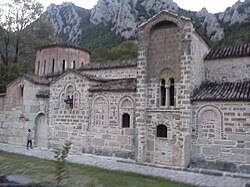
The Foundation of the Monastery
The church was originally the katholikon (the main church of a monastery) of a stauropegic monastery—a monastery that is exempt from the jurisdiction of the local bishop and falls directly under the authority of the Patriarch. Dedicated to the "Unconquerable Panagia" (Panagia Akatamachetos), the monastery was founded in 1283 by John I Doukas, the sebastokrator and ruler of Thessaly.
The monastery's influence extended far beyond its walls. Its extensive regional possessions were formally confirmed by the Byzantine emperors Andronikos II Palaiologos and Andronikos III Palaiologos. These holdings included several metochia (monastic dependencies or estates), such as:
- St. Athanasios in Fanari
- St. Nicholas in Lykousada
- An unidentified St. Demetrius
- SS. Theodores tou Kyrou Pavlou
- Theotokos Monastery in Mavrovouni
- Theotokos metochi in the castle of Fanari
- Theotokos Monastery known as Boxista
Cultural and Religious Significance
Beyond its monastic ties, the original village of Megale Porta holds a place of honor in ecclesiastical history as the birthplace of Saint Bessarion, the Metropolitan of Larissa. While the surrounding settlement was destroyed over two centuries ago, the church endured. In 1843, the church passed under the jurisdiction of the nearby Dousikou Monastery, though it has continued to serve as the parish church for the village of Porta.
| Feature | Detail |
|---|---|
| Founder | John I Doukas (1283) |
| Original Dedication | Unconquerable Panagia (Panagia Akatamachetos) |
| Location | Northern bank of Portaikos river, Megale Porta |
| Current Status | Parish church; open to visitors free of charge |
| Historical Affiliation | Dousikou Monastery (since 1843) |
Key Facts
- Founded: 1283 by the ruler of Thessaly, John I Doukas.
- Location: Situated in the ruins of Megale Porta, near the Pindus Mountains pass.
- Survival: It is the only remaining building of the original stauropegic monastery.
- Ancient Roots: The church was built on the site of an ancient temple.
- Imperial Support: Possessions were confirmed by Emperors Andronikos II and Andronikos III Palaiologos.
Frequently Asked Questions
What does the name Megale Porta mean?
The name means "door" or "gate" in Greek, which refers to the nearby mountain pass that acts as an entrance to the Pindus Mountains.
Who founded the monastery?
The monastery was founded in 1283 by John I Doukas, who was the sebastokrator and ruler of Thessaly.
Is the church open to the public?
Yes, the church is accessible by road and is open to visitors free of charge.
What happened to the original settlement of Megale Porta?
The old settlement was razed by the Ottomans in 1822, leaving the church as the only surviving structure of the monastery complex.
Which saint is associated with the village of Megale Porta?
The village is celebrated as the birthplace of Saint Bessarion, the Metropolitan of Larissa.