Church of Saint Simeon Stylites: The Legacy of the Pillar Saint
Located approximately 30 kilometers northwest of Aleppo, Syria, the Church of Saint Simeon Stylites stands as one of the oldest surviving church complexes in existence. Founded in the 5th century, this architectural marvel was built to honor a monk whose extreme devotion redefined asceticism in the early Christian world. Known locally as Qalaat Semaan (the Fortress of Simeon) or Deir Semaan (the Monastery of Simeon), the site represents a pivotal moment in Byzantine architecture.
Completed in 490 AD, the complex remained the largest Christian church of its time until the completion of the Hagia Sophia in 537 AD. Today, it is recognized as part of the "Ancient Villages of Northern Syria," a UNESCO World Heritage Site.
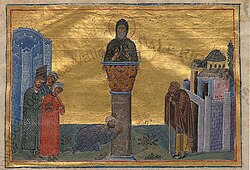
Key Facts
- Consecrated: 475 AD (Completed 490 AD).
- Location: Mount Simeon, Aleppo Governorate, Syria.
- Architectural Style: Byzantine.
- Significance: Built around the pillar of Saint Simeon Stylites, a pioneer of stylite asceticism.
- UNESCO Status: Designated as a World Heritage Site in June 2011.
- Current State: In ruins, further damaged by modern conflict.
The Life of Saint Simeon Stylites
Saint Simeon was born in 390 AD in a village in the Amanus mountains. After entering a monastery at age 16, his intense asceticism—characterized by extreme self-denial—was deemed too extravagant for communal (cenobitic) life. Seeking solitude, he became a hermit, but his reputation for endurance attracted crowds of pilgrims.
To escape these distractions, Simeon began living on a small platform atop a 3-meter column. Over time, the height of this pillar was increased to 18 meters. From this height, he preached twice daily to the masses. Communication was handled via a ladder, which messengers used to deliver food and written correspondence. His influence grew so vast that the Eastern Roman Emperors Theodosius, Leo, and Theodosius II sought his spiritual guidance on state affairs.
Simeon passed away in 459 AD at approximately 69 years of age. Following a dispute between Antioch and Constantinople over his remains, they were eventually interred in Antioch, accompanied by a massive procession of bishops, counts, and 6,000 soldiers.
Architectural Grandeur and Design
Unlike many medieval European cathedrals that evolved over centuries, the Church of Saint Simeon was conceived and executed as a single, cohesive project. Construction began in 473 AD to accommodate the overwhelming number of pilgrims visiting the site of the pillar.
The complex is designed in a cruciform (cross-shaped) layout, consisting of four distinct basilicas—three-aisled halls based on Roman traditions—that radiate from a central octagonal courtyard. This central octagon was originally surmounted by a dome, with Saint Simeon's pillar standing at the very center.
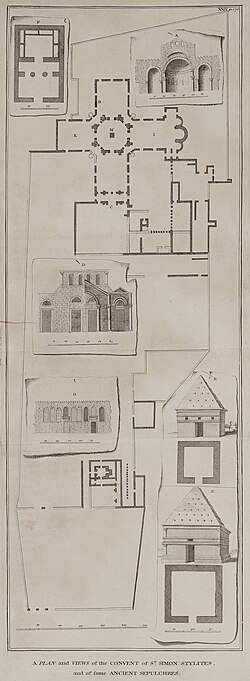
The Four-Basilica Church
The church's cross shape was intended to symbolize the crucifixion of Jesus. While all four basilicas are impressive, the eastern basilica is significantly larger than the others, as it served as the primary venue for key religious ceremonies.
The Baptistery and Via Sacra
A critical component of the pilgrimage experience was the baptistery, located along the Via Sacra (Sacred Way). This structure featured an octagonal drum resting on a square base, likely topped with a conical or domed wooden roof. The baptistery was built in two phases: the main chamber first, followed by smaller accompanying basilicas.
The U-Shaped Monastery
Bordering the southern partition of the eastern basilica was a monastery and chapel. Originally known as Telanissos, this monastic community was established to utilize the productive plains surrounding the mountain before Simeon moved his residence to the heights above.
Decline and Modern History
The monastery's prominence faded over the centuries. In 638 AD, it passed to the Miaphysites, and by 985 AD, it was destroyed by Arab tribes. The site eventually became part of the "Dead Cities of Syria," a region of abandoned ancient settlements.
Over centuries, the pillar of Saint Simeon was slowly dismantled by pilgrims who cut away small pieces of stone to keep as holy relics. By the 17th century, only a fraction of the shaft remained; today, it resembles a boulder roughly 2 meters high.
![The remains of the pillar of Saint Simeon Stylites in 2000, before 2016 Russian airstrikes.[1]](/images/b3/8b/b38bf1d5a4b49af06d2651ec48a58ce08d1b4f03ed23592c0df4923714f0530c.jpg)
Impact of Modern Conflict
The site has suffered severely during the Syrian Civil War. Beyond the general violence, the ruins have been degraded by illegal digging and stone theft. The complex has been a flashpoint in territorial disputes between various factions, including the YPG/YPJ and forces opposing the Assad government. In May 2016, Russian airstrikes caused significant damage to the remaining ruins and the pillar of Saint Simeon.
Summary of the Complex
| Feature | Description | Key Detail |
|---|---|---|
| Main Church | Cruciform layout with four basilicas | Central octagonal courtyard |
| The Pillar | Original site of Simeon's asceticism | Reduced to ~2m due to relic gathering |
| Baptistery | Octagonal drum on square base | Located along the Via Sacra |
| Monastery | U-shaped structure | Originally called Telanissos |
| Status | UNESCO World Heritage Site | Currently in ruins |
Frequently Asked Questions
Who was Saint Simeon Stylites?
Saint Simeon was a 5th-century Christian monk known for his extreme asceticism. He spent decades living atop a pillar to distance himself from the crowds of pilgrims who sought his guidance, eventually becoming an influential advisor to Byzantine emperors.
Why is the church designed in a cross shape?
The cruciform design, consisting of four basilicas radiating from a center, was intended to represent the crucifixion of Jesus Christ.
What happened to the pillar of Saint Simeon?
The pillar, which once reached 18 meters, was gradually whittled down by pilgrims who removed pieces of stone as relics. It was further damaged by Russian airstrikes in 2016 and now stands as a small boulder-like remnant.
What are the "Dead Cities of Syria"?
The Dead Cities are a collection of abandoned ancient settlements in northwestern Syria. The ruins of the Church of Saint Simeon Stylites are part of this historical landscape.
When was the church built?
Construction began in 473 AD and the complex was completed by 490 AD, making it one of the largest and most significant churches of the early Byzantine era.