Dead Cities of Syria: Ancient Settlements of the Limestone Massif
Nestled in the rugged landscapes of northwest Syria, between the cities of Aleppo and Idlib, lies a hauntingly beautiful collection of abandoned settlements known as the Dead Cities (Arabic: al-mudun al-mayyita) or the Forgotten Cities (al-mudun al-mansiyya). These sites offer a rare and profound glimpse into the rural life of Late Antiquity and the Byzantine period, preserving the echoes of a prosperous society that once thrived in the hills.
The region consists of approximately 700 abandoned settlements, with around 40 villages organized into eight archaeological parks. Most of these sites date from the 1st to the 7th centuries CE and were largely deserted between the 8th and 10th centuries. Today, they stand as silent witnesses to the transition from the pagan traditions of the Roman Empire to the rise of Byzantine Christianity.
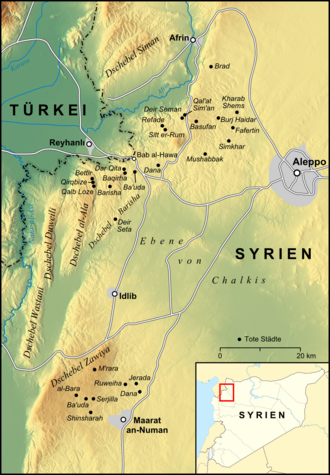
Key Facts
- UNESCO Status: Inscribed as a World Heritage Site in 2011 under the name "Ancient Villages of Northern Syria"; listed as Endangered since 2013.
- Scale: Approximately 700 abandoned settlements covering an area of 12,290 hectares.
- Geography: Located on the Limestone Massif, stretching 140 km in length and 20–40 km in width.
- Architecture: Well-preserved dwellings, pagan temples, churches, cisterns, and bathhouses.
- Economic Basis: Prosperity was driven by a robust international trade in olive oil.
Geography and Landscape
The Dead Cities are situated on the Limestone Massif, an elevated plateau of limestone. This geographic region is divided into three primary highland groups:
- Northern Group: Comprising Mount Simeon and Mount Kurd.
- Middle Group: Comprising the Harim Mountains.
- Southern Group: Comprising the Zawiya Mountain.
Historical Significance and Economy
Contrary to typical urban centers, historian Chris Wickham suggests that these were primarily settlements of prosperous peasants. The impressive scale of the domestic architecture was not the result of city-state wealth, but rather the success of rural farmers who benefited from the high demand for olive oil in international markets during the end of Antiquity.
Architecturally, the sites illustrate a pivotal cultural shift. Many settlements contain Roman temples that were later converted into Christian basilicas, marking the religious evolution of the region during the Byzantine era.
Notable Archaeological Sites
The region is home to several world-renowned monuments and villages, each offering unique insights into ancient Syrian life.
The Northern Highlands (Mount Simeon and Mount Kurd)
This area is home to the Church of Saint Simeon Stylites (Deir Semaan), one of the oldest standing Christian churches in the world. Other significant sites include Kafr Nabu, an Assyrian settlement from the 9th century BC with a Roman temple converted into a church, and Kalota, where a 2nd-century Roman temple evolved into a basilica and eventually a 10th-century castle.
The Harim Mountains (Mount Barisha and Mount A'la)
This region features sites like Bab Al-Hawa, which boasts a well-preserved 6th-century historical gate, and Behyo, where ruins of villas, olive presses, and churches remain visible.
Mount Zawiya
The southern group includes the well-preserved villages of Serjilla and Ruweiha, as well as Bara. This area also contains the remains of Ebla, one of the earliest known kingdoms in Syria, located near the village of Mardikh.
| Highland Group | Key Sites | Notable Features |
|---|---|---|
| Northern (Simeon/Kurd) | Church of St. Simeon, Kafr Nabu, Kalota | Early Christian basilicas, Roman-to-Christian conversions |
| Middle (Harim) | Bab Al-Hawa, Behyo, Qalb Loze | Historical gates, olive presses, rural villas |
| Southern (Zawiya) | Serjilla, Ruweiha, Bara, Ebla | Well-preserved village layouts, early kingdom tells |
Frequently Asked Questions
Why are they called the Dead Cities?
They are called Dead Cities because they are a group of hundreds of settlements that were completely abandoned between the 8th and 10th centuries, leaving behind ghost-like ruins of once-thriving communities.
What caused the wealth of these ancient villages?
The prosperity of these settlements was largely due to the production and international trade of olive oil during the late Roman and Byzantine periods.
When were the Dead Cities recognized by UNESCO?
They were inscribed as a UNESCO World Heritage Site in 2011 under the official name "Ancient Villages of Northern Syria."
Why is the site currently listed as Endangered?
The Dead Cities have been on the UNESCO List of World Heritage in Danger since 2013, primarily due to the instability and conflict within the region.
What types of buildings can be found at these sites?
The sites feature a variety of well-preserved structures, including domestic dwellings, pagan temples, Christian churches, bathhouses, and water cisterns.