Psophodidae: The Whipbirds and Wedgebills of Australasia
The Psophodidae are a family of passerine birds—perching birds characterized by their song and foot structure—native primarily to Australia and surrounding regions. These birds are best known for their terrestrial habits and distinctive calls, though their scientific classification has been a subject of significant debate among ornithologists for decades.
Key Facts
- Primary Species: Includes whipbirds and wedgebills.
- Distribution: Found across Australia, with some related groups in New Guinea.
- Habitat: Ranges from dense rainforests to arid scrublands.
- Diet: Primarily insectivorous, feeding on invertebrates on the forest floor.
- Behavior: Terrestrial birds that prefer running or squatting over flying when threatened.
Taxonomic History and Classification
The classification of Psophodidae is complex, with various authors disagreeing on which species belong in the family. In its strictest definition, the family consists only of the whipbirds and wedgebills (genera Psophodes and Androphobus). However, some taxonomists expand this to include the quail-thrushes (Cinclosoma), found in Australia and New Guinea, and the jewel-babblers (Ptilorrhoa) of the New Guinean rainforests.
Historically, these birds were grouped with logrunners (Orthonyx) in the family Orthonychidae. In 1985, researchers Sibley and Ahlquist determined that logrunners were unrelated, leading to a period where whipbirds and their allies were treated as a subfamily (Cinclosomatinae) within the crow family, Corvidae. More recent studies have further refined these relationships, showing that the Malaysian rail-babbler (Eupetes macrocerus), once associated with this group, is actually an early offshoot of the Passerida and is unrelated to the Psophodidae.
The naming of the family depends on its composition: if whipbirds are included, the name Psophodidae (established by Bonaparte in 1854) takes priority. If the group is limited to quail-thrushes and allies, it is often referred to as Cinclosomatidae.
Physical Characteristics and Distribution
Whipbirds and wedgebills typically measure between 19 and 31 cm in length. Their plumage is generally olive-green or brown, providing excellent camouflage against the forest floor, and they are characterized by the presence of a crest.
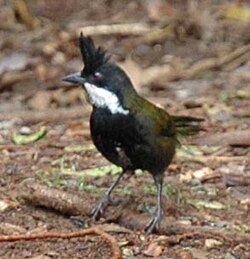
These birds are distributed throughout Australia, adapting to diverse environments from lush rainforests to dry, arid scrub. Conservation statuses vary by species; for example, the western whipbird is considered near-threatened due to the impacts of fire and habitat loss, while the Papuan whipbird is currently listed as data deficient.
Behavior and Ecology
Psophodidae are primarily terrestrial. Because they are relatively weak flyers, they tend to squat or run quickly through undergrowth when disturbed. Their foraging behavior is centered on the ground, where they hunt for insects and other invertebrates. In desert environments, quail-thrushes supplement their diet with seeds.
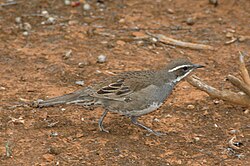
Their nesting habits involve constructing cup-shaped nests, which are placed either directly on the ground or tucked among low-lying shrubs. Typically, a clutch consists of two to three eggs.
Summary of Psophodidae Genera and Species
| Genus | Common Name | Scientific Name |
|---|---|---|
| Androphobus | Papuan whipbird | Androphobus viridis |
| Psophodes | Eastern whipbird | Psophodes olivaceus |
| Psophodes | Black-throated whipbird | Psophodes nigrogularis |
| Psophodes | White-bellied whipbird | Psophodes leucogaster |
| Psophodes | Chiming wedgebill | Psophodes occidentalis |
| Psophodes | Chirruping wedgebill | Psophodes cristatus |
Frequently Asked Questions
What is the primary diet of the Psophodidae family?
They mainly feed on insects and other invertebrates found on the ground. Some species, such as the quail-thrushes in desert regions, also consume seeds.
Where are whipbirds and wedgebills found?
They are native to Australia, where they inhabit a wide variety of environments ranging from arid scrub to rainforests.
Why is the taxonomy of this family considered complicated?
The classification has shifted over time, with species being moved between families like Orthonychidae and Corvidae. There is ongoing debate over whether quail-thrushes and jewel-babblers should be included in Psophodidae or placed in their own family, Cinclosomatidae.
How do these birds react to threats?
Because they are weak flyers, they prefer to run or squat low to the ground rather than taking flight when they are disturbed.
What are the nesting habits of the Psophodidae?
They build cup-shaped nests located either on the ground or within shrubs, typically laying two to three eggs per clutch.