Prototype Theory: How the Mind Categorizes the World
How do we know that a robin is a bird, but an ostrich is slightly less "bird-like"? For centuries, the Western world relied on Aristotelian categories—the idea that things either belong to a group or they do not, based on strict definitions. However, in 1971, psychologist Eleanor Rosch introduced a paradigm shift known as Prototype Theory.
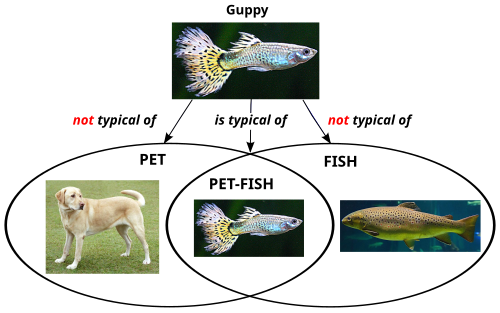
Prototype Theory suggests that categorization is not all-or-nothing. Instead, it is a graded system where some members of a category are more central than others. In this view, every concept has a "prototype"—a real-world example that best represents that concept in our minds.
Key Facts
- Origin: Developed by Eleanor Rosch in 1971, drawing on Ludwig Wittgenstein's concept of "family resemblance."
- Core Idea: Categories are organized around a central prototype rather than a strict set of defining features.
- Graded Membership: Some items are considered "better" examples of a category than others (e.g., a couch is a more prototypical piece of furniture than a wardrobe).
- Cognitive Speed: Humans generally identify prototypical members of a category faster than peripheral ones.
- Application: Used extensively in cognitive linguistics to map phonological structures to semantics.
The Mechanics of Categorization
At its heart, Prototype Theory argues that we categorize objects based on their similarity to a mental ideal. Rosch initially defined a prototype as the first stimulus associated with a category, later refining it as the most central member of that group.
Basic Level Categories
Not all levels of categorization are equal. Basic level categories are the most efficient way we organize information because they achieve two goals: they maximize the attributes shared by members of the category and minimize the attributes shared with other categories.
Evidence for Prototypicality
To prove that some members of a category are more privileged than others, researchers have utilized several experimental methods:
- Response Times: People answer "Yes" faster when asked if a robin is a bird than when asked if a penguin is a bird.
- Priming: When primed with a broad category like "furniture," people recognize the equivalence of "chair-chair" faster than "stove-stove."
- Exemplars: When asked to name examples of a category, people consistently list prototypical items first.
In a famous 1975 study, Rosch asked 200 college students to rate items in the "furniture" category. Chairs and sofas ranked as the best examples (1), while lamps (31) and telephones (60) were seen as far less representative.
Advanced Conceptual Frameworks
Conceptual Spaces and Distance
Peter Gärdenfors expanded this theory by proposing conceptual spaces. He suggests that categories exist in multi-dimensional feature spaces where membership is defined by "conceptual distance." In this model, central members sit between peripheral members, creating a convex shape in the conceptual space.
Combining Categories
When we combine concepts, the prototype shifts. For example, the prototype for "tall" differs depending on the object; a 6-foot man is tall, but a 400-foot skyscraper is the prototype for a tall building. Similarly, in compounds like "red wine," the word "red" doesn't mean the wine is prototypically red (like a fire truck), but rather indicates a shift from the prototypical color of wine.
The Role of Emotion
Research by Mikulincer, Paz, and Kedem has shown that prototypes are not static. They found that emotional states, such as situational stress and trait anxiety, can change how people organize semantic categories, often leading to a narrowing of category breadth and a preference for less inclusive levels of categorization.
Comparing Theories of Categorization
While influential, Prototype Theory is not without its critics. Some linguists, such as Eugenio Coseriu, continue to support structural semantics and traditional categories. Others propose Exemplar Theory, which suggests that we categorize things based on a collection of specific stored memories (exemplars) rather than a single abstract prototype.
| Theory | Core Mechanism | View of Membership |
|---|---|---|
| Aristotelian | Defining features/rules | Binary (Yes/No) |
| Prototype Theory | Central representative example | Graded (More/Less central) |
| Exemplar Theory | Average of all stored examples | Based on specific instances |
Frequently Asked Questions
What is the difference between a prototype and an exemplar?
A prototype is a single, idealized mental representation of a category (the "average" bird), whereas an exemplar is a specific memory of a real instance of that category (a specific robin you saw yesterday).
Does Prototype Theory apply to verbs?
It is more difficult to apply to verbs than nouns. For example, the verb "to run" does not seem to have a clear central or peripheral member in the same way that "furniture" does.
How does culture affect prototypes?
While the existence of graded categorization is likely universal across all cultures, the specific items that serve as prototypes can vary based on cultural specifics and environment.
What is the "Copernican Revolution" in categorization?
This term describes the massive shift in cognitive science when the field moved away from rigid, definition-based Aristotelian categories toward the flexible, graded approach of Prototype Theory.
Can emotional stress change how we categorize things?
Yes. Research indicates that stress and anxiety can cause people to use less inclusive levels of categorization and narrow the breadth of their semantic categories.