Pronouns: Linguistic Functions, Grammar, and Binding Theory
In the study of linguistics and grammar, a pronoun (often glossed as pro) is a word or group of words used as a substitute for a noun or a noun phrase. While traditionally categorized as one of the primary parts of speech, modern theorists often debate whether pronouns constitute a single class due to the diverse functions they perform across different languages.
A central concept in pronoun usage is anaphora, where a pronoun's meaning depends on a previously mentioned noun, known as the antecedent. For example, in the sentence "That poor man looks as if he needs a new coat," the pronoun he relies on the antecedent that poor man for its meaning.
Related to this is the term pronominal, which refers to a word or phrase acting as a pronoun. An example is the phrase "the one" in the sentence "That's not the one I wanted."
Key Facts
- Substitution: Pronouns replace nouns or noun phrases to avoid repetition and streamline communication.
- Pro-forms: While most pronouns are pro-forms (standing in for other content), some pronouns (like dummy pronouns) are not, and some pro-forms (like pro-verbs) are not pronouns.
- Binding Theory: English governs the use of reflexive and personal pronouns through specific structural rules known as Principle A and Principle B.
- Classification: English pronouns are categorized by person (1st, 2nd, 3rd), number (singular, plural), gender, and case (subject or object).
Pronouns versus Pro-forms
It is important to distinguish between a pronoun as a category of words and a pro-form. A pro-form is a functional word or expression that stands in for another word, phrase, clause, or sentence, provided the meaning is recoverable from the context.
In English, these categories overlap but are not identical. For instance, in the sentence "Who works there?", the word who is an interrogative pronoun but not a pro-form because it does not stand in for a specific previously mentioned entity. Similarly, in "It is raining," it is a dummy pronoun (or expletive pronoun) that satisfies grammatical requirements without referring to a specific object.
Conversely, some pro-forms are not pronouns. The phrase "did so" can act as a pro-verb, standing in for a previously mentioned verb phrase. Likewise, the word "others" can function as a common noun acting as a pro-form for a list of proper names.
Linguistic Perspectives and Determiners
Linguists often struggle to place pronouns in a single category. Some observe that pronouns are frequently identical in form to determiners—words that introduce noun phrases. This has led some scholars, such as Paul Postal, to suggest that pronouns are actually determiners where the following noun has been deleted.
The distinction is often viewed as one of valency (the number of arguments a word takes). Determiners require a noun phrase complement, whereas pronouns do not. Cross-linguistically, pronouns generally share three categories: point of view, person, and number.
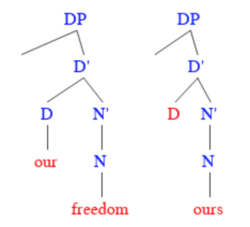
| Type | Pronoun Example | Determiner Example |
|---|---|---|
| Possessive | ours | our freedom |
| Demonstrative | this | this gentleman |
| Indefinite | some | some frogs |
| Negative | none | no information |
| Interrogative | which | which option |
Binding Theory and Antecedents
In English, the relationship between a pronoun and its referent is governed by Binding Theory, specifically through a structural relationship called C-command.
Principle A: Reflexives and Reciprocals
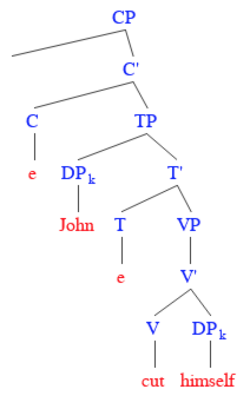
Reflexive pronouns (e.g., himself) and reciprocal pronouns (e.g., each other) must be bound within their governing category (usually the clause). This means they must have an antecedent that is higher in the syntactic structure. For example, "John cut himself" is grammatical because himself is lower in structure than John.
Principle B: Personal Pronouns
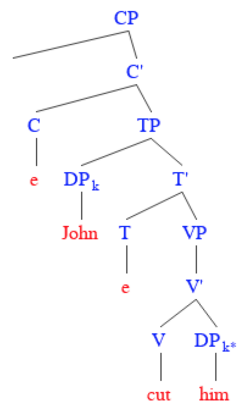
Personal pronouns (e.g., him, them) must be free within their governing category. They cannot have a direct C-command relationship where the referent selects the pronoun in the same clause. Therefore, "John cut him" is only grammatical if him refers to someone other than John.
English Pronoun Classifications
English personal pronouns are defined by several features: person, number, gender, and case.
Personal and Possessive Pronouns
English utilizes two primary cases: subject (used in the subject position, e.g., "I like chips") and object (used as the object of a verb or preposition, e.g., "John likes me").
Other Pronoun Types
- Demonstrative: Words like this, that, these, and those used to point to specific targets.
- Relative: Words like who, whom, whose, which, and that used to introduce relative clauses.
- Interrogative: Used to ask questions (e.g., "Who did that?").
- Indefinite: Used for non-specific references, including distributive (each), negative (nobody), and impersonal (one) pronouns.
Specialized Uses of Pronouns
English employs several unique pronoun constructions for specific social or grammatical contexts:
- Generic you: Using the second person to refer to people in general.
- Dummy pronouns: Words like it in "It is raining" that carry no semantic meaning.
- Royal we: A single monarch referring to themselves as we.
- Nosism: The habit of using we to refer to oneself.
- Resumptive pronouns: Intrusive pronouns found in some relative clauses (e.g., "the girl that I don't know what she said").
Frequently Asked Questions
What is the difference between a pronoun and a pro-form?
A pronoun is a specific category of words, while a pro-form is any word or expression that stands in for another element (word, phrase, or clause) whose meaning is recoverable from context. While most pronouns are pro-forms, some pro-forms (like pro-verbs) are not pronouns, and some pronouns (like dummy pronouns) are not pro-forms.
What is an antecedent in linguistics?
An antecedent is the noun or noun phrase that a pronoun refers back to. For example, in the sentence "Julia arrived yesterday; I met her at the station," Julia is the antecedent of the pronoun her.
How does Principle A differ from Principle B in Binding Theory?
Principle A requires reflexive and reciprocal pronouns to be bound (have a direct relationship with an antecedent) within their local clause. Principle B requires personal pronouns to be free (not bound) within that same local clause.
What is a dummy pronoun?
A dummy pronoun, also known as an expletive pronoun, is a word that fulfills a grammatical requirement for a subject or object but does not refer to any actual person, thing, or idea. A common example is the it in "It is raining."
Are pronouns and determiners the same thing?
They are closely related and often share the same form (e.g., "this" can be both). However, determiners typically function as modifiers that precede a noun, whereas pronouns substitute for the noun entirely. Some linguists view pronouns as determiners with the noun deleted.