Apostrophe Usage: Rules, History, and Typographic Standards
The apostrophe is one of the most versatile yet frequently misunderstood marks of punctuation in the English language. Primarily used to indicate the omission of letters or to signal possession, this small mark plays a critical role in disambiguating meaning and maintaining grammatical clarity. From its historical roots to its complex implementation in modern digital typography, the apostrophe serves as a vital tool for writers and editors alike.
Key Facts
- Primary Functions: Used for contractions (omission of letters) and marking the possessive case of nouns.
- Possessive Logic: Generally, singular nouns take
's, while plural nouns ending instake only an apostrophe. - Disambiguation: The placement of an apostrophe can entirely change the meaning of a sentence (e.g., "husband's" vs "husbands'").
- Digital Standards: Unicode distinguishes between the typewriter apostrophe (U+0027) and the punctuation apostrophe (U+2019).
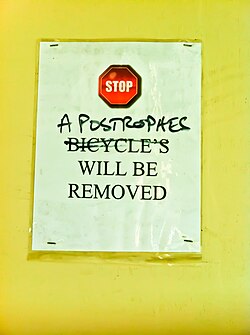
- Common Error: The "greengrocer's apostrophe" refers to the incorrect use of an apostrophe to form a simple plural.
The Possessive Apostrophe
The possessive apostrophe indicates ownership or a close relationship between two nouns. While the general rules are straightforward, specific scenarios require careful attention to detail.
Basic Rules for Possession
- Singular Nouns: Most singular nouns form the possessive by adding an apostrophe and an
s(e.g., "the eagle's feathers"). - Plural Nouns: For plural nouns already ending in
s, only the apostrophe is added (e.g., "the twins' coats"). - Compound Nouns: Possession is typically marked on the final element of the compound.
Joint and Separate Possession
When two or more nouns are joined by "and," the punctuation depends on whether the possession is shared or individual. For joint possession (e.g., "Jack and Jill's children"), only the last noun is marked. For separate possession (e.g., "my aunt's and uncle's medical profiles"), each noun receives its own apostrophe.
The Importance of Disambiguation
Apostrophes are essential for distinguishing between singular and plural possessives. Consider these variations:
- My sister's friend's investment: One sister, one friend, one investment.
- My sister's friends' investment: One sister, multiple friends, one shared investment.
- My sisters' friend's investment: Multiple sisters, one friend, one investment.
- My sisters' friends' investment: Multiple sisters, multiple friends, one shared investment.
Apostrophes for Omission and Plurals
Beyond possession, the apostrophe marks elision—the omission of one or more letters. This is most common in contractions, such as turning "do not" into "don't." In some contexts, the function of the apostrophe depends entirely on the grammatical environment; for example, "Friday's opening night" uses the possessive form to indicate a specific date.
The use of apostrophes in plurals is a point of significant stylistic debate. While historically used for noun plurals in loanwords or words ending in s, z, ch, or sh, modern standard English generally avoids this. However, apostrophes are still frequently used to pluralize single letters (e.g., "mind your p's and q's") to avoid confusion with other words.
Numbers, Dates, and Abbreviations
Style guides vary on the treatment of numbers. Some prefer 3s and 4s, while others recommend 3's and 4's. For decades, most guides prefer 1980s or '90s over 1980's or 90's. The Australian Government Style Manual, for instance, suggests 0's and 1's for binary code but 2020s for the decade.

Non-English and Specialized Uses
The apostrophe is not exclusive to English. In transliteration, it can represent a glottal stop (as in the Russian river "Ob'") or separate syllables in Arabic (e.g., "mus'haf"). In Hebrew, the geresh and gershayim are used to denote numerals or specific letter names.
Interestingly, in Switzerland, the apostrophe serves as a thousands separator in all four national languages (e.g., 2'000'000).

Typography and Computing
In the digital age, not all apostrophes are created equal. The Unicode Standard identifies several distinct characters that look similar but serve different purposes.
| Character Name | Unicode | Common Use |
|---|---|---|
| Typewriter Apostrophe | U+0027 | ASCII/Coding, basic typing |
| Right Single Quotation Mark | U+2019 | Professional punctuation/Smart quotes |
| Prime | U+2032 | Mathematics, measurements (feet/minutes) |
| Grave Accent | U+0060 | Programming (backtick) |
Many word processors use "smart quotes," which automatically convert straight typewriter apostrophes into curved punctuation apostrophes. However, this can lead to errors, such as converting a leading apostrophe in a year ('29) into an opening single quotation mark (‘29), or using a punctuation apostrophe where a mathematical prime is required for coordinates.

Frequently Asked Questions
What is a greengrocer's apostrophe?
A greengrocer's apostrophe is a common error where an apostrophe is incorrectly inserted into a simple plural noun (e.g., writing "Apple's 50p" instead of "Apples 50p").
Should I use 's or just an apostrophe for names ending in S?
This varies by style guide. Some authorities, like the BBC Academy and The Economist, argue that 's should follow all singular nouns regardless of the ending. Others suggest using only the apostrophe if the extra s is not naturally pronounced.
How do I pluralize a single letter?
To avoid confusion, lowercase letters are typically pluralized with an apostrophe and an s (e.g., "x's and y's"). For uppercase letters, the apostrophe is often omitted unless it aids comprehension.
What is the difference between an apostrophe and a prime?
An apostrophe is a punctuation mark used for grammar (possession and contraction), whereas a prime is a technical symbol used in mathematics and science to denote measurements like feet, arcminutes, or derivatives.