Prokofiev Crater: Mercury's Giant Polar Ice Reservoir
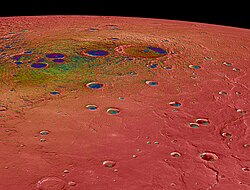
Deep within the Borealis quadrangle of Mercury lies one of the planet's most intriguing geological features: the Prokofiev crater. This massive impact site is not merely a scar on the planetary surface but a critical location for scientists studying the composition of the inner solar system.
Named after the renowned Russian composer Sergei Prokofiev, this crater serves as a primary example of how Mercury's extreme environment can preserve volatile materials that would otherwise evaporate under the intense heat of the sun.
Geological Characteristics
Prokofiev is classified as a central-peak impact crater, a type of crater formed by a high-velocity collision that causes the crater floor to rebound upward, creating a distinct peak at the center. With a diameter of 112 kilometers, it is a significant landmark in Mercury's northern polar region.
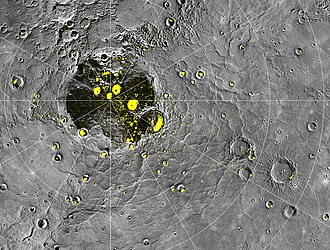
The crater's location at 86°00′N 296°18′W places it near the north pole, where the planet's axial tilt creates unique lighting conditions. Because of this positioning, certain areas of the crater floor remain in perpetual darkness, never receiving direct sunlight.
The Presence of Ice and Organics
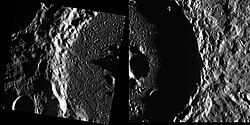
Data collected by the MESSENGER (MErcury Surface, Space ENvironment, GEochemistry, and Ranging) spacecraft has revealed that Prokofiev is more than just rock and dust. Analysis indicates that the crater contains water ice and organic compounds.
While several craters in the north polar region are believed to harbor ice, Prokofiev is the largest of these deposits. The ice is likely concentrated along the southern crater floor, where the permanent shadows act as a "cold trap," shielding the volatile materials from the sun's radiation and preventing them from sublimating into space.
Key Facts
- Diameter: 112 kilometers.
- Location: Borealis quadrangle, Mercury (86°N 296.3°W).
- Composition: Contains water ice and organic compounds.
- Distinction: The largest ice-bearing crater in Mercury's north polar region.
- Feature Type: Central-peak impact crater.
Summary of Prokofiev Crater Specifications
| Attribute | Detail |
|---|---|
| Eponym | Sergei Prokofiev |
| Coordinates | 86°00′N 296°18′W |
| Diameter | 112 km |
| Primary Findings | Water ice and organic compounds |
| Spacecraft Source | MESSENGER |
Frequently Asked Questions
Who is the Prokofiev crater named after?
The crater is named after Sergei Prokofiev, a famous Russian composer.
What makes Prokofiev crater different from other polar craters?
While other craters in the north polar region may contain ice, Prokofiev is the largest of them.
How is water ice preserved on a hot planet like Mercury?
Ice is preserved in areas of perpetual darkness, such as the southern floor of the Prokofiev crater, where the lack of sunlight prevents the ice from evaporating.
What spacecraft provided the data for these findings?
The data was provided by the MESSENGER spacecraft.
What is a central-peak impact crater?
It is a type of crater where the center of the floor rebounds upward following a massive impact, creating a central peak.