Prokaryotes: The Architecture and Evolution of Simple Life
The word prokaryote derives from the Ancient Greek pro ("before") and karyon ("nut" or "kernel"). In biological terms, these are cellular organisms that lack a distinct cell nucleus and other membrane-bound organelles. As single-celled microorganisms, prokaryotes represent some of the most ancient and resilient forms of life on Earth, serving as the foundational architects of our planet's ecosystems.
In modern science, molecular phylogenetics—the study of evolutionary relationships through genetic data—has shifted how we classify these organisms. While they were once grouped together in a single "empire," they are now divided into two distinct domains: Bacteria and Archaea. A third domain, Eukaryota, contains the more complex organisms we see around us, though some scientific theories suggest eukaryotes may actually be a specialized branch of the Archaea.
Key Facts
- Cellular Structure: Lack a nucleus and membrane-bound organelles.
- Reproduction: Primarily asexual via binary fission.
- Domains: Divided into Bacteria and Archaea.
- Ecological Role: Essential for carbon, nitrogen, phosphorus, and oxygen cycles.
- Ancient Origins: Evolved from the Last Universal Common Ancestor (LUCA) approximately 4.09–4.33 billion years ago.
Cellular Structure and Organization
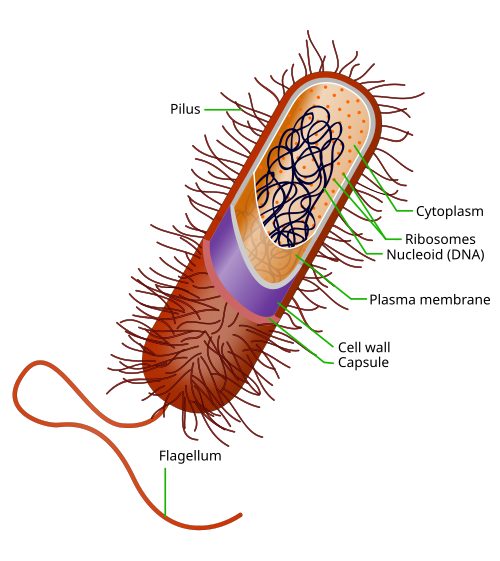
Prokaryotic cells are characterized by their simplicity. Unlike eukaryotic cells, their DNA is not enclosed in a membrane but exists freely within the cytoplasm in a region called the nucleoid. While they lack complex organelles like mitochondria, they possess essential components for survival and reproduction.
Essential Components
- Cell Membrane: The outer boundary that regulates what enters and exits the cell.
- Cell Wall: Provides structural support (absent in groups like Mollicutes and Thermoplasma).
- Cytoplasm: The gel-like substance filling the cell.
- Ribosomes: The machinery responsible for protein synthesis.
- Flagellum: A whip-like appendage used for movement (not present in all species).
- Capsule: A protective outer layer found in certain groups.
Reproduction and Genetic Exchange
Prokaryotes reproduce asexually through binary fission, a process where a single cell duplicates its genetic material and divides into two identical daughter cells. However, they maintain genetic diversity through horizontal gene transfer, which allows them to exchange DNA without traditional reproduction.
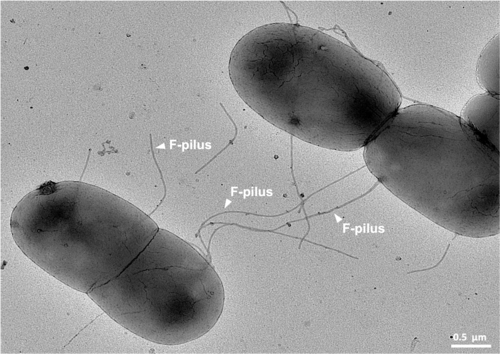
One common method of this exchange is conjugation, where bacteria use specialized structures called F-pili to transfer genetic material to another cell.
Colonies, Biofilms, and the Environment
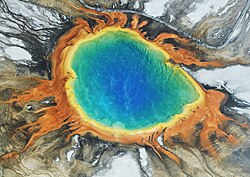
Although they are single-celled, many prokaryotes do not live in isolation. Some, such as cyanobacteria, form colonies held together by biofilms—slimy, protective layers of extracellular material. When different groups of prokaryotes form symbiotic colonies, they can create thick, multilayered microbial mats.
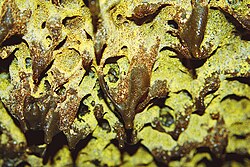
Over geological time, these mats can become mineralized, leaving behind fossilized structures known as stromatolites. These organisms are not just historical curiosities; they are vital primary producers and degraders in both aquatic and terrestrial environments, driving the Earth's essential chemical cycles.
Evolutionary History and Phylogeny
Prokaryotes are among the earliest known life forms. They evolved from a pre-cellular first universal common ancestor (FUCA), with significant diversification occurring between 3.72 and 4.18 billion years ago (Ga). The last universal common ancestor (LUCA), which is considered "prokaryote-grade," appeared around 4.09–4.33 Ga.
The Path to Complexity: Symbiogenesis
The transition from simple prokaryotes to complex eukaryotes is explained by the theory of symbiogenesis. This theory proposes that a merger between an archaean and an aerobic bacterium created the first eukaryotes, with the bacterium becoming the mitochondrion. A subsequent merger with a photosynthetic cyanobacterium led to the creation of chloroplasts, giving rise to green plants.
![In the theory of symbiogenesis, a merger of two prokaryotes, an archaean and an aerobic bacterium, created the eukaryotes, with aerobic mitochondria; a second merger added chloroplasts from a third prokaryote, a photosynthetic cyanobacterium, creating the green plants.[43]](/images/e9/cb/e9cb97de8e68d89d1e7e206794ffe6c0406cbffe0cc8b1aa6226645ea032242a.webp)
Taxonomic Perspectives
The relationship between the domains is still a subject of scientific refinement. Traditional views see Bacteria, Archaea, and Eukaryota as three separate branches. However, newer proposals, such as the eocyte hypothesis, suggest that eukaryotes emerged from within the archaean Asgard group.
![Phylogenetic tree showing the diversity of prokaryotes, mainly Bacteria. The eukaryotes appear bottom right as a branch of the Archaea.[52]](/images/aa/d2/aad29dec8bd614fd06bf8e03d23ac0d516b545318ea1853f506b537d3f2f047e.png)
![Phylogenetic tree showing the diversity of prokaryotes.[66] This 2018 proposal shows eukaryotes within the archaean Asgard group which represents a modern version of the eocyte hypothesis. In this view, the division between bacteria and the rest is what groups organisms into the two major domains.](/images/2e/39/2e39a0af250f3580981b27809954359261dd79918d9607f009108a29fd6afb1d.png)
Comparing Prokaryotes and Eukaryotes
The primary distinction between these two types of cells is the level of organization. Eukaryotes possess a membrane-enclosed nucleus and specialized organelles, whereas prokaryotes maintain a more streamlined, open architecture.
| Feature | Prokaryotes | Eukaryotes |
|---|---|---|
| Nucleus | None (DNA free in cytoplasm) | DNA enclosed in nucleus |
| Organelles | Few to none | Membrane-bound (Mitochondria, Chloroplasts, etc.) |
| Reproduction | Asexual (Binary fission) + Horizontal transfer | Sexual (Haploid gametes) |
| Complexity | Single-celled | Single- or multi-cellular |
Frequently Asked Questions
What is the main difference between Bacteria and Archaea?
While both are prokaryotes, they differ in their molecular makeup. Archaea share certain homologies with eukaryotes, such as similar histone proteins and DNA replication processes, which distinguish them from Bacteria.
How do prokaryotes contribute to the environment?
They act as primary producers and decomposers, playing a critical role in cycling carbon, nitrogen, phosphorus, and oxygen through the Earth's ecosystems.
What are stromatolites?
Stromatolites are geologically preserved, mineralized microbial mats formed by symbiotic colonies of different prokaryote groups.
Can prokaryotes exchange DNA without reproducing?
Yes, through a process called horizontal gene transfer, prokaryotes can exchange genetic material, which helps them adapt and evolve rapidly.
What is the eocyte hypothesis?
It is a phylogenetic proposal suggesting that eukaryotes are not a separate domain but are actually a branch within the archaean Asgard group.