Princeton Public Library: A Hub of Knowledge and Community
The Princeton Public Library serves as a vital intellectual center for the town of Princeton, New Jersey. As the most visited municipal public library in the state, it provides an expansive array of resources and programs that far exceed the typical usage patterns of libraries of its size. With over 860,000 annual visitors, the library is a cornerstone of the community, facilitating everything from academic research to lifelong learning.
Key Facts
- Established: 1909
- Location: 65 Witherspoon Street, Princeton, New Jersey
- Annual Visitors: Over 860,000
- Collection Size: 204,144 items (as of 2013)
- Annual Circulation: 555,959 items (as of 2013)
- Annual Programs: More than 1,300
A History of Growth and Evolution
While Princeton was already home to prestigious institutions like the Princeton Theological Seminary (which established the Lenox Library in 1843) and Princeton University (which opened the Chancellor Green Library in 1873), the town did not have its own dedicated public library until the early 20th century.
The Bainbridge House Era
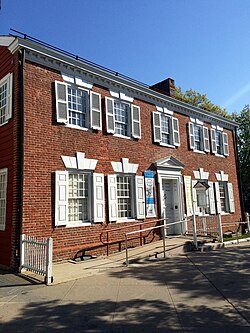
The Princeton Public Library officially opened its doors in 1909. Its first home was the historic Bainbridge House on Nassau Street. Built in 1766 by Job Stockton, this residence was the birthplace of naval hero William Bainbridge. The house was owned by Princeton University, which supported the library's early years by renting the space for a nominal fee of $1 per year.
Transition to Witherspoon Street
As the community's needs grew, the library moved to 65 Witherspoon Street in 1966. However, by 2002, the facility had become overcrowded; the building was designed to hold 80,000 books, but the collection had swelled to 130,000. This necessitated the construction of a modern, state-of-the-art facility.
During the construction phase, the library operated from a temporary site at 301 North Harrison Street. In April 2004, the new 58,000-square-foot building opened at the original Witherspoon Street address. Designed by Hillier Architecture, the new facility features updated signage and logos to reflect its modern identity.
Funding and Facilities
The construction of the current library cost $18 million. This project was made possible through a combination of private philanthropy and public funding. Two-thirds of the cost was raised via private donations, including a $5 million contribution from George and Estelle Sands (half of which served as an endowment), a $1 million donation from the J. Seward Johnson Charitable Trust, and $400,000 from Princeton University. Public contributions included $4 million from Princeton Township and $2 million from Princeton Borough.
| Metric | Value |
|---|---|
| Collection Size (2013) | 204,144 |
| Circulation (2013) | 555,959 |
| Population Served (2012) | 28,572 |
| Total Members (2012) | 30,838 |
| Annual Budget (2012) | $4,948,790 |
| Full-Time Equivalent Employees (2013) | 57.3 |
Community Impact
The library's impact is evident when compared to other municipal systems in New Jersey. Despite serving a population a tenth the size of Newark, Princeton's library sees nearly double the absolute number of visitors and circulation. Furthermore, the library spends four times as much per capita as Newark's largest municipal library, underscoring its role as a high-resource hub for its residents.
Frequently Asked Questions
Who is eligible to use the Princeton Public Library?
Access to the library is available to residents of Princeton, New Jersey, as well as individuals affiliated with Princeton University.
Where is the library located?
The library is located at 65 Witherspoon Street, Princeton, New Jersey.
How many people visit the library annually?
The library is the most visited municipal public library in New Jersey, welcoming over 860,000 visitors each year.
Who designed the current library building?
The current state-of-the-art building, as well as the library's logos and signage, were designed by Hillier Architecture.
What was the original location of the library?
The library was originally located at Bainbridge House on Nassau Street from 1909 until 1966.