Presidential Medal of Freedom: The United States' Highest Civilian Honor
The Presidential Medal of Freedom stands as the joint-highest civilian award in the United States, sharing its prestige with the Congressional Gold Medal. This distinguished honor is bestowed by the President of the United States to recognize individuals who have made an especially meritorious contribution to the security or national interests of the U.S., world peace, or other significant public or private endeavors, including cultural achievements.
Established in its current form in 1963, the award is a testament to excellence across a vast array of fields. While it is primarily a civilian award, it is not limited to U.S. citizens, nor is it restricted to civilians; military personnel may also receive the honor and wear it on their uniforms.
Key Facts
- Established: December 6, 1963, by President John F. Kennedy.
- Purpose: To honor meritorious contributions to national security, world peace, or significant public/private endeavors.
- Total Recipients: 674 individuals (averaging one per month since inception).
- Youngest Recipient: Simone Biles, who received the award at age 25.
- Precedence: Higher than the Presidential Citizens Medal and equivalent to the Congressional Gold Medal.
History and Evolution
The current iteration of the award was created by President John F. Kennedy through Executive Order 11085, signed on February 22, 1963. This order superseded the original Medal of Freedom established by President Harry S. Truman in 1945. Kennedy's version vastly expanded the purpose and prestige of the decoration, making it the first U.S. civilian neck decoration.
Unlike its predecessor, which was awarded by Cabinet secretaries and held lower precedence than the Medal for Merit, the Presidential Medal of Freedom is the supreme civilian decoration awarded at the sole discretion of the president.
The Two Degrees of the Award
The medal is issued in two degrees. The standard Presidential Medal of Freedom is the primary honor, but the president may occasionally grant the Presidential Medal of Freedom with Distinction. There are no specific criteria for this higher degree; it is awarded entirely at the president's discretion to indicate an "additional level of veneration."
As of June 2024, the version with Distinction has been awarded at least 55 times, representing approximately 8% of all recipients. Some individuals have received the award more than once; for example, Colin Powell received two awards (the second with Distinction), and Ellsworth Bunker received two awards, both with Distinction.
Insignia and Design
Designed by the Army's Institute of Heraldry under Col. Harry Downing Temple, the badge is a golden star with white enamel and a red enamel pentagon. The center features a blue enamel disc with thirteen gold stars, mirroring the Great Seal of the United States, surrounded by a golden ring and golden bald eagles with spread wings.
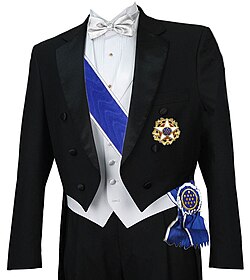
The standard medal is worn around the neck on a blue ribbon with white edge stripes. Women may opt to wear the award as a bow on the left chest. The version with Distinction features a larger badge worn as a star on the left chest, accompanied by a sash worn over the right shoulder with a rosette resting on the left hip.
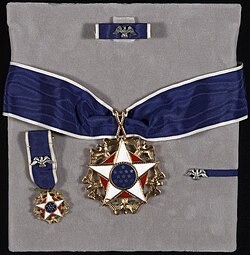
The full presentation set also includes a service ribbon for military uniforms, a miniature medal for formal wear, and a lapel badge for civilian clothing. The miniature and service ribbons feature a silver eagle for the standard award and a golden eagle for the award with Distinction.
Selection and Presentation
While the selection process is not public, it typically involves recommendations from the public, the Cabinet, White House senior staff, and presidential advisory bodies. The Distinguished Civilian Service Awards Board also serves as a major source of recommendations. The executive order suggests the medal be awarded annually around July 4, though this is not strictly followed.
The award can be granted posthumously. Notable posthumous recipients include Steve Jobs, Elvis Presley, Babe Ruth, and civil rights workers James Chaney, Andrew Goodman, and Michael Schwerner, who were honored 50 years after their deaths. In a unique instance in 1970, President Richard Nixon awarded the medal to the entire Apollo 13 mission operations team and crew.
| Feature | Standard Medal | Medal with Distinction |
|---|---|---|
| Precedence | Joint-highest civilian award | Highest degree of the award |
| Wear Style | Neck ribbon (or bow for women) | Sash, chest star, and neck ribbon |
| Eagle Color (Miniature) | Silver | Gold |
| Frequency | Common | Rare (~8% of awards) |
Frequently Asked Questions
Can the Presidential Medal of Freedom be revoked?
No, there is currently no established process for the award to be revoked, despite public discussions regarding certain recipients.
Who is eligible to receive the medal?
Any person recommended to the President or selected by the President's own initiative is eligible. This includes U.S. citizens, non-citizens, and military personnel.
What is the difference between this medal and the Congressional Gold Medal?
Both are the highest civilian honors in the U.S., but the Presidential Medal of Freedom is awarded by the President, whereas the Congressional Gold Medal is awarded by the U.S. Congress.
How often is the medal awarded?
Since 1963, there have been 674 recipients, which averages to approximately one award per month. While intended to be an annual event around July 4, it has not been awarded every single year.