President of the Republic of Indonesia
The President of the Republic of Indonesia serves as the head of state, head of government, and commander-in-chief of both the Indonesian National Armed Forces and the Indonesian National Police. As the leader of the executive branch, the president wields significant authority over the nation's administration and security.
Since 2004, the president and vice president have been directly elected by the people to a five-year term. To ensure a balance of power, the constitution limits a president to two terms, whether served consecutively or separately, allowing for a maximum of ten years in office.
The current incumbent is Prabowo Subianto, who assumed office on 20 October 2024.
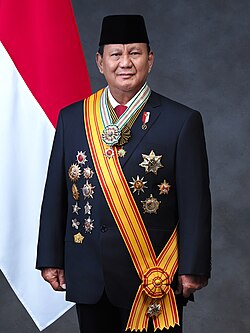
Key Facts
- Current President: Prabowo Subianto (since 20 October 2024).
- Term Length: Five years, renewable once.
- Election Method: Direct popular election.
- Primary Residence: Merdeka Palace, Jakarta.
- Constitutional Basis: Constitution of Indonesia (1945).
- Monthly Salary: Rp 62,657,809 (approximately US$ 4,379).
Evolution of the Presidency
The Sukarno Era (1945–1967)
The office was established during the formulation of the 1945 Constitution. Sukarno became the inaugural holder on 18 August 1945, elected by the Preparatory Committee for Indonesian Independence (PPKI). Early in his tenure, Indonesia functioned as a de facto parliamentary democracy, separating the ceremonial head of state from the head of government.
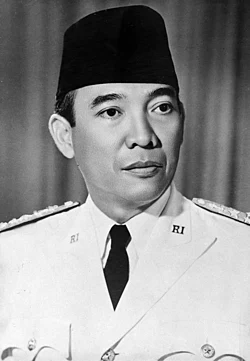
Following a period of instability, Sukarno issued a decree on 5 July 1959, returning the nation to the 1945 Constitution, which merged the roles of head of state and government. In 1963, the People's Consultative Assembly (MPR) elected him president for life, though he was eventually forced to resign in 1967.
The Suharto Era (1967–1998)
Suharto assumed the presidency in 1968. While he maintained the outward forms of constitutional governance—such as delivering accountability speeches to the MPR—he effectively ruled by decree. He ensured the MPR remained subservient to his authority and limited the influence of opposition parties through the pro-government grouping, Golkar.
The Reform Era (1998–Present)
The fall of Suharto in 1998 sparked a movement for democratic reform. This era saw the introduction of significant checks and balances to prevent the abuse of power. Key changes included the 2001 constitutional amendments that mandated direct elections starting in 2004 and strictly limited the president to two terms.
Susilo Bambang Yudhoyono became the first directly elected president in 2004. He was followed by Joko Widodo in 2014, and most recently by Prabowo Subianto in 2024.
Administrative Details and Residences
The president operates from the seat of government in Jakarta and maintains several official residences for state functions and administrative duties.
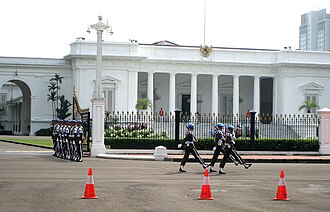
| Residence Name | Location/Type |
|---|---|
| Merdeka Palace | Official Residence (Jakarta) |
| Garuda Palace | Official Residence |
| State Palace | Official Residence |
| Bogor Palace | Official Residence |
| Tampaksiring Palace | Official Residence |
| Gedung Agung | Official Residence |
| Cipanas Palace | Official Residence |

Requirements for Candidacy
To run for the presidency, a candidate must meet strict criteria outlined in the Amended 1945 Constitution and Law No. 7 of 2017. Key requirements include:
- Citizenship: Must be an Indonesian citizen since birth and have never willingly acquired another nationality.
- Integrity: Must not have betrayed the nation or been involved in corruption or serious criminal offenses.
- Capability: Must be physically and mentally capable of performing duties and free from drug abuse.
- Age and Education: Must be at least 40 years old and have graduated from senior high school or its equivalent.
- Political Support: Must be nominated by a political party or coalition that holds 20% of the seats in the DPR or 25% of the valid votes from the previous election.
Election and Succession
The president and vice president are elected on a single ticket. To win outright, a ticket must receive over 50% of the total votes and at least 20% of the votes in at least half of the 38 provinces. If no ticket meets these criteria, a runoff election is held between the top two candidates.
Line of Succession
If the president dies, resigns, or is removed from office, the Vice President assumes the presidency. If both offices become vacant, the government is temporarily managed by a triumvirate consisting of the Minister of Home Affairs, Minister of Foreign Affairs, and Minister of Defense, while the MPR elects a new pair within 30 days.
Frequently Asked Questions
How long can a person serve as President of Indonesia?
A president can serve for a maximum of ten years, consisting of two five-year terms, whether these terms are served consecutively or separately.
Who elects the President of Indonesia?
Since 2004, the president and vice president have been directly elected by the citizens of Indonesia through a popular vote.
What happens if no candidate wins a majority in the first round?
If no ticket receives more than 50% of the vote and the required provincial distribution, a runoff election is held between the two candidates who received the most votes.
What are the benefits provided to former presidents?
Under Law No. 7 of 1978, former presidents are entitled to a pension, a government-provided house with covered utility bills, free healthcare for their families, and a car with a chauffeur.
Who is the current President of Indonesia?
The current president is Prabowo Subianto, who took office on 20 October 2024.