Power Forward: The Role and Evolution of the Four in Basketball
In the structured world of basketball, the power forward (PF), commonly referred to as the "four," serves as a critical bridge between the interior strength of the center and the versatility of the perimeter players. Traditionally one of the five standard positions, the power forward is designed to provide a blend of size, strength, and scoring ability that can shift the momentum of a game.
Historically, power forwards have mirrored the responsibilities of centers, often standing as the tallest or second-tallest players on the court. However, they are typically leaner than centers, allowing them more mobility to operate in various areas of the floor.
Key Facts
- Primary Role: Responsible for rebounding, screen setting, rim protecting, and scoring.
- NBA Height Range: Typically between 6' 9" (2.06 m) and 7' 0" (2.13 m).
- WNBA Height Range: Typically between 6' 0" (1.83 m) and 6' 3" (1.91 m).
- Offensive Style: Traditionally plays with their back to the basket for post scoring.
- The "Stretch Four": A modern variation of the position capable of hitting three-point shots.
Core Responsibilities and Gameplay
Offensive Contributions
On offense, the power forward is often a primary scoring option in the post. A staple of their game is the pick and roll—a tactical play where the power forward sets a screen for a guard and then "rolls" toward the basket to receive a pass for a layup or short shot. Alternatively, they may "pop" toward the perimeter to create an open shooting opportunity.
Defensive Duties
Defensively, the power forward's role depends on the team's strategy. In a zone defense, they typically position themselves under the basket to prevent easy scores. In a man-to-man defense, they are tasked with guarding the opposing team's power forward, utilizing their size to disrupt plays and secure rebounds.
The Evolution of the "Stretch Four"
While the position was once defined by interior play, the game has evolved. Many power forwards now possess a lethal mid-range jump shot, particularly from 12 to 18 feet (3.7 to 5.5 m). This skill set was more common in European styles of play before becoming a staple in the NBA.
This evolution led to the rise of the stretch four, a power forward who extends their range to include three-point field goals. By pulling opposing defenders away from the basket, stretch fours create more space for their teammates to drive toward the rim. Some, like Dirk Nowitzki, combined this range with a signature fadeaway shot in the post.
The "pick and pop" play is a hallmark of the stretch four; instead of rolling to the rim, the player pops out to the perimeter. A notable example is 6'10" (2.08m) Amar'e Stoudemire, who utilized this strategy effectively with Steve Nash on the Phoenix Suns from 2004 to 2010.
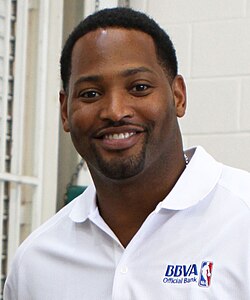
Notable Stretch Fours
- Robert Horry
- Dirk Nowitzki
- Kevin Love
- Al Horford
- Rasheed Wallace
- Carmelo Anthony
- Jayson Tatum
- Steve Novak
- Amar'e Stoudemire
Position Versatility and "Tweeners"
Not every player fits a rigid positional mold. Some athletes are considered tweeners—players whose size and skill set allow them to slide between the small forward, power forward, or center positions depending on the coach's needs or the opponent's lineup.
For instance, players like Draymond Green and the 6' 5" (1.96 m) P. J. Tucker have played center despite lacking the traditional height associated with the position, relying instead on their specific skill sets to compete against larger opponents.
| League | Typical Height Range | Primary Traditional Role |
|---|---|---|
| NBA | 6' 9" (2.06 m) to 7' 0" (2.13 m) | Post scoring & Rim protection |
| WNBA | 6' 0" (1.83 m) to 6' 3" (1.91 m) | Post scoring & Rim protection |
Hall of Fame Legacy
The impact of the power forward is cemented by the legends inducted into the Naismith Memorial Basketball Hall of Fame. These players defined the position across different eras, including:
- Men: Karl Malone, Dirk Nowitzki, Kevin Garnett, Charles Barkley, Dennis Rodman, Tim Duncan, Kevin McHale, Elvin Hayes, Bob Pettit, Jerry Lucas, Dave Debusschere, Vern Mikkelsen, and Dolph Schayes.
- Women: Lauren Jackson and Tina Thompson.
Frequently Asked Questions
What is the difference between a power forward and a center?
While both play near the basket, power forwards are typically leaner and more mobile than centers. They often operate slightly further from the rim and are more likely to possess perimeter shooting skills.
What does "stretch four" mean?
A stretch four is a power forward who can shoot three-pointers. This "stretches" the opposing defense by forcing the opposing power forward to leave the paint to guard them on the perimeter.
What is a "tweener" in basketball?
A tweener is a player who doesn't fit perfectly into one traditional position. They may have the height of a small forward but the skills of a power forward, or the skills of a center but the height of a power forward.
What is a "pick and pop" play?
In a pick and pop, the power forward sets a screen (the pick) for a guard and then moves away from the basket toward the perimeter (the pop) to receive a pass and take an open shot.