Port of Buenos Aires: Argentina's Gateway to Global Trade
The Port of Buenos Aires (Spanish: Puerto de Buenos Aires) serves as the primary maritime hub for Argentina. Managed by the state-owned Administración General de Puertos (General Ports Administration), it is the nation's leading transshipment point for foreign trade, facilitating the movement of millions of tons of cargo and hundreds of thousands of passengers annually.
While the city's maritime activity is spread across several areas, the official port since 1928 is located in the Retiro ward and is commonly referred to as Puerto Nuevo (New Port). This facility works in tandem with Dock Sud, a separate entity owned by the Province of Buenos Aires located south of the city proper.
Key Facts
- Official Name: Port of Buenos Aires (Puerto Nuevo).
- Annual Cargo: Approximately 11 million metric tons (Puerto Nuevo) and 17 million metric tons (Dock Sud).
- Infrastructure: 51 berths with a draft depth of 10.7 meters.
- Land Area: 91 hectares (220 acres).
- Passenger Hub: Includes the Benito Quinquela Martín Terminal for cruise ships and ferry services to Uruguay.
- Key Industry: Home to Tandanor, the largest shipbuilding and repair facility in Argentina.
Historical Evolution
Early Challenges and Smuggling
Founded by Captain Juan de Garay in 1580, Buenos Aires was intended as a Spanish imperial port. However, its growth was stunted when merchants from the Viceroyalty of Perú successfully lobbied to have the port closed in 1595. This restriction led to a rampant smuggling trade until 1776, when the establishment of the Viceroyalty of Río de la Plata legalized exports—primarily cowhides and salted meat—making customs duties the government's primary revenue source.
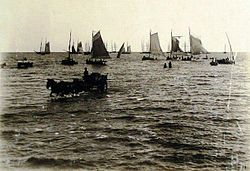
For centuries, the city relied on the natural harbor of Balizas Interiores. This site was plagued by swampy terrain and heavy silt deposits from the Río de la Plata estuary and the Matanza River, forcing large merchant ships to anchor miles offshore and transfer cargo to shallow-draft vessels.
The Path to Modernization
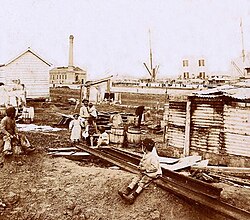
The drive for a modern port began with Law 280 in 1868. After years of jurisdictional disputes between the federal government and provincial authorities, the 1880 Federalization of Buenos Aires finally cleared the way for large-scale construction. An early milestone was the Catalinas Norte harbor, established in 1872 by Francisco Seeber, which utilized land reclamation to create an extensive pier.
The Era of Puerto Madero and Puerto Nuevo
In 1882, a design by British engineer Sir John Hawkshaw was approved, leading to the creation of Puerto Madero. Opened in 1889, it consisted of four impounded docks. However, by 1907, the surge in cereal exports—the backbone of Argentina's economy—outpaced the port's capacity.
This necessitated the construction of Puerto Nuevo. Based on plans by Luis Huergo and executed by Richard Souldby Oldham, Walker & Co., the project added a breakwater and six docks. Upon its inauguration in 1925, the Port of Buenos Aires became the largest in the Southern Hemisphere and Latin America.
Port Operations and Infrastructure
The port is currently operated by the state, following a history of reorganization. Originally the National Port Directorate (est. 1949), it became the Administración General de Puertos in 1987. While many port services were privatized in the 1990s, the Port of Buenos Aires itself remained under federal control.
A defining architectural landmark of the district is the Dr. Carlos Givogri power plant, built in 1930. Its 71-meter eclecticist façade remains one of the most recognizable structures in the area.
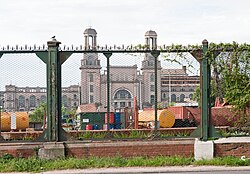
Industrial activity is anchored by Tandanor, a shipbuilding and repair facility. After facing bankruptcy in 1999, it transitioned into a worker cooperative and continues to operate under a self-management system.
The Transformation of Puerto Madero
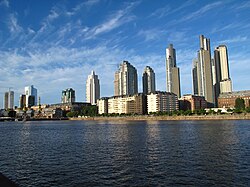
Once the primary port, Puerto Madero became ancillary after 1925. In 1989, the Corporación Antiguo Puerto Madero was formed to revitalize the area. Starting in 1994, a massive urban renewal project converted old red-brick warehouses into luxury lofts, high-end offices, and five-star hotels.
The district now features contributions from world-renowned architects such as Norman Foster and Santiago Calatrava. It is separated from the estuary by the Buenos Aires Ecological Reserve and has evolved into one of the city's most prestigious residential and commercial boroughs.
Port Statistics Summary
| Metric | Value | Year/Detail |
|---|---|---|
| Vessel Arrivals | 1,900 | 2010 |
| Annual Cargo Tonnage | 11.7 Million Metric Revenue Tons | 2010 |
| Container Volume | 1.1 Million TEU | 2010 |
| Passenger Traffic | 336,000 | 2010 |
| Annual Revenue | US$53 Million | 2008 |
| Net Income | US$0.6 Million | 2008 |
Frequently Asked Questions
What is the difference between Puerto Nuevo and Puerto Madero?
Puerto Nuevo is the current official port of Buenos Aires used for commercial shipping and trade. Puerto Madero is the older port facility that has been redeveloped into a luxury residential and commercial district.
Who manages the Port of Buenos Aires?
The port is operated by the Administración General de Puertos, which is a state-owned enterprise.
How does the port handle passenger traffic?
Passenger traffic includes cruise ships arriving at the Benito Quinquela Martín Terminal and fast ferry services (operated by Buquebus and Ferrylíneas) connecting Buenos Aires to Colonia del Sacramento and Montevideo in Uruguay.
What is the significance of Tandanor?
Tandanor is the largest shipbuilding and repair facility in Argentina and is notable for being operated as a worker cooperative since 1999.
Why was the port's development delayed in the 19th century?
Development was hindered by geographical challenges, such as heavy silt deposits in the Río de la Plata, and political disputes between the federal government and the provincial government of Buenos Aires over the control of customs duties.