Port Imperial and the Weehawken Waterfront History
The North Hudson waterfront, situated north of Weehawken Cove, occupies a narrow strip of land nestled between the Hudson River and the towering Hudson Palisades—the steep cliffs that define the region's geography. Once a tidal marsh known as Slough's Meadow, this area has undergone a dramatic evolution over three centuries, transforming from a colonial outpost into a massive industrial shipping hub, and finally into a modern residential and commercial community.
Early Colonial Roots and the Era of Duels
The recorded history of the area dates back to the 17th century. On April 18, 1670, the government of the Province of New Jersey confirmed a land grant to Maryn Adriaensen for a parcel called Wiehacken, located in the jurisdiction of Bergen on Hobooken Creek. This grant covered 50 morgen (a traditional Dutch unit of land area) and had originally been granted on May 11, 1647.
Early transportation was defined by sporadic ferry services. In 1700, a royal patent granted by Richard Coote, the 1st Earl of Bellomont, led to the naming of Weehawken Street at the landing located across the river in what is now New York City's West Village.
Beyond commerce, the waterfront became a site of historical notoriety. It served as the location for numerous duels, most notably the 1804 encounter between Alexander Hamilton and Aaron Burr. The specific site of this famous duel was eventually obliterated by the expansion of the West Shore Railroad infrastructure.
The Industrial Peak: Rail and Shipping
By the turn of the 20th century, the waterfront had evolved into a critical transportation artery. The Weehawken Terminal became a bustling hub featuring passenger stations, ferry slips, carfloats, and extensive railyards. The primary ferry route connected the terminal to 42nd Street in Manhattan, and for a brief period, the area was part of the transcontinental Lincoln Highway.
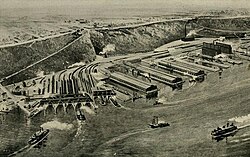
Transportation to the cliffs was facilitated by trolleys from the Public Service Railway and the North Hudson County Railway, which ascended Pershing Road. The industrial capacity of the port was immense; for instance, the United Fruit Company operated the largest banana warehouse in the United States adjacent to its berths.
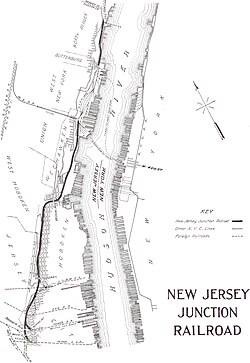
The decline of this era began as freight and passenger patterns shifted. The final ferry to the West Shore Terminal departed on March 25, 1959, at 1:10 am, marking the end of train service. The right of way, once part of the New York Central's New Jersey Junction Railroad, saw later use by the Conrail River Line and the Penn Central River Division before being abandoned.
The Post-Industrial Transition to Port Imperial
The modern era of the waterfront began in 1981 when trucking magnate Arthur Edward Imperatore, Sr. purchased a 2.5-mile stretch of the Weehawken Yard from the bankrupt Penn Central for $7.5 million. This acquisition laid the groundwork for the development known as Port Imperial, named after Imperatore.
The restoration of transit services occurred on a smaller, more specialized scale. New York Waterway was established in 1986, initially operating from a converted ferry. To support this growth, New Jersey Transit undertook the extensive renovation and waterproofing of the Weehawken Tunnel under Bergen Hill, a structure originally built in 1881.
Key infrastructure milestones include:
- November 2005: The Hudson-Bergen Light Rail (HBLR) station opened for weekend service.
- May 2006: A new ferry terminal, owned by New Jersey Transit and leased by NY Waterway, opened to the public.
- October 29, 2006: The HBLR station began full-time service.
- June 2013: A bridge connecting the ferry terminal and the light rail station finally opened.
Modern Community and Waterfront Development
Today, the area has expanded into a residential and commercial neighborhood spanning West New York and Guttenberg. The landscape is now characterized by luxury high-rise residential buildings and retail spaces, including an 850-space garage that broke ground in June 2011.
The area has also been the site of significant events and ambitious plans. In 2009, New York Waterway played a key role in rescuing passengers from US Airways Flight 1549 after its emergency landing on the Hudson River. Additionally, a memorial commemorating the September 11 attacks was unveiled on the 10th anniversary of the event.
Not all plans came to fruition; in 2011, the hub was announced as the site for the Port Imperial Street Circuit to host the Grand Prix of America (a Formula One World Championship round). While pit facilities were planned opposite the ferry terminal, the event never materialized.
Key Facts
- Original Land Grant: 50 morgen granted to Maryn Adriaensen in 1647/1670.
- Historical Event: Site of the 1804 Hamilton-Burr duel.
- Industrial Peak: Home to the largest banana warehouse in the U.S. (United Fruit Company).
- Transit End: Last West Shore Terminal ferry departed March 25, 1959.
- Modern Development: Port Imperial was initiated by Arthur Edward Imperatore, Sr. in 1981.
- Tunnel History: The Weehawken Tunnel under Bergen Hill dates back to 1881.
| Era | Primary Use | Key Infrastructure/Events |
|---|---|---|
| Colonial (1600s-1700s) | Agricultural/Early Ferry | Wiehacken grant; Royal patent (1700) |
| Industrial (1800s-1959) | Rail & Shipping Port | West Shore Railroad; Weehawken Terminal |
| Transition (1981-2006) | Redevelopment | Purchase by Imperatore; NY Waterway start |
| Modern (2006-Present) | Residential/Commercial | HBLR Station; Luxury high-rises; Ferry Terminal |
Frequently Asked Questions
Who is Port Imperial named after?
Port Imperial is named after Arthur Edward Imperatore, Sr., a trucking magnate who purchased a 2.5-mile section of the Weehawken Yard from Penn Central in 1981.
What famous historical event took place on the Weehawken waterfront?
The waterfront was the site of the famous 1804 duel between Alexander Hamilton and Aaron Burr, though the specific location was later destroyed by railroad infrastructure.
When did the original train and ferry service to the West Shore Terminal end?
The final ferry departed on March 25, 1959, at 1:10 am, which coincided with the discontinuation of train service.
What is the history of the Weehawken Tunnel?
The Weehawken Tunnel under Bergen Hill was originally constructed in 1881 and underwent extensive renovation and waterproofing by New Jersey Transit in the modern era.
Did the Formula One Grand Prix of America ever happen at Port Imperial?
No. Although the Port Imperial Street Circuit was announced in 2011 and plans for pit facilities were made, the event never materialized.