Pontefract History: From Neolithic Henges to the Fall of the Castle
The history of Pontefract is a rich tapestry of shifting empires and strategic importance. From its earliest roots as a prehistoric site to its role as a formidable stronghold during the English Civil War, the town has served as a crossroads for various cultures and a witness to some of England's most dramatic political upheavals.
Prehistoric and Roman Foundations
Long before the town became a medieval center, the area held significance for Neolithic peoples. In 2007, a survey conducted for residential construction revealed an extension of the Ferrybridge Henge, a Neolithic henge (a circular earthwork enclosure), confirming that the region was inhabited during the Stone Age.
During the Roman occupation, the area became a strategic transit point. The modern town sits near the "Roman Ridge" (now the A639), an old Roman road. Historians believe this route served as an alternative path from Doncaster to York via Tadcaster and Castleford. This diversion from the primary Ermine Street likely allowed travelers to avoid the dangerous crossing of the River Humber near North Ferriby during periods of severe weather.
The Anglo-Scandinavian Era
Between the fall of the Viking king Eric Bloodaxe in 954 and the Norman arrival in 1068, Yorkshire entered the Anglo-Scandinavian age. During this time, the area that would become Pontefract consisted of two distinct settlements: Kirkby and Tanshelf. The influence of Danish settlers remains visible today; the suffix "-by" in Kirkby and the use of the word "gate" (meaning street) in names like Bailygate are direct linguistic legacies of this period.
Tanshelf, recorded in the Domesday Book as Tateshale (among other variations), was the primary settlement. Its importance is highlighted in the Anglo-Saxon Chronicle, which notes that in 947, King Eadred of England met with the Northumbrian ruling council there to accept their submission. However, this peace was short-lived, as the kingdom voted Eric Bloodaxe as King of York just one year later.
By the time of the Domesday survey in 1086, Tanshelf was a thriving community. The records list 101 landholders, including 60 petty burgesses, 16 cottagers, 16 villagers, and 8 smallholders. Because only landholders were recorded, the actual population was likely four to five times larger. The settlement featured a church, a fishery, and three mills. Archaeological evidence on The Booths has uncovered a church with graves dating back to approximately 690, suggesting a religious presence long before the Norman conquest.
Medieval Power and the Tragedy of Richard II
Following the Norman conquest of 1066, ownership of Tateshale passed to Ilbert de Lacy, a follower of William the Conqueror. De Lacy established a wooden motte and bailey castle (a fortified mound with an enclosed courtyard) before 1086, which was later reconstructed in stone. The de Lacy family maintained control of the castle and the Honour of Pontefract for over two centuries, until the death of Alice de Lacy in 1348.
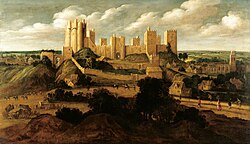
The castle later became the site of a notorious royal tragedy. In 1400, King Richard II was murdered within its walls. While the exact circumstances remain debated, three primary theories exist: he was starved to death by his captors, he committed suicide by starvation, or he was murdered by Sir Piers (Peter) Exton in either 1399 or 1400.
Early Modern Conflict and Decline
By the Elizabethan era, the town and castle were commonly referred to as "Pomfret." This name was immortalized by William Shakespeare in his play Richard III, where he describes the castle as a "bloody prison" and a "dismal seat."
The 17th century brought devastation during the English Civil War. The castle became a focal point of conflict, enduring three separate sieges by Parliamentarian forces. Oliver Cromwell described it as one of the strongest inland garrisons in the kingdom. These conflicts left the town impoverished and depopulated.
Fearing a fourth siege in March 1649, the residents of Pontefract petitioned Parliament to have the castle slighted (intentionally damaged to make it unusable as a fortress). Demolition began in April 1649, and the ruins remain accessible to the public today.
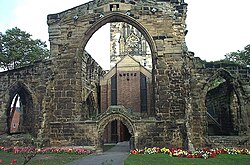
Parallel to the castle's history was the Pontefract Priory, a Cluniac priory founded in 1090 by Robert de Lacy and dedicated to St John the Evangelist. The priory was dissolved by royal authority in 1539. Its historic documents, known as the Chartularies of St John, were later preserved by Thomas Levett and Roger Dodsworth before being published by the Yorkshire Archaeological Society.
Key Facts
- Neolithic Roots: An extension of Ferrybridge Henge was discovered near the town in 2007.
- Roman Infrastructure: The "Roman Ridge" (A639) served as a weather-safe alternative to Ermine Street.
- Danish Influence: Street names ending in "gate" and the name "Kirkby" reflect Anglo-Scandinavian heritage.
- Domesday Population: Tanshelf had 101 recorded landholders in 1086, with an estimated total population 4-5 times higher.
- Royal Death: King Richard II was murdered at Pontefract Castle around 1400.
- Civil War Destruction: The castle was slighted in 1649 after three sieges by Oliver Cromwell's forces.
| Era | Key Feature/Event | Significant Figure/Site |
|---|---|---|
| Neolithic | Henge construction | Ferrybridge Henge |
| Roman | Strategic road network | Roman Ridge (A639) |
| Anglo-Scandinavian | Settlement of Tanshelf and Kirkby | King Eadred / Eric Bloodaxe |
| Medieval | Castle construction and royal murder | Ilbert de Lacy / Richard II |
| Early Modern | Civil War sieges and demolition | Oliver Cromwell |
Frequently Asked Questions
What was the "Roman Ridge"?
The Roman Ridge is an ancient Roman road, now the A639, that provided an alternative route from Doncaster to York. It was likely used to avoid crossing the River Humber during rough weather.
Who built Pontefract Castle?
The castle was established by Ilbert de Lacy, a follower of William the Conqueror, shortly after the Norman conquest. It began as a wooden motte and bailey structure before being rebuilt in stone.
How did King Richard II die?
While the exact details are unclear, theories suggest he was either starved to death by his keepers, starved himself, or was murdered by Sir Piers Exton around 1400.
Why was Pontefract Castle demolished?
After suffering through three sieges during the English Civil War, the local inhabitants feared a fourth attack and petitioned Parliament to have the castle slighted in 1649 to prevent further conflict.
What is the significance of the name "Tanshelf"?
Tanshelf (recorded as Tateshale in the Domesday Book) was one of the two original Anglo-Scandinavian settlements in the area and is the site where the modern town of Pontefract now stands.