Political Legitimacy: Forms, Frameworks, and Foundations of Governance
At its core, political legitimacy is the justification for a government's right to exercise power. It is the difference between a regime that rules by raw force and one that is accepted by its people as rightful. Legitimacy is not a monolithic concept; it varies across cultures, historical eras, and political philosophies, ranging from divine mandates to the rational delivery of public services.
Key Facts
- Numinous legitimacy is based on spiritual or divine authority, such as the Pharaohs of ancient Egypt.
- Civil legitimacy arises from agreements between autonomous institutions like the legislative, judicial, and executive branches.
- Dynastic legitimacy relies on the acceptance of a monarch's right to rule through succession.
- Good governance, as defined by the UN, requires transparency, responsibility, accountability, participation, and responsiveness.
- Foundational legitimacy focuses on basic survival (safety and security), while contingent legitimacy focuses on "living well" (rights and fairness).
Traditional Forms of Legitimacy
Numinous Legitimacy
In a theocracy—a system of government in which priests rule in the name of God or a god—legitimacy is derived from spiritual authority. A primary historical example is ancient Egypt (c. 3150 BC), where the Pharaoh's dominion was theologically established. The Pharaoh was viewed as a god-king, specifically the Egyptian patron god Horus, the son of Osiris.

Civil Legitimacy
Civil legitimacy is grounded in the agreement among autonomous constituent institutions—the executive, legislative, and judicial branches—working together for the national common good. In modern democracies like the United States, this form of legitimacy is often debated in the context of voting access, the impact of gerrymandering (the manipulation of electoral district boundaries), the Electoral College's potential for minority rule, and the 2013 repeal of parts of the Voting Rights Act.
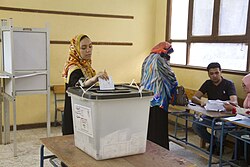
Beyond voting, civil legitimacy can be maintained through other accountability measures, such as stakeholder accountability and financial transparency. Organizations like the Center for Public Impact study these dynamics through global conversations and case studies in regions such as Canada, Lebanon, and Bristol.
Dynastic Legitimacy
Dynastic legitimacy is the acceptance of a monarch's right to rule based on dynastic succession. This becomes particularly critical when a ruler's claim is weak—perhaps obtained through conquest or factional support—compared to a pretender, as seen with the British Jacobites. This conflict can persist even in republics; for example, French legitimists opposed the French Republic while also rivaling other royalist factions like the Bonapartists and Orleanists.
Theoretical Frameworks of Legitimacy
Negative vs. Positive Legitimacy
Drawing on Isaiah Berlin's concepts of freedom, Abulof distinguishes between two types of political legitimacy:
- Negative Political Legitimacy (NPL): Focuses on the object of legitimation (what is legitimate). It defines the line between good and bad actions. Figures like Hobbes (security) and Locke (liberty) emphasized NPL.
- Positive Political Legitimacy (PPL): Focuses on the source of legitimation (who is the legitimator). It asks who has the right to draw the lines of authority. Rousseau, emphasizing "the people," focused on PPL.
Instrumental vs. Substantive Legitimacy
While Max Weber linked legitimacy to shared values and rational-legality, Weigand differentiates between the usefulness of a state and its normative right to rule:
- Instrumental Legitimacy: Based on the perceived effectiveness of service delivery and the rational assessment of how well an authority responds to shared needs.
- Substantive Legitimacy: An abstract normative judgment based on shared values. A citizen with substantive legitimacy may accept personal disadvantages because they believe the entity has the inherent right to exercise social control.
Perceived Legitimacy
Legitimacy is not merely a transaction; providing services or holding elections does not automatically guarantee it. Instead, it is often co-constructed between citizens and state actors based on perceptions and expectations. This is highly contextual. For instance, research by McCullough et al. (2020) found that public water provision drove legitimacy in Nepal, whereas health services were the primary driver in Pakistan. Notably, non-state actors, such as armed groups in conflict zones, can sometimes construct higher legitimacy among certain populations than the state itself.
Foundational and Contingent Legitimacy
Political theorist Ross Mittiga proposes a typology that separates the basic requirements of a state from its higher-order functions.
Foundational Legitimacy (FL)
FL is the government's basic ability to ensure the safety and security of its citizens. This includes providing essential goods (food, water, shelter), preventing catastrophes, providing disaster relief, and defending against invading forces. Mittiga argues that if a government cannot fulfill these basic functions, it is not legitimate.
Contingent Legitimacy (CL)
CL occurs when a government exercises power in acceptable ways. This includes democratic processes, equal representation, protection of individual rights, and social justice. Unlike FL, which is universal, CL is subject to:
- Pluralism: Constant contestation over which factors matter most.
- Partial Displacement: New legitimacy factors replacing older ones over time.
- Exceptional Circumstances: The tendency to relax CL factors during emergencies.
In short, FL is about living, while CL is about living well. Foundational legitimacy must exist before contingent legitimacy can be established.
Summary of Legitimacy Types
| Type | Primary Source/Driver | Key Focus |
|---|---|---|
| Numinous | Divine/Spiritual Authority | Theocratic mandate |
| Civil | Institutional Agreement | Common good and accountability |
| Dynastic | Hereditary Succession | Right of bloodline/inheritance |
| Instrumental | Service Delivery | Effectiveness and utility |
| Substantive | Shared Normative Values | Abstract right to rule |
| Foundational | Basic Security | Survival and safety |
| Contingent | Rights and Fairness | Quality of governance |
Frequently Asked Questions
What is the difference between instrumental and substantive legitimacy?
Instrumental legitimacy is based on the practical effectiveness of a government—essentially, how well it delivers services to meet shared needs. Substantive legitimacy is based on a deeper, normative belief that the government has the inherent right to rule, regardless of immediate personal advantage.
How does the UN define "good governance"?
The United Nations Human Rights Office of the High Commission (OHCHR) identifies five key attributes of good governance: transparency, responsibility, accountability, participation, and responsiveness to the needs of the people.
What is the relationship between foundational and contingent legitimacy?
Foundational legitimacy (FL) is a prerequisite for contingent legitimacy (CL). FL ensures basic survival and security; once those are met, CL determines if the government is ruling in a way that allows citizens to "live well" through rights and justice.
Can non-state actors possess legitimacy?
Yes. In certain contexts, such as conflict zones, armed groups may successfully construct legitimacy among specific strata of the population, sometimes more effectively than the official state government.
What is the difference between negative and positive political legitimacy?
Negative political legitimacy (NPL) is concerned with what is legitimate (the actions), while positive political legitimacy (PPL) is concerned with who is the legitimator (the source of authority).