Polandball: The Art and Satire of Countryball Comics
Polandball, also known as Countryballs, is a unique internet phenomenon that blends geopolitical commentary with a distinct visual style. Similar to traditional political cartoons, these comics use simplified characters to satirize international relations, history, and national identities. By transforming nations into spherical characters, the medium creates a playful yet often biting lens through which to view global affairs.
Key Facts
- Core Purpose: Satirizes political entities, geopolitical events, history, and national stereotypes.
- Visual Style: Hand-drawn characters; the use of circle or line tools is generally forbidden in community standards.
- Linguistic Trait: Non-Anglosphere countries typically speak a strategic form of broken English.
- Character Variations: While most are balls, some nations are depicted as bricks, triangles, or hypercubes.
The Role of Satire and Stereotypes
At its heart, Polandball is a tool for caricature. It frequently employs stereotypes rooted in xenophobia and racism to create humor, often portraying countries through exaggerated lenses. A primary example is Poland, which is commonly depicted as a low-income, poorly educated immigrant who speaks broken English.
Beyond national traits, the comics often present abridged or over-simplified versions of historical events. According to Anna Borkiewicz in Memes and Graphic Novels as Public History, the brevity of the format often leads to historical accuracy being sacrificed for unnuanced simplifications, which serves as a primary source of humor.
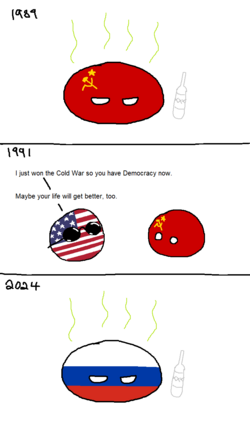
While some content can be offensive, moderators of the r/Polandball community argue that the high effort required to hand-draw these comics reduces the likelihood of the format being used for simple, low-effort political campaigning.
Artwork and Visual Conventions
Unlike many template-based memes, Polandball is characterized by a user-drawn aesthetic. To maintain the organic feel of the art, strict conventions are often enforced, such as the prohibition of Microsoft Paint's rectangle and line tools, as well as the circle tool for drawing the balls themselves.
Many characters are identified by specific accessories. For instance, the United States is typically seen wearing sunglasses, while the United Kingdom is depicted with a top hat and a monocle.
Deviations from the Sphere
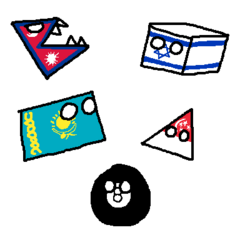
While the "ball" is the standard, several entities deviate based on flags or inside jokes:
- Nepal: Depicted as a monster due to its non-rectangular national flag.
- Kazakhstan: Depicted as a brick, stemming from an early oversight by krautchan moderators.
- Israel and Jewish Autonomous Oblast: Depicted as hypercubes, satirizing the term "Jewish physics" used by Nazi Germany.
- Singapore and Bermuda: Depicted as triangles, referencing the Indonesia–Malaysia–Singapore growth triangle and the Bermuda Triangle, respectively.
- Non-state entities: People without statehood or flags are often represented by billiard balls (e.g., Black people are depicted as the black 8-ball).
Dialogue and the Use of Broken English
A defining characteristic of Polandball is the use of broken English for countries where English is not the official language. This is not accidental but a strategic linguistic choice known as styling. As noted by researcher Ondrej Prochazka, authors consciously mix linguistic repertoires to fit the specific countryball's persona.
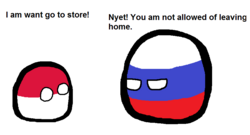
Common linguistic tropes include the phrase "cannot into" (most famously seen in "Poland cannot into space") and the incorrect addition of the suffix "-ings" to verbs. Authors may also blend English with words, phrases, or grammatical structures from the character's native language to enhance the effect.
Summary of Polandball Characteristics
| Category | Standard Convention | Notable Exceptions |
|---|---|---|
| Shape | Sphere (Countryball) | Brick (Kazakhstan), Triangle (Singapore), Hypercube (Israel) |
| Art Style | Hand-drawn (No circle tools) | N/A |
| Language | Broken English (Non-Anglosphere) | Standard English (Anglosphere countries) |
| Accessories | National symbols/props | Sunglasses (USA), Top hat/Monocle (UK) |
Frequently Asked Questions
Why is Polandball drawn by hand?
The community prefers a hand-drawn look to avoid the sterile appearance of template memes. Specifically, the use of geometric tools like the circle or line tool is discouraged to maintain the unique aesthetic of the genre.
Why does Poland cannot into space?
This is one of the most famous tropes in the series, utilizing broken English to satirize Poland's perceived struggles and aspirations, serving as a recurring joke within the community.
Why is Kazakhstan a brick instead of a ball?
Kazakhstan's rectangular shape is a reference to an early mistake made by moderators on the krautchan board when assigning flairs to national flags.
What is the purpose of the broken English used in the comics?
The broken English is a strategic stylistic choice used to create a caricature of non-native speakers, adding to the humor and characterization of the various countryballs.
How are people without a country represented?
Entities or groups of people who do not have a recognized state or national flag are typically represented as billiard balls, such as the use of the 8-ball for Black people.