Poisson Clumping: The Science of Random Bursts
Have you ever noticed how random events often seem to happen in clusters? Whether it is a sudden surge of emails in a single afternoon or a series of unlikely coincidences in a short timeframe, our intuition often suggests there must be a hidden cause. However, in the realm of probability, this phenomenon is known as Poisson clumping (or Poisson bursts). It describes a scenario where events that are entirely random and independent appear to group together purely by chance.
Key Facts
- Definition: A phenomenon where random, independent events appear in clusters or bursts despite having a uniform probability of occurrence.
- Origin: Named after Siméon Denis Poisson, a 19th-century French mathematician.
- Mechanism: Occurs when the expected number of events (λ) is small, making rare events appear clumped by chance.
- Distinction: Unlike seismic activity (which may follow a Weibull distribution), Poisson clumping has no underlying causal link between the events in a cluster.
- Application: Used to analyze shark attacks, coin tosses, and digital correspondence.
The Mathematical Foundation
To understand Poisson clumping, one must first understand the Poisson process. This is a mathematical description of random independent events occurring with uniform probability across a specific measure of time or space. The expected number of events, represented by the parameter λ (lambda), is proportional to that measure.
The distribution of these events follows the Poisson distribution. When λ is small, events are rare. Paradoxically, because these events are independent and random, they do not spread themselves out evenly. Instead, they often occur in tight groupings. In these instances, there is no external force driving the cluster; the "clumping" is simply a natural property of randomness.
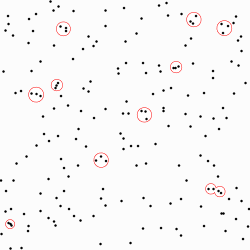
Poisson Clumping vs. Causal Clustering
It is important to distinguish between random clumping and causal clustering. Not every group of events is a Poisson burst. For example, earthquakes often occur in clusters because a primary seismic event triggers local aftershocks. This type of clustering is driven by physical causality and may be better represented by a Weibull distribution rather than a Poisson distribution.
Real-World Applications
Poisson clumping provides a framework for explaining marked increases or decreases in the frequency of various events that might otherwise seem suspicious or meaningful. Common examples include:
- Natural Events: Sudden spikes in shark attacks.
- Daily Life: The occurrence of "coincidences" or shared birthdays within a small group.
- Probability Trials: Streaks of heads or tails during a series of coin tosses.
- Communication: The bursty nature of e-mail correspondence.
| Feature | Poisson Clumping | Causal Clustering (e.g., Earthquakes) |
|---|---|---|
| Cause | Pure chance / Randomness | Physical trigger / Dependency |
| Event Relationship | Independent | Interdependent (e.g., aftershocks) |
| Distribution Model | Poisson Distribution | Often Weibull Distribution |
| Predictability | Unpredictable | Higher probability following an initial event |
The Poisson Clumping Heuristic (PCH)
In 1989, David Aldous introduced the Poisson clumping heuristic (PCH). This is a more advanced model used to find first-order approximations across a large class of stationary probability models. These models possess a specific monotonicity property with large exclusions.
The PCH is particularly useful when the probability of a value becoming very large is asymptotically small. In such cases, the occurrences of these large values are distributed in a Poisson fashion, allowing mathematicians to approximate the behavior of complex systems.
Frequently Asked Questions
What is the difference between a Poisson burst and a coincidence?
A coincidence is the subjective perception of two events being related. A Poisson burst is the mathematical reality that random events will naturally cluster, creating the appearance of a coincidence where no causal link exists.
Who was Siméon Denis Poisson?
Siméon Denis Poisson was a 19th-century French mathematician who made significant contributions to probability theory, electromagnetic theory, and definite integrals.
Can all clusters be explained by Poisson clumping?
No. Only clusters of independent events can be explained this way. Events that are linked by cause-and-effect, such as aftershocks following an earthquake, are not Poisson clumps.
How does the parameter λ affect clumping?
The parameter λ represents the expected number of events. When λ is small, events are rare, which makes the occasional random clumping more visually striking and apparent.
What is the Poisson clumping heuristic used for?
The PCH is used by researchers to create first-order approximations for stationary probability models, specifically when dealing with rare, large values that follow a Poisson distribution.