Platysteiridae: The Wattle-eyes and Batises of Africa
The Platysteiridae are a family of small, stout passerine birds native to the African tropics. Comprising the wattle-eyes and batises, these insect-eating birds were previously classified as a subfamily of the Old World flycatchers (Muscicapidae). Today, they are recognized as a distinct group known for their specialized hunting techniques and striking visual communication tools.
Typically found in open forests or bush, these birds employ diverse foraging strategies. They are adept at flycatching—catching insects mid-air—or hunting prey from the ground in a manner similar to a shrike. Their nests are characterized as small, neat cups positioned low within trees or bushes.
Key Facts
- Distribution: Restricted to mainland sub-Saharan Africa and its offshore islands.
- Diet: Primarily insectivorous, consuming beetles, grasshoppers, flies, and occasionally small lizards.
- Communication: Use brightly colored irides (in batises) and supra-orbital wattles (in wattle-eyes) to communicate.
- Diversity: Highest species diversity occurs at equatorial latitudes, particularly in Tanzania, Kenya, and the DRC.
- Conservation: The banded wattle-eye is currently listed as endangered due to forest clearance in Cameroon.
Distribution and Habitat
Platysteiridae are arboreal birds found throughout the woodlands and forests of sub-Saharan Africa. While the family is generally sedentary, some batis species engage in seasonal migrations or local movements based on environmental changes.
Habitat preferences vary by genus. The Dyaphorophyia wattle-eyes inhabit dense forests, whereas other wattle-eyes prefer general woodlands. Batises are versatile, occupying almost all wooded habitats, though they are generally absent from the densest forests of the Congo Basin. Specialized adaptations exist as well: the pririt and pygmy batis survive in arid environments with minimal cover, and the white-fronted wattle-eye favors the mangrove forests of Angola. Many species have also successfully adapted to habitats altered by human activity.
Morphology and Behavior
These small to medium-sized passerines are characterized by an upright stance and short legs. Their bills are wide, flat, and hooked at the tip, featuring well-developed rictal bristles (stiff hairs around the mouth that help capture insects).
Tail length varies across the family; Dyaphorophyia wattle-eyes and batises have short tails, while Platysteria wattle-eyes and shrike-flycatchers possess longer tails. Most species exhibit sexual dimorphism, meaning males and females differ in appearance. While most have white undersides and dark, speckled upperparts, some wattle-eyes display brightly colored plumage. Some genera possess erectile feathers on their backs, earning them the nickname "puffback flycatchers."
Communication is a central part of their biology. Batises and the black-and-white shrike-flycatcher have brightly colored irides that intensify when the bird is excited. Wattle-eyes are named for their supra-orbital wattles—fleshy growths above the eyes used for communication.
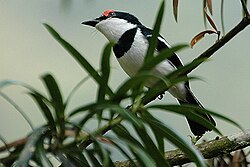
Beyond visual cues, the family is highly vocal, utilizing a complex repertoire of whistles, harsh calls, and duets.
Diet and Foraging
Insects are the primary food source for all Platysteiridae, including beetles, grasshoppers, Orthoptera, flies, mosquitoes, wasps, and termites. They also consume spiders, millipedes, scorpions, and occasionally small lizards. Foraging methods range from foliage-gleaning (picking insects off leaves) to active flycatching.
These birds may forage individually, in family groups, or as part of mixed-species feeding flocks, which can provide strategic advantages in locating prey.
Conservation Status
While many species are stable, some face significant threats from habitat loss. The banded wattle-eye is listed as endangered by the IUCN due to its restricted range in Cameroon and the ongoing threat of forest clearance. The Gabon batis and white-fronted wattle-eye are categorized as near-threatened. Some species remain poorly understood; for instance, the dark batis was only identified as a distinct species in 2006.
Taxonomy Summary
| Genus | Common Name Group | Notable Species |
|---|---|---|
| Lanioturdus | Shrike-flycatcher | White-tailed shrike |
| Dyaphorophyia | Wattle-eyes | Chestnut, West African, and White-spotted wattle-eyes |
| Platysteira | Wattle-eyes | Brown-throated, Banded, and Yellow-bellied wattle-eyes |
| Batis | Batises | Cape, Pygmy, and Dark batis |
Frequently Asked Questions
What are wattle-eyes named after?
Wattle-eyes are named after their supra-orbital wattles, which are fleshy growths located above their eyes used for communication.
Where are Platysteiridae birds primarily found?
They are restricted to mainland sub-Saharan Africa and its offshore islands, with the highest diversity found in Tanzania, Kenya, and the Democratic Republic of the Congo.
What do wattle-eyes and batises eat?
Their diet consists primarily of insects such as beetles, flies, and grasshoppers, though they also eat spiders, scorpions, and occasionally small lizards.
Which species of Platysteiridae is most threatened?
The banded wattle-eye is considered endangered due to forest clearance within its restricted range in Cameroon.
How do batises communicate visually?
Batises use their brightly colored irides, which can become even more vivid when the adult birds are excited.