Pitch Pine: Characteristics, Growth, and Fire Adaptations
The pitch pine is a resilient conifer known for its irregular form and remarkable ability to survive harsh environmental conditions. Growing between 6 and 30 metres (20–98 ft), this species is characterized by its twisted branches and a distinct lack of self-pruning, which contributes to its rugged, natural appearance.
Physical Characteristics
The pitch pine is easily identified by its stout needles, which grow in fascicles (bundles) of three. These needles typically measure 6–13 centimetres (2 1⁄ 4–5 inches) in length, exceed 1 millimetre (1 ⁄ 16 in) in breadth, and are often slightly twisted. The trunk is generally straight with a slight curve, encased in thick, irregular plates of bark.
The reproductive structures of the tree consist of oval cones measuring 4–7 cm (1 1⁄ 2–2 3 ⁄ 4 in) in length, featuring scales equipped with prickles. These cones require two years to reach full maturity.
Adaptations to Fire
One of the most defining traits of the pitch pine is its evolutionary adaptation to fire. The tree protects its cambium layer—the sensitive growth tissue located between the bark and the wood—with a thick layer of bark that shields it from extreme heat.
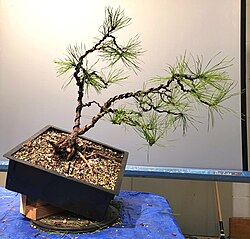
Furthermore, the species possesses a high regenerative capacity through the use of epicormic shoots (buds that develop from dormant tissue under the bark). If the main trunk is damaged or destroyed by fire, the tree can re-sprout from these shoots. This process often results in stunted, twisted trees with multiple trunks, a visual characteristic that makes the pitch pine a highly sought-after species for bonsai enthusiasts.
Growth Cycle and Lifespan
In its youth, the pitch pine is a rapid grower, adding approximately 30 cm (12 in) in height annually under optimal conditions. This growth phase continues until the tree is 50–60 years old, after which the rate slows significantly. By age 90, annual height gain becomes minimal.
Reproduction begins early; trees grown in open areas may start bearing cones in as little as three years, while those in shaded environments take slightly longer. Because the species cannot self-pollinate, seed dispersal occurs across the fall and winter months to ensure genetic diversity.
The typical lifespan of a pitch pine is 200 years or more, with the oldest recorded specimen reaching 398 years as of January 2026.
Key Facts
- Height: Ranges from 6 to 30 metres.
- Needles: Found in bundles of three, typically 6–13 cm long.
- Fire Survival: Uses thick bark and epicormic shoots to regenerate after burns.
- Growth Rate: Up to 30 cm per year during the first 50–60 years.
- Max Age: Recorded up to 398 years.
- Bonsai Appeal: Valued for its twisted form and multi-trunk growth after resprouting.
| Feature | Detail |
|---|---|
| Needle Arrangement | Fascicles of three |
| Cone Maturity Period | 2 years |
| Pollination | Cross-pollination required (cannot self-pollinate) |
| Bark Type | Thick, irregular plates |
| Growth Slowdown | 50–60 years |
Frequently Asked Questions
Why is the pitch pine popular for bonsai?
Its tendency to form stunted, twisted shapes and multiple trunks—especially after resprouting from fire damage—creates a natural aesthetic highly prized in bonsai art.
How does the pitch pine survive forest fires?
It employs two main strategies: thick bark that protects the internal cambium layer from heat and the ability to grow new epicormic shoots if the main trunk is destroyed.
How long does it take for a pitch pine to produce cones?
Trees in open-growth conditions can begin bearing cones in as little as three years, though those in the shade may take longer.
Can a pitch pine self-pollinate?
No, the pitch pine cannot self-pollinate; it relies on external pollination, with seed dispersal occurring during the fall and winter.
What is the maximum known age of a pitch pine?
As of January 2026, the maximum recorded age for a pitch pine is 398 years.