Pinnation: The Science of Feather-Like Patterns in Nature
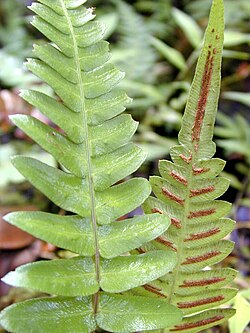
In the natural world, patterns often repeat themselves in strikingly beautiful ways. One such recurring motif is pinnation (sometimes spelled pennation). Derived from the Latin word pinna, meaning feather, wing, or fin, pinnation describes an arrangement where multi-divided features arise from both sides of a common central axis. This structural design is not limited to biology; it can also be observed in the growth of certain crystals and the complex patterns of erosion in stream beds.
To understand pinnation, it is helpful to distinguish it from similar geometric arrangements. While pectination refers to a comb-like structure where parts arise from only one side of an axis, and palmation describes structures radiating from a single central point, pinnation is defined by its bilateral, feather-like symmetry along a stem or axis.
Key Facts
- Etymology: The term comes from the Latin pinna, meaning feather or fin.
- Botanical Application: It describes leaves, veins, or branches arranged along a central axis (rachis).
- Variations: Patterns can be even (paripinnate) or odd (imparipinnate) based on the terminal leaflets.
- Complexity: Divisions can be iterated, such as bipinnate (twice-pinnate) or tripinnate (thrice-pinnate).
- Cross-Disciplinary: Pinnation occurs in botany, zoology, crystallography, and geomorphology.
Pinnation in Botany
In plant morphology, pinnation refers to the arrangement of discrete structures—such as leaflets, veins, or lobes—along a common axis known as a rachis. Plants exhibiting this trait are often colloquially referred to as "feather-leaved." This structure is a hallmark of many ferns, cycads, grevilleas, and certain palms, such as the feather palms.
Depth and Type of Leaf Divisions
Botanists use specific terminology to describe how deeply a leaf is divided and whether the segments are fully separated from one another:
- Pinnatifid and Pinnatipartite: The leaf has lobes that are not discrete; they remain connected to the main structure rather than being separate leaflets.
- Pinnatisect: The divisions cut all the way to the midrib or axis, but the bases of the segments are not contracted to form distinct leaflets.
- Pinnate-pinnatifid: A pinnate structure where the individual pinnae are themselves pinnatifid.
Classifying Leaf Complexity
The complexity of a pinnate leaf can be categorized by the number of divisions and the arrangement of the leaflets:
Number of DivisionsLeaflets can be arranged in different numerical patterns along the rachis:
- Paripinnate (Even-pinnate): Leaflets are borne in pairs along the axis, with no single leaflet at the very end.
- Imparipinnate (Odd-pinnate): The arrangement concludes with a single, lone terminal leaflet.
- Alternipinnate: An arrangement where leaflets are positioned alternately along the axis.
Some plants exhibit highly complex, multi-layered divisions. This is known as iteration:
- Unipinnate: A solitary compound leaf with a single row of leaflets along the rachis.
- Bipinnate (Twice-pinnate): The leaflets themselves are pinnately compound.
- Tripinnate (Thrice-pinnate): The leaflets are bipinnate.
- Tetrapinnate: The leaflets are tripinnate.
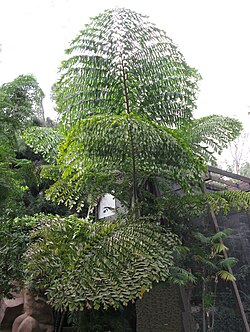
In these complex structures, the smallest ultimate divisions are sometimes called pinnules (the diminutive of pinna), though definitions of this term can vary among botanical authorities.
Pinnation in Other Fields
Zoology and Animal Morphology
Pinnation is not exclusive to the plant kingdom. In animals, it appears in various anatomical structures. For instance, certain muscles can be classified as unipinnate or bipinnate. Additionally, the fish Platax pinnatus is commonly known as the pinnate spadefish or pinnate batfish due to its distinctive shape.
Geomorphology and Crystallography
In the study of Earth's physical features, pinnation describes specific waterway systems. This occurs when major tributary streams enter main channels by flowing in a single direction at an oblique angle. Furthermore, the concept extends to the microscopic level in crystallography, where certain metal or ice crystals can form pinnate patterns.
Summary of Pinnation Terms
| Term | Description | Key Characteristic |
|---|---|---|
| Paripinnate | Even-pinnate | Leaflets in pairs; no terminal leaflet |
| Imparipinnate | Odd-pinnate | Ends with a single terminal leaflet |
| Bipinnate | Twice-pinnate | Leaflets are themselves pinnately compound |
| Pinnatifid | Lobed | Lobes are not discrete leaflets |
| Pinnatisect | Deeply cut | Cut to the axis but bases are not contracted |
Frequently Asked Questions
What is the difference between pinnation and palmation?
Pinnation refers to structures arranged along a central axis like a feather, whereas palmation refers to structures that radiate outward from a single common point, similar to the fingers on a palm.
What does it mean if a leaf is bipinnate?
A bipinnate leaf is "twice-pinnate," meaning the leaflets attached to the main stem are themselves divided into smaller leaflets in a pinnate pattern.
Is there a difference between pinnation and pennation?
No. The terms pinnation and pennation are cognates. While they are sometimes used distinctly in specific contexts, there is no consistent difference in their meaning or usage.
How does pinnation appear in geomorphology?
In geomorphology, pinnation describes a drainage pattern where tributary streams enter a main channel at an oblique angle, all flowing in the same direction.
What are pinnae?
In botany, specifically regarding ferns, the leaflets or segments of a pinnate frond are typically referred to as pinnae.