Perth Railway Station: A Hub of Scottish Rail History and Connectivity
Perth railway station serves as a vital transport artery for the city of Perth, Scotland. Strategically positioned in Perth and Kinross, the station acts as a critical junction where the Glasgow–Dundee line meets the Highland Main Line. Managed by ScotRail, the station facilitates travel across the Scottish Highlands and connects the region to major urban centers including Glasgow, Edinburgh, and London.
The station is located 140 km (86 miles 77 chains) from Edinburgh Waverley via Kirkcaldy and Inverkeithing, and 243.5 km (151 miles 25 chains) from Carlisle via Stirling, Cumbernauld, and Motherwell.
Key Facts
- Opened: 22 May 1848 as Perth General Station.
- Management: Currently managed by ScotRail.
- Infrastructure: Features 7 active platforms and is a Category B Listed Building.
- Connectivity: Serves as a gateway to Inverness, Aberdeen, Dundee, Glasgow, and London.
- Recent Usage: Recorded 0.853 million entries and exits in the 2024/25 period.
Historical Evolution
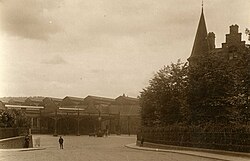
Designed by architect William Tite, the station opened in 1848 as Perth General Station under the Scottish Central Railway (SCR). It quickly evolved from a terminus into a significant junction with the arrival of the Dundee and Perth Railway, the Edinburgh and Northern Railway (E&NR), and the Scottish Midland Junction Railway (SMJR). These connections provided travelers with efficient access to Scotland's major cities by 1856.
Over the decades, ownership shifted through various entities, including the Caledonian Railway, the London Midland and Scottish Railway, and eventually nationalization. The station's layout was influenced by the competing interests of the North British Railway (NBR) and the Caledonian Railway, leading to the development of multiple routes to Edinburgh.
Closures and Route Changes
The mid-20th century brought significant changes. The Almond Valley line to Crieff and Methven closed in 1951, followed by the Ladybank service in 1955. The 1960s "Beeching Axe"—a series of large-scale railway closures—led to the loss of the main line to Aberdeen via Forfar in 1967.
One of the most controversial changes occurred on 5 January 1970, when the direct line to Edinburgh via Glenfarg was closed to make way for the M90 motorway. Although the route was recommended for retention, its closure forced passengers onto a longer route via Stirling. Due to public unpopularity, the line to Ladybank was reopened in 1975, serving as the primary route for most Edinburgh services today.
Station Layout and Facilities
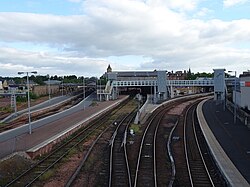
The station currently operates seven platforms, divided into two distinct functional areas:
- Platforms 1 and 2: Located on the eastern side, these handle services between Glasgow Queen Street, Dundee, and Aberdeen.
- Platform 3: A through platform that accommodates some terminating services from the south and access from the Highland Main Line.
- Platforms 4–7: Situated under the main train shed in an H-shaped island configuration. Platforms 4 and 7 are the long outer platforms, while 5 and 6 serve as southern bays.
Modern Connectivity and Access
For passengers using multi-modal transport, the Perth bus station is conveniently located approximately 100 meters northeast of the railway station along Leonard Street (A989).
Passenger Traffic and Services
Passenger numbers have shown a steady recovery and growth following the 2020/21 dip. The station is served by three primary operators: ScotRail, London North Eastern Railway (LNER), and the Caledonian Sleeper.
| Year | Entries & Exits (Millions) | Interchanges |
|---|---|---|
| 2020/21 | 0.181 | 15,491 |
| 2021/22 | 0.615 | 56,960 |
| 2022/23 | 0.695 | 118,969 |
| 2023/24 | 0.812 | 99,349 |
| 2024/25 | 0.853 | 110,940 |
Current Service Frequencies
ScotRail provides the bulk of the regional connectivity, offering approximately 2 trains per hour (tph) to Glasgow Queen Street and 1 tph each to Edinburgh Waverley, Aberdeen, Dundee, and Inverness. Long-distance travel is supported by LNER (The Highland Chieftain) and the Caledonian Sleeper, both providing daily services to and from London.
Cultural Impact and Controversy
The station's historic architecture has made it a desirable filming location; scenes for the movie The Railway Man were shot here, with platforms 3 and 5 doubling as Crewe and Edinburgh Waverley.
However, the station has not been without criticism. In 2015, it was nominated for the Carbuncle Award—which highlights poor planning decisions—due to the installation of a modern footbridge. Critics argued the "off-the-shelf" structure clashed with the Victorian surroundings and was an inefficient use of funds.
Frequently Asked Questions
Which train companies operate out of Perth station?
The station is primarily served by ScotRail, with additional long-distance services provided by London North Eastern Railway (LNER) and the Caledonian Sleeper.
What is the station's architectural status?
Perth railway station is designated as a Category B Listed Building, recognized for its historical and architectural significance.
How do I get to the bus station from the railway station?
The Perth bus station is located about 100 meters northeast of the railway station along Leonard Street.
Why was the Glenfarg route to Edinburgh closed?
The route was abandoned on 5 January 1970 to allow the alignment of the M90 motorway to be constructed through the Glenfarg area.
Which platforms serve the Highland Main Line?
The Highland Main Line begins at the northern end of the station, where disused bay platforms are now used as sidings for fueling trains.