Personal Weather Stations: Monitoring Local Climate Data
A personal weather station is a collection of meteorological instruments operated by private individuals, clubs, associations, or businesses. These systems are intended for those who wish to track local weather conditions, provided that the collection and distribution of this data is not the primary business operation of the entity.
Modern weather stations have evolved into sophisticated tools, offering a wide array of sensors that allow users to monitor their immediate environment with precision. From simple home setups to advanced customizable arrays, these stations bridge the gap between professional meteorology and hobbyist observation.
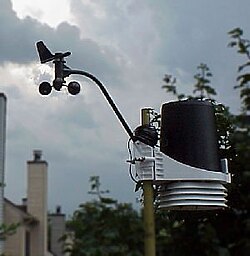
Key Facts
- Operated by non-professional entities for education, enjoyment, or community sharing.
- Commonly measure wind, temperature, humidity, pressure, and rainfall.
- Data is typically managed via a digital console and can be uploaded to global networks.
- Accuracy varies significantly based on the quality of instruments and their placement.
- Open-source options exist for users who want full customization of their hardware and software.
Components and Capabilities
The capabilities of a personal weather station depend largely on the model selected. Most standard retail stations include sensors for the following metrics:
- Wind Speed and Direction: Tracking the movement and velocity of air.
- Temperature and Humidity: Measuring both indoor and outdoor thermal conditions and moisture levels.
- Barometric Pressure: Monitoring atmospheric pressure to help predict weather changes.
- Precipitation: Measuring rainfall amounts.
- Radiation: Tracking UV or solar radiation levels.
Specialized Sensors
For those with specific needs, such as gardening or agricultural research, additional sensors are available. These can measure soil moisture, soil temperature, and leaf wetness, providing a more granular view of the local ecosystem.
Data Management and Distribution
Most stations utilize a digital console to provide real-time readouts. These consoles often interface with personal computers, enabling users to store data locally or upload it to external ingestion and distribution systems.
Sharing Weather Data
Many enthusiasts choose to share their findings with the wider community. This can be done manually, via the internet, or through amateur radio. Several established platforms facilitate this exchange:
- Citizen Weather Observer Program (CWOP): A service that allows users to submit data via software and the internet (or amateur radio). This data is used by organizations like the National Weather Service (NWS) to improve forecast models.
- Weather Underground: A popular global site where users can submit data and maintain a unique web page for their station.
- Weather Observations Website (WOW): A platform operated by the UK Met Office for sharing and displaying local observations.
| Sensor Type | What it Measures | Availability |
|---|---|---|
| Anemometer/Vane | Wind speed and direction | Standard |
| Hygrometer/Thermometer | Temperature and humidity | Standard |
| Barometer | Atmospheric pressure | Standard |
| Rain Gauge | Precipitation levels | Standard |
| Soil Sensors | Moisture, temperature, leaf wetness | Specialized |
Frequently Asked Questions
Who can operate a personal weather station?
They can be operated by private individuals, clubs, associations, or businesses, as long as the distribution of weather data is not the entity's primary business operation.
How is the data from these stations used by professionals?
Data submitted through programs like CWOP is utilized by groups such as the National Weather Service (NWS) to help generate more accurate forecast models.
Can I customize my own weather station?
Yes, there are open-source weather stations available that are specifically designed to be fully customizable by the user.
Why does the accuracy of personal weather stations vary?
Accuracy is influenced by the quality of the instruments used, the number of sensors installed, and the specific placement of the station in its environment.
Which platforms allow me to share my weather data online?
Popular platforms include the Citizen Weather Observer Program (CWOP), Weather Underground, and the UK Met Office's Weather Observations Website (WOW).