People's Revolutionary Army: The Rise and Fall of Argentina's ERP
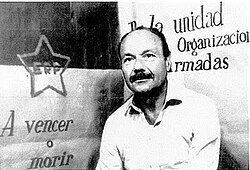
The People's Revolutionary Army (Ejército Revolucionario del Pueblo, or ERP) was a far-left guerrilla organization that operated in Argentina from March 30, 1969, to December 24, 1981. Driven by a blend of Marxism-Leninism, Maoism, and Guevarism—the revolutionary theory of Che Guevara—the ERP sought to overthrow the Argentine government to establish "proletarian rule" through a communist revolution.
The group utilized Foco theory, which posits that a small, fast-moving paramilitary group can provide the spark (foco) to ignite a general uprising. Their campaign was characterized by a dual strategy: urban guerrilla warfare in Buenos Aires and rural insurgency in the Tucumán province.
Key Facts
- Active Period: 1969–1981.
- Primary Leaders: Mario Roberto Santucho, Benito Urteaga, and Enrique Gorriarán Merlo.
- Ideology: Far-left (Marxism-Leninism, Maoism, Guevarism, and Trotskyist factions).
- Peak Strength: Approximately 400-500 members by 1975.
- Major Operations: Kidnappings for ransom, attacks on military barracks, and rural territorial control in Tucumán.
Origins and Urban Warfare
The ERP began its campaign in 1969 against the military dictatorship of Juan Carlos Onganía. The organization specialized in targeted urban strikes, including the assassination of government officials and the kidnapping of foreign executives to fund their operations.
One of their most high-profile operations occurred in 1973, when Enrique Gorriarán Merlo and Benito Urteaga kidnapped Victor Samuelson, an executive for the oil company Esso (later Exxon). Samuelson was held for 144 days and released only after a record ransom of $14.2 million was paid. The ERP also employed an elite "Special Squad" to assault corporate offices and government installations.
Official records from Crónica de la subversión en la Argentina suggest the scale of their activity was vast, claiming that rural guerrillas occupied 52 towns, robbed 166 banks, and secured $76 million in ransoms from 185 kidnappings.
Escalation and Military Confrontations
Even after the return to civilian rule under Juan Perón in 1973, the ERP continued its violent campaign. Their tactics evolved to include direct assaults on police stations, military convoys, and prisons. In September 1971, they successfully took over the Villa Urquiza Prison in Tucumán, liberating 14 fighters while killing five guards.
The violence intensified throughout the mid-1970s. In January 1974, the Compañía Héroes de Trelew attacked the Azul barracks, resulting in the death of Colonel Camilo Arturo Gay and his wife. However, the ERP also suffered significant losses. An August 1974 assault on the Villa Maria explosives factory and the 17th Airborne Infantry Regiment resulted in the deaths of 16 guerrillas after they surrendered to paratroopers.
The most dramatic confrontation occurred in December 1975 during the "Christmas offensive." Approximately 1,000 ERP and Montoneros militants attacked the Domingo Viejobueno army supply base at Monte Chingolo. The assault failed, leaving 63 ERP members dead.
The Tucumán Campaign and Operacion Independencia
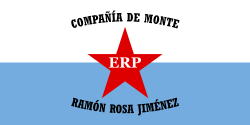
In the rural northwest, the ERP established a significant presence in Tucumán. Led by Mario Roberto Santucho, the group controlled roughly one-third of the province, supported by a network of 2,500 sympathizers. Evidence suggests the group received international support; Cuban leader Fidel Castro later admitted to promoting revolutions across South America, and some reports indicate the presence of foreign mercenaries in the "Ramón Rosa Jiménez" Mountain Company.
In response, the government of Isabel Perón issued "annihilation decrees" in February 1975, granting the military expanded powers. This led to Operacion Independencia, a counter-insurgency campaign led by Brigadier-General Acdel Vilas. The military deployed thousands of troops, including the 5th Mountain Infantry Brigade, and utilized A-4B Skyhawk fighters and B.62 Canberra bombers for air support.
General Vilas employed search-and-destroy missions and state terror tactics to dismantle the ERP's urban support networks. By October 1975, the ERP's headquarters staff in the region were largely killed or dispersed, effectively breaking the rural insurgency.
The Path to the Dirty War and Aftermath
The persistence of guerrilla activity—including the bombing of the Argentine Army headquarters in December 1975 and the damaging of the destroyer Santísima Trinidad by Montoneros divers—convinced many junior military officers that the civilian government was too weak. This sentiment paved the way for the rise of Lieutenant-General Jorge Videla and the subsequent military coup.
Following the defeat of the left-wing movements in Argentina, some cadres fled to Nicaragua. Enrique Gorriarán Merlo and a team of veterans were involved in the 1980 assassination of the Nicaraguan ex-dictator Anastasio Somoza. Merlo eventually returned to Argentina in 1987 to lead the Movimiento Todos por la Patria (MTP).
| Category | Details |
|---|---|
| Primary Goal | Communist revolution and proletarian rule |
| Key Tactics | Kidnappings, urban assassinations, rural insurgency |
| Major Financial Gain | $14.2 million ransom from Exxon (Victor Samuelson) |
| Critical Defeat | Battle of Monte Chingolo (December 1975) |
| Military Response | Operacion Independencia and "annihilation decrees" |
Frequently Asked Questions
What was the primary ideology of the ERP?
The ERP followed a far-left ideology combining Marxism-Leninism, Maoism, and Guevarism, with some factions incorporating Trotskyist views. Their ultimate goal was to establish a communist state in Argentina.
Who were the main leaders of the People's Revolutionary Army?
The organization was led by Mario Roberto Santucho, Benito Urteaga, and Enrique Gorriarán Merlo.
What was the significance of the Monte Chingolo attack?
The attack on the Monte Chingolo barracks in December 1975 was one of the largest guerrilla operations in Argentine history. Its failure resulted in heavy losses for the ERP and contributed to the military's perception that the civilian government could not maintain order.
How did the Argentine military defeat the ERP in Tucumán?
Through Operacion Independencia, the military used a combination of large-scale troop deployments, air support, and state terror tactics to dismantle the ERP's rural bases and urban support networks.
Did the ERP receive international support?
Yes, Fidel Castro admitted that Cuba attempted to promote revolutions throughout South America. Additionally, there are claims that mercenaries from Jordan, Nicaragua, and Angola served in the ERP's Mountain Company.