Penalty Area: Rules, Dimensions, and Functions in Association Football
In association football, the penalty area—commonly referred to as the 18-yard box or simply "the box"—is one of the most critical zones on the pitch. This rectangular region surrounding each goal governs key rules regarding player conduct, goalkeeper privileges, and the awarding of penalty kicks. Understanding the precise boundaries and functions of this area is essential for grasping the strategic flow of the game.
Dimensions and Layout
The penalty area is a large rectangle that extends 18 yards (16.5 m) from each goalpost to the sides and 18 yards (16.5 m) out into the field of play from the goal line. According to the rules, if any part of the ball is over any part of the line demarking the area, the ball is considered to be inside the penalty area.
Within this larger box, there are several specific markings:
- The Penalty Spot: A mark located 12 yards (11.0 m) from the goal line, positioned directly in line with the center of the goal.
- The Goal Area: Also known as the "six-yard box," this smaller rectangle extends 6 yards (5.5 m) from the goalposts and 6 yards (5.5 m) into the pitch.
- The Penalty Arc: Often called "the D," this arc adjoins the penalty area and encloses a 10-yard (9.1 m) radius around the penalty spot. It is important to note that the arc is not part of the penalty area itself.
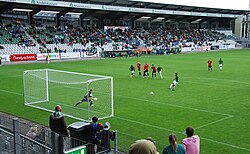
Key Facts
- The penalty area extends 18 yards from the goal line and goalposts.
- The penalty spot is positioned exactly 12 yards from the goal line.
- The goal area (six-yard box) is used for goal kicks and defensive free kicks.
- The penalty arc is used to prevent encroachment during penalty kicks.
- Penalty areas were reduced to their current dimensions in 1901.
Functions and Regulatory Rules
The penalty area serves several regulatory purposes that dictate how the game is officiated:
Penalty Kicks and Fouls
If the defending team commits a foul punishable by a direct free kick (such as handling the ball or most physical fouls) within their own penalty area, the attacking team is awarded a penalty kick taken from the penalty spot.
Goalkeeper Privileges
The penalty area defines the legal boundary in which a goalkeeper is permitted to handle the ball with their hands.
Restarts and Free Kicks
The goal area plays a specific role in restarts. Goal kicks and free kicks taken by the defending team can be played from anywhere within the six-yard box. Conversely, indirect free kicks awarded to the attacking team inside the goal area must be taken from the line parallel to the goal line (the six-yard line) nearest to where the foul occurred.
Player Positioning
During a penalty kick, all players except the kicker and the goalkeeper must remain outside both the penalty area and the penalty arc until the ball is struck. Additionally, during goal kicks or defensive free kicks, opponents must stay outside the area and at least 10 yards away from the ball until it is in motion.
The Penalty Area in Active Play
For much of a match, the penalty area is occupied solely by the goalkeeper. However, the attacking team's primary objective is often to move the ball and their players into this zone, as a vast majority of professional goals are scored from within the box. Research indicates that goal-scoring patterns vary, with some studies showing up to 87% to 90% of goals occurring inside the penalty area in major tournaments like the English Premier League or the World Cup.
During set pieces, such as corners, the area becomes crowded with both attackers and defenders. While illegal, physical grappling between players is frequently observed in these high-pressure situations.
| Feature | Dimensions (Yards) | Dimensions (Meters) | Primary Purpose |
|---|---|---|---|
| Penalty Area | 18 x 18 yd | 16.5 x 16.5 m | Goalkeeper handling & penalty fouls |
| Goal Area | 6 x 6 yd | 5.5 x 5.5 m | Goal kicks & defensive free kicks |
| Penalty Spot | 12 yd from goal | 11.0 m from goal | Location for penalty kicks |
| Penalty Arc | 10 yd radius | 9.1 m radius | Preventing encroachment |
Frequently Asked Questions
Is the penalty arc part of the penalty area?
No, the penalty arc (the D) is not part of the penalty area. Its sole purpose is to ensure players remain the required distance from the penalty spot during a penalty kick.
What happens if a foul occurs inside the goal area?
If the defending team commits a direct free kick foul, a penalty kick is awarded. If the attacking team is awarded an indirect free kick within the goal area, it must be taken from the six-yard line nearest to the infringement.
When is a ball considered "inside" the penalty area?
A ball is considered inside the penalty area if any part of the ball is over any part of the line that demarks the area.
Where can a goalkeeper handle the ball?
A goalkeeper may legally handle the ball only within the boundaries of their own penalty area.
How has the penalty area changed over time?
Historically, penalty areas extended across the full width of the field, but they were reduced to their current rectangular dimensions in 1901.