Pedro Bonifacio Palacios: The Life and Legacy of Almafuerte
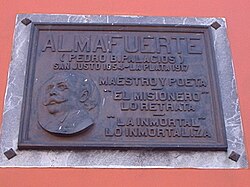
Pedro Bonifacio Palacios, widely recognized by his evocative pseudonym Almafuerte (meaning "strong soul"), was a towering figure in Argentine literature. A man of diverse talents, he navigated a tumultuous life as a poet, teacher, journalist, and translator, leaving behind a body of work that reflected both his personal struggles and his critical view of the society around him.
Key Facts
- Birth: May 13, 1854, in San Justo, Argentina.
- Death: February 28, 1917, in La Plata, Argentina.
- Pseudonym: Almafuerte ("strong soul").
- Primary Roles: Poet, educator, journalist, and translator.
- Notable Works: Lamentaciones (1906) and Evangélicas (1915).
- Political Role: First President of the Civic Union Committee (founded 1890).
Early Life and Career Transitions
Born into a humble family in San Justo, a western suburb of Buenos Aires, Palacios faced significant hardship from a young age. After losing his mother and being abandoned by his father, he was raised by relatives. His initial professional aspirations were in the arts; he began his career as a painter. However, when the government denied him a grant to study in Europe, he pivoted his focus toward writing and education.
His rise in education was rapid. At just 16 years old, he was appointed as the director of a school in the then-rural area of Chacabuco.
Political Conflict and Professional Struggles
Palacios's career was frequently interrupted by his political convictions. In 1884, following a meeting with former President Domingo Faustino Sarmiento, he was dismissed from his position as school director. While the official reason cited a lack of a teaching degree, it is widely believed that his dismissal was a result of his poems, which were highly critical of the government.
Despite these setbacks, Palacios remained active in public life. He was elected to the Buenos Aires Province Chamber of Deputies and served as a translator and librarian for the Provincial Statistical Bureau. In 1887, he relocated to La Plata, where he joined the newspaper El Pueblo as a journalist.
His leadership skills were further recognized in 1890 when he became the first President of the Civic Union Committee. Though he returned to teaching near Trenque Lauquen in 1894, he was once again removed from his post two years later due to political reasons.
Later Years and Literary Contribution
As the 20th century began, Palacios engaged briefly in active politics. However, his lack of economic stability and his refusal to accept official political appointments limited his enthusiasm for the field. In his final years, the Argentine National Congress granted him a pension, allowing him to devote his remaining energy entirely to his poetry.
Palacios passed away on February 28, 1917, in La Plata at the age of 63, following a period of deteriorating health.
Major Published Works
Writing under various pseudonyms—most notably Almafuerte—Palacios produced a significant volume of work. His bibliography includes:
- Lamentaciones (1906)
- Evangélicas (1915)
- Poesías (1917)
- Nuevas Poesías (1918)
- Milongas clásicas, sonetos medicinales y Dios te salve. Discursos (1919)
- Other notable titles: La inmortal, El misionero, Trémolo, Cantar de los cantares, and La sombra de la patria.
Summary of Palacios's Life
| Category | Details |
|---|---|
| Lifespan | 1854–1917 (63 years) |
| Key Locations | San Justo, Chacabuco, La Plata |
| Professional Versatility | Painting, Teaching, Journalism, Politics, Poetry |
| Political Affiliation | Civic Union Committee (President) |
| Cultural Legacy | Subject of the 1949 film Almafuerte by Luis César Amadori |
Frequently Asked Questions
What does the name "Almafuerte" mean?
Almafuerte is a Spanish sobriquet meaning "strong soul," which Pedro Bonifacio Palacios used as his most famous pseudonym.
Why was Palacios dismissed from his teaching positions?
He was dismissed twice; the first time in 1884 officially for lacking a teaching degree, though it is believed his government-critical poetry played a role, and the second time in 1896 for political reasons.
What were some of his most important literary works?
His most prominent published collections include Lamentaciones (1906), Evangélicas (1915), and Poesías (1917).
Did Palacios have a career outside of writing?
Yes, he was a painter in his youth, a school director, a member of the Buenos Aires Province Chamber of Deputies, a librarian, a translator, and a journalist.
How was his life commemorated in cinema?
His life was dramatized in the 1949 Argentine film titled Almafuerte, directed by Luis César Amadori.