Pedanius Dioscorides: The Father of Pharmacognosy
For nearly two millennia, the study of medicinal plants was guided by the wisdom of a single man. Pedanius Dioscorides, a Greek physician and botanist active in the 1st century AD, authored a work so foundational that it served as the primary medical authority in the West for over 1,500 years. Often referred to as the "father of pharmacognosy"—the study of medicinal drugs derived from plants or other natural sources—his observations bridged the gap between ancient tradition and modern science.
The Life of a Physician-Soldier
Born around 40 AD in Anazarbus, located in the Cilicia region of Asia Minor, Dioscorides likely received his medical training in nearby Tarsus. This school was known for its specific emphasis on pharmacology, the branch of medicine concerned with the uses of drugs. His writings suggest he lived a "soldier-like life," likely serving as an army physician during his travels. While he moved through various regions, his botanical observations focus primarily on plants found within the Greek-speaking eastern Mediterranean.
The name "Pedanius" is Roman in origin, which suggests that he may have been sponsored by an aristocrat of that name to achieve Roman citizenship. This connection highlights the intersection of Greek scientific thought and Roman administrative life during his era.
De Materia Medica: A Medical Revolution
Between 50 and 70 AD, Dioscorides composed his masterpiece, De materia medica (meaning "On Medical Material"). This five-volume encyclopedic pharmacopeia—a collection of medicinal substances and their uses—became the precursor to all modern pharmaceutical references. Unlike many other classical texts, Dioscorides' work was never "lost" and subsequently rediscovered during the Renaissance; instead, it remained in continuous circulation, eventually eclipsing the works of Hippocrates in the realm of plant-based medicine.
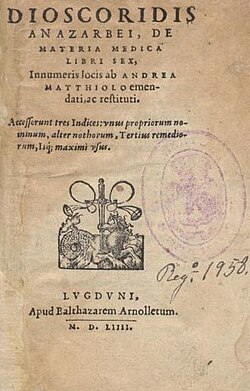
The work was incredibly diverse, documenting approximately 600 different plants. Dioscorides did not just list Greek names; he recorded the Dacian, Thracian, Roman, ancient Egyptian, and North African (Carthaginian) names for various species, preserving linguistic knowledge that might otherwise have been lost to history. While some of his descriptions were occasionally obscure, leading to identification challenges for medieval scholars, his empirical approach—based on observation and trial and error—ensured its long-term accuracy.
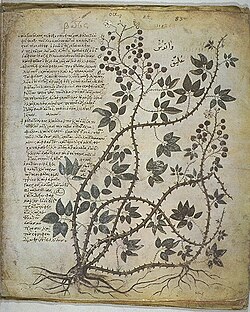
The survival of his work is owed to a rich tradition of manuscript production. Throughout the medieval period, De materia medica was translated into Latin and Arabic, often supplemented by commentaries from scholars such as Ibn al-Baitar. One of the most significant surviving versions is the Vienna Dioscurides, a lavishly illustrated manuscript produced in Constantinople around 512/513 AD.
A Lasting Scientific Legacy
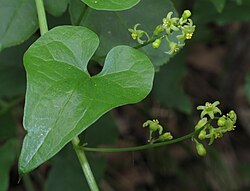
The influence of Dioscorides extends far beyond the ancient world. His empirical methods provided a stable foundation for European medicine through the 19th century. Even today, his name is immortalized in the biological world. The plant genus Dioscorea, which includes various species of the yam, was named in his honor by the scientist Linnaeus. Additionally, the bush hopper butterfly, Ampittia dioscorides, carries his name.
Key Facts
- Full Name: Pedanius Dioscorides
- Lifespan: Approximately 40–90 AD
- Primary Occupation: Army physician, botanist, and pharmacologist
- Major Work: De materia medica (5 volumes)
- Scientific Contribution: Known as the "father of pharmacognosy"
- Botanical Legacy: The genus Dioscorea is named after him
| Category | Details |
|---|---|
| Origin | Anazarbus, Cilicia, Asia Minor |
| Key Text | De materia medica |
| Plant Count | Approximately 600 plants |
| Historical Impact | Core of European pharmacopeia until the 19th century |
Frequently Asked Questions
Who was Pedanius Dioscorides?
Dioscorides was a Greek physician, botanist, and pharmacologist who lived in the 1st century AD. He is most famous for his extensive writings on medicinal plants.
What is the significance of De materia medica?
It is a five-volume encyclopedia of herbal medicine that served as the primary authority on medicinal substances for over 1,500 years and acted as the precursor to modern pharmacopeias.
Why is he called the "father of pharmacognosy"?
He earned this title because his systematic study and documentation of medicinal plants provided the foundational knowledge for the science of pharmacognosy (the study of medicines derived from natural sources).
How did his work survive through the Middle Ages?
His work remained in constant use and was translated into Latin and Arabic. It was also frequently supplemented with new commentaries and illustrated in famous manuscripts like the Vienna Dioscurides.
What is the connection between Dioscorides and the yam?
The plant genus Dioscorea, which contains various species of the yam, was named after him by the botanist Linnaeus to honor his contributions to botany.