PBS NewsHour: A Legacy of Public Service Journalism
For nearly five decades, PBS NewsHour has served as a cornerstone of American public broadcasting, providing in-depth analysis and comprehensive reporting. Since its inception in 1975, the program has evolved from a half-hour report into a sprawling news operation known for its commitment to accuracy, fairness, and a refusal to prioritize entertainment over information.
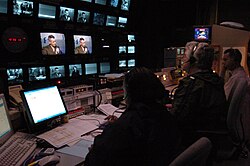
The program is produced at the WETA-TV studios in Arlington County, Virginia, and is broadcast across the PBS network. Over the years, it has navigated numerous branding shifts and leadership transitions to remain a trusted source of news in an increasingly fragmented media landscape.

Key Facts
- Launch Date: October 20, 1975.
- Founders: Robert MacNeil, Jim Lehrer, and Lester Crystal.
- Current Anchors: Amna Nawaz and Geoff Bennett.
- Production Hub: WETA-TV studios, Arlington County, Virginia.
- Format: 60-minute weekday editions; 30-minute weekend editions.
- Core Philosophy: A strict adherence to editorial guidelines that prioritize objectivity and the separation of news from opinion.
Evolution of the Program
The program's history is marked by several distinct eras, reflecting the changing nature of broadcast news. It began as The Robert MacNeil Report (1975–1976) before expanding into The MacNeil/Lehrer Report (1976–1983). In 1983, the show transitioned to a 60-minute format and became The MacNeil/Lehrer NewsHour.
Following Robert MacNeil's departure in 1995, the show was rebranded as The NewsHour with Jim Lehrer. Jim Lehrer remained the face of the program until 2009, after which the show moved toward a co-anchor model to modernize its presentation.
Expansion and Modernization
From 2013 onward, the program expanded its reach significantly. This included the launch of PBS NewsHour Weekend (later PBS News Weekend) and a specialized western edition known as PBS News Hour West, which operated from 2019 to 2025.
In June 2024, the news division adopted a new branding name, PBS News, to unify its digital, social media, and broadcast platforms.

Editorial Standards and Ethics
What distinguishes PBS NewsHour from its commercial competitors—such as ABC World News Tonight, NBC Nightly News, and CBS Evening News—is its rigorous set of editorial guidelines. These principles serve as a moral compass for its journalists:
- Objectivity: Assume there is at least one other side or version to every story.
- Integrity: Do nothing that cannot be defended.
- Privacy: Treat personal lives as private matters unless a legitimate turn in the story mandates otherwise.
- Transparency: Clearly label and separate opinion and analysis from straight news.
- Sourcing: Avoid anonymous sources or blind quotes except on rare and monumental occasions.
Staff and Contributors
The program relies on a diverse team of anchors and correspondents. Current weekday anchors include Amna Nawaz and Geoff Bennett, supported by a team of specialists such as Nick Schifrin (foreign affairs and defense) and Miles O'Brien (science and aviation).
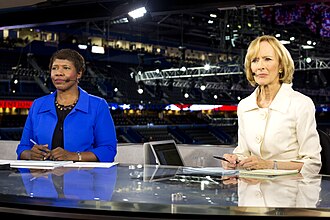
The show also integrates political analysis from respected voices across the spectrum, including David Brooks of The Atlantic and Jonathan Capehart of MS NOW, ensuring that viewers receive a balanced perspective on government affairs.
Regional Reach
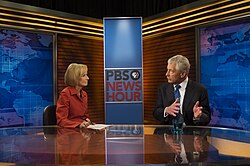
To better serve the United States' diverse geography, the program launched PBS News Hour West. This edition allowed for more focused coverage of Western regional issues, anchored by Stephanie Sy until December 2025.

Program Summary
| Feature | Details |
|---|---|
| Original Release | October 20, 1975 |
| Production Companies | WNET (1975–1995), WETA-TV (1995–Present), NewsHour Productions |
| Weekday Runtime | 60 Minutes |
| Weekend Runtime | 30 Minutes |
| Network | PBS |
Frequently Asked Questions
Who are the current anchors of PBS NewsHour?
The current weekday anchors are Amna Nawaz and Geoff Bennett.
How does PBS NewsHour differ from commercial news networks?
Unlike many commercial networks, PBS NewsHour follows strict editorial guidelines that prohibit the use of anonymous sources in most cases and mandate a clear separation between news reporting and opinion analysis.
Where is the program produced?
The program is produced at the WETA-TV studios located in Arlington County, Virginia.
What was the original name of the program?
The program first debuted in 1975 as The Robert MacNeil Report.
Does the program have weekend editions?
Yes, the program produces weekend editions, which have been branded as PBS NewsHour Weekend and later PBS News Weekend.