Partlets: The Versatile Neckwear of 16th-Century Fashion
In the landscape of 16th-century European attire, few accessories were as adaptable as the partlet. A sleeveless garment designed to cover the neck and shoulders, the partlet served a dual purpose: it could be worn over a dress for modesty or used to fill in the plunging low necklines characteristic of the era's style.
The Evolution and Origins of the Partlet
The earliest iterations of the partlet appeared in European fashion during the late 15th century. Historical records, including comments on a miniature from approximately 1485, highlight a Flemish style of partlet during this period. While the garment existed earlier, the English term "partlet" is documented as far back as 1515.
The origin of the word remains uncertain, though some historians suggest it may derive from "Dame Partlet," a traditional name for a hen, possibly referencing the ruffle of feathers found on a hen's neck.
Materials and Gender in Early 16th-Century Style
As the fashion grew in popularity, specialized partlet makers emerged. These artisans produced garments primarily from silk or linen. Initially, partlets were not exclusive to women; they were worn by both men and women to fill the low necklines of Burgundian dress. Men continued to utilize partlets, often crafted from rich materials, to complement the low-cut doublets of the early 1500s.
For women, the early 16th century saw a wide array of colors and fabrics, though black remained the most popular choice. Upper-class women frequently wore black partlets made of velvet or satin over their gowns. This trend is evidenced in a June 1538 wardrobe warrant for Princess Mary, which specified black velvet for a "French partlet."
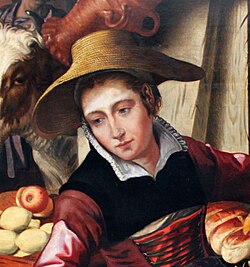
These garments are well-documented in art. The works of Hans Holbein the Younger, who worked in England between 1526 and approximately 1540, frequently depict Tudor court ladies in black partlets. Similarly, Dutch painters throughout the 16th century captured market women wearing these accessories.
Elizabethan Elegance and Elaborate Craftsmanship
As fashion evolved into the Elizabethan era, partlets became more refined. Fine versions were crafted from linen lawn (a lightweight, plain-weave fabric) and featured small standing collars and ruffles. These could be worn over a kirtle or directly over a low-necked smock.
The "Pelican Portrait" of Elizabeth I illustrates the Elizabethan preference for matching partlets and sleeves adorned with blackwork embroidery (a technique using black silk thread on white linen). Such matching sets were highly prized and often given as New Year's gifts to the queen. For instance, in 1562, Lady Cobham presented the queen with a partlet and pair of sleeves made of sypers and worked with silver and black silk.
Luxury and "Caulle Fashion"
At the height of luxury, partlets became canvases for goldsmiths. Some featured elaborate lattice-work decorated with gold, pearls, and jewels, a style known in England as "Caulle fashion." A notable example is seen in the portrait of Eleanor of Toledo (1522-1562) by Bronzino.
The maintenance and updating of these garments were significant undertakings. In 1563, Alice Montague, the queen's silkwoman, employed a specialist to "alter and translate" the queen's partlets. By 1568, Elizabeth I tasked her "Mistress Launder" with translating her partlets using 520 pearls, each costing a penny.
Key Facts
- Function: A sleeveless garment used to cover the neck and shoulders or fill low necklines.
- Timeline: Appeared in late 15th-century Europe; English term attested by 1515.
- Common Materials: Linen, silk, velvet, satin, and linen lawn.
- Popular Colors: Black was the most prevalent color for women's partlets.
- Gender: Worn by both men (with doublets) and women.
- High-End Decor: Decorated with blackwork embroidery, gold, jewels, and pearls.
| Style/Era | Typical Materials | Key Features |
|---|---|---|
| Early 16th Century (Upper Class) | Black velvet or satin | Worn over the gown for modesty/style |
| Elizabethan | Linen lawn | Standing collars, ruffles, and blackwork |
| Caulle Fashion | Lattice-work, gold, pearls | Jeweled embellishments by goldsmiths |
| Men's Burgundian/Early 16th C. | Rich silks and linens | Worn with low-cut doublets |
Frequently Asked Questions
What exactly was a partlet?
A partlet was a sleeveless accessory worn around the neck and shoulders in the 16th century. It was used either to fill in low necklines for modesty or as an ornamental layer over a dress.
Did men wear partlets?
Yes, men wore partlets, particularly during the early 16th century. They were typically made of rich materials and worn with low-cut doublets.
What was "blackwork" in the context of partlets?
Blackwork refers to a style of embroidery using black silk thread on white fabric, which was a popular fashion for matching partlets and sleeves during the Elizabethan era.
What was "Caulle fashion"?
Caulle fashion referred to the use of elaborate lattice-work partlets that were decorated by goldsmiths with precious metals, jewels, and pearls.
Where does the name "partlet" come from?
While the origin is uncertain, it may be derived from "Dame Partlet," a traditional name for a hen, likely referring to the ruffle of feathers on a hen's neck.