Paris Peace Accords: The Complex Path to Ending the Vietnam War
The road to peace in Vietnam was not a straight line, but a grueling series of diplomatic deadlocks, secret channels, and geopolitical maneuvering. The Paris Peace negotiations sought to resolve a conflict born from the division of Vietnam at the 17th parallel following the First Indochina War in 1954. While the North, under the Democratic Republic of Vietnam, sought unification under a communist model, the South, led by the pro-Western State of Vietnam, resisted, eventually drawing the United States into a protracted Cold War struggle.
Key Facts
- Official Signing: The accords were signed on January 27, 1973, at the Hotel Majestic in Paris.
- Primary Negotiators: Key figures included US National Security Advisor Henry Kissinger and North Vietnamese representative Lê Đức Thọ.
- Major Concession: The US agreed to a "cease-fire in place," allowing US withdrawal without requiring North Vietnamese troops to leave the South.
- Military Pressure: Operation Linebacker II was launched in December 1972 to force a final agreement.
- Key Deadlock: Early talks were stalled by disputes over the legitimacy of the South Vietnamese government and the National Liberation Front (NLF).
Background and Early Deadlocks
The conflict escalated after South Vietnamese dictator Ngo Dinh Diem cancelled planned nationwide elections, leading to open warfare. By 1968, the US faced rising domestic anti-war sentiment following the Tet Offensive. In March 1968, President Lyndon B. Johnson halted Operation Rolling Thunder—the bombing of North Vietnam—to encourage Hanoi to negotiate.
The first official meeting took place on May 10, 1968, between Xuân Thuỷ of North Vietnam and US ambassador-at-large W. Averell Harriman. However, progress was slow. For five months, the parties clashed over the terms of bombing halts and reciprocal de-escalation.
Beyond military terms, the negotiations were plagued by symbolic and political disputes. North Vietnam and the National Liberation Front (NLF)—also known as the Viet Cong—refused to recognize the government in Saigon, while Saigon refused to acknowledge the NLF. To bypass this, Harriman structured the talks so that the US and North Vietnam were the primary named parties, with other representatives attached to their respective allies.
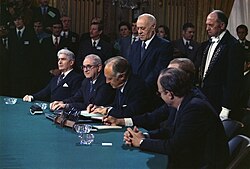
Even the furniture became a point of contention. The North requested a circular table to symbolize equality among all parties, while the South insisted on a rectangular table to emphasize two distinct opposing sides. The eventual compromise featured a circular table for the main governments and separate square tables for other representatives.
Political Intrigue and the 1968 Election
The negotiations were heavily influenced by the 1968 US presidential election. Richard Nixon's campaign utilized various channels to gather intelligence on the peace process. Henry Kissinger, who maintained ties with both the Johnson and Nixon camps, provided insights into the White House's bombing halt decisions.
More controversially, Nixon used Anna Chennault as a secret channel to South Vietnamese President Nguyễn Văn Thiệu, encouraging him to delay attending the peace conference. When President Johnson discovered these actions via the NSA, he accused Nixon of treason and ordered wire-taps on the Nixon campaign. Despite these tensions, historians suggest Nixon's interference may have had little practical effect, as Thiệu was already reluctant to attend the talks.
The Nixon Administration and Secret Diplomacy
Upon taking office in January 1969, Richard Nixon shifted the diplomatic strategy. While official talks continued in Paris, the real progress occurred during secret negotiations between Henry Kissinger and Lê Đức Thọ, beginning in August 1969.
A primary sticking point for three years was the status of President Thiệu. North Vietnam argued that the US must remove Thiệu from power for a deal to be reached. Nixon and Kissinger refused to overthrow a government that the NLF had failed to defeat militarily, though some historians argue that Hanoi's original requests were less extreme than Kissinger portrayed them.
The 1972 Breakthrough
The deadlock finally broke on May 8, 1972, when Nixon conceded that the US would accept a cease-fire in place, allowing US forces to withdraw without a reciprocal withdrawal by North Vietnam.
Further progress was driven by military and geopolitical shifts. The North's Nguyen Hue Offensive (Easter Offensive) was blunted by the US Operation Linebacker bombing campaign. Simultaneously, Nixon's détente—the easing of strained relations—with the Soviet Union and China left North Vietnam fearing diplomatic isolation. By October 1972, Lê Đức Thọ modified his position, allowing the Saigon government to remain in power during final settlements.
The Final Push to Peace
Despite a draft agreement being reached in October 1972, President Thiệu was furious that he had been excluded from the secret talks and refused to sign. This led to a public clash, with Radio Hanoi broadcasting the draft's details to expose the rift.
Facing immense domestic pressure to end the war, the Nixon administration applied heavy diplomatic pressure on Thiệu. To prove his commitment to South Vietnam's defense while simultaneously forcing Hanoi back to the table, Nixon ordered the massive Operation Linebacker II bombings in December 1972. He also bolstered South Vietnamese forces through Operations Enhance and Enhance Plus.
With the US committed to disengagement and threatening to abandon South Vietnam if he did not comply, Thiệu eventually acceded. On January 27, 1973, the official delegations signed the agreement at the Hotel Majestic in Paris.
| Feature | Detail |
|---|---|
| Date Signed | January 27, 1973 |
| Location | Hotel Majestic, Paris |
| US Concession | Cease-fire in place (withdrawal without reciprocal NVA withdrawal) |
| Key US Figures | Richard Nixon, Henry Kissinger |
| Key North Vietnamese Figures | Xuân Thuỷ, Lê Đức Thọ |
| Final Military Pressure | Operation Linebacker II |
Frequently Asked Questions
Why was the shape of the negotiating table a point of conflict?
The table shape represented political legitimacy. North Vietnam wanted a circular table to imply that all parties, including the NLF, were equal. South Vietnam insisted on a rectangular table to maintain a clear distinction between the two opposing sides of the conflict.
What was the significance of the "cease-fire in place"?
This was a major concession by the United States. It meant that US forces could withdraw from South Vietnam without requiring the North Vietnamese Army to simultaneously withdraw their troops from the South.
How did the 1968 US election affect the negotiations?
The election introduced secret channels and political maneuvering. Richard Nixon's campaign encouraged South Vietnamese President Thiệu to avoid the peace conference, leading to accusations of treason from the Johnson administration.
What role did secret negotiations play in the final agreement?
While public talks occurred in Paris, the actual terms were largely hammered out in secret meetings between Henry Kissinger and Lê Đức Thọ, which began in August 1969 and bypassed the official delegations.
Why did President Thiệu initially refuse to sign the accords?
Thiệu was excluded from the secret negotiations between Kissinger and Thọ. When presented with the draft, he felt betrayed by his US allies and believed the terms were unfavorable to the South Vietnamese government.