Pardalotes: Australia's Vibrant Forest Specialists
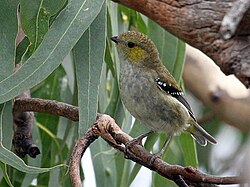
Pardalotes, often referred to as peep-wrens, are a family of diminutive, brightly colored birds endemic to Australia. Belonging to the family Pardalotidae, these birds are characterized by their compact bodies, short tails, and robust, blunt beaks. Their name is derived from the Greek word for "spotted," a fitting description for these striking avian specialists that play a vital role in the health of Australia's iconic eucalyptus forests.
Key Facts
- Endemism: All species are native to Australia.
- Diet: Primarily insectivores, specializing in eating lerps.
- Habitat: Specialists of eucalyptus forests and woodlands.
- Nesting: They drill deep horizontal tunnels into earth banks.
- Conservation: The Forty-spotted Pardalote is listed as Endangered.
Taxonomy and Classification
The genus Pardalotus was established in 1816 by Louis Pierre Vieillot, with the spotted pardalote serving as the type species. While they were once grouped with oriental flowerpeckers due to their similar plump appearance and reduced tenth primary flight feather, genetic analysis has since revealed they are more closely related to the Acanthizidae family, which includes thornbills and scrubwrens.
Currently, the family is generally recognized as consisting of four species. Some of these species exhibit high variability; for instance, the striated pardalote has six subspecies, and the spotted pardalote has three. One subspecies of the spotted pardalote, the yellow-rumped pardalote, is occasionally treated as a distinct species due to its unique call and plumage.
Physical Characteristics
Pardalotes are small birds, typically ranging from 8.5 to 12 cm in length. They follow Bergmann's rule, meaning individuals found in southern regions tend to be larger than those in the north. Both males and females are similar in size, though plumage can vary by species. Their bills are deep and strong, designed for their specific diet, and notably lack the rictal bristles (stiff hairs around the mouth) common in many other insect-eating birds.
Distribution and Habitat
These birds are highly specialized for life in eucalyptus forests, ranging from towering canopies over 30 meters high to low mallee woodlands. While they may occasionally enter other forest types, these are considered marginal habitats.
Distribution varies significantly by species. The striated pardalote is the most widespread, found across most of Australia except for the driest central and western deserts. The red-browed pardalote dominates the north and west, while the spotted pardalote prefers the southern and eastern coasts. The most restricted is the forty-spotted pardalote, which is found only in Tasmania.
Behavior and Ecology
Pardalotes are almost exclusively insectivores, foraging by gleaning insects from foliage rather than catching them in mid-air. Their primary food source is lerps—protective honeydew casings secreted by psyllid insects. By consuming these, pardalotes help control lerp infestations in eucalyptus forests.
Life in the canopy is not without conflict. Larger honeyeaters also seek lerps and often aggressively defend these resources. Research indicates that pardalotes may spend up to 5% of their day simply evading attacks from honeyeaters.
Breeding and Social Structure
Pardalotes are monogamous and share all parental duties, including nest construction, incubation, and rearing. In temperate regions, they are seasonal breeders, though those in warmer climates may breed year-round. Their nesting habit is unique: they drill deep horizontal tunnels into earth banks, creating holes the size of a mouse-hole that can extend over a meter in depth. Some species also utilize tree hollows.
Movement and Migration
Many pardalotes exhibit seasonal dispersal. Striated pardalotes are known to migrate from Tasmania across the Bass Strait to the mainland for the winter. Both spotted and striated species move from high-altitude forests to lower rainfall plains in Southeast Australia, often following the availability of psyllid food sources. In contrast, the forty-spotted pardalote is largely sedentary, with movements limited to eastern Tasmania and nearby islands.
Conservation Status
While the red-browed, spotted, and striated pardalotes are common, they face population declines due to habitat loss from land clearing and commercial forestry. The Forty-spotted Pardalote is critically threatened and listed as Endangered. It faces a combination of habitat fragmentation, competition from the Noisy Miner (a colonial honeyeater), and high nestling mortality caused by the ectoparasite Passeromyia longicornis.
Climate change also poses a threat, with predictions suggesting a reduction in the distribution of the striated pardalote within the Western Australian wheatbelt.
| Scientific Name | Common Name | Distribution | Notable Subspecies |
|---|---|---|---|
| Pardalotus punctatus | Spotted Pardalote | Southern & Eastern Australia | Yellow-rumped Pardalote |
| Pardalotus quadragintus | Forty-spotted Pardalote | Tasmania | N/A |
| Pardalotus rubricatus | Red-browed Pardalote | Northern & Western Australia | N/A |
| Pardalotus striatus | Striated Pardalote | Widespread Australia | Yellow-tipped, Red-tipped, Black-headed |
Frequently Asked Questions
What are lerps and why are they important to pardalotes?
Lerps are honeydew casings produced by sap-sucking insects of the family Psyllidae. They constitute the primary diet of pardalotes, and the birds are specifically adapted to feed on them, helping to regulate insect populations in eucalyptus forests.
How do pardalotes build their nests?
Most pardalotes are tunnel-nesters. They drill deep, horizontal tunnels into the banks of earth. While the entrance is small, the tunnel can reach depths of one meter or more. Some species may also use tree hollows.
Why is the Forty-spotted Pardalote endangered?
This species suffers from a very restricted and fragmented habitat in Tasmania. It faces threats from habitat loss, competition with aggressive honeyeaters like the Noisy Miner, and high nestling mortality due to a specific fly parasite.
Do pardalotes migrate?
Some species do. Striated pardalotes migrate from Tasmania to the Australian mainland during winter, and both spotted and striated pardalotes move between high-altitude forests and lower plains based on food availability.
What is the difference between a pardalote and a honeyeater?
Pardalotes are much smaller, compact insectivores that glean food from leaves. Honeyeaters are generally larger and more aggressive; while both compete for lerps, honeyeaters often drive pardalotes away from food sources.