Parasitoid Wasps: Nature's Specialized Biological Controllers
In the intricate web of the natural world, few creatures are as specialized or as misunderstood as parasitoid wasps. Unlike true parasites, which typically coexist with their hosts for long periods without killing them, parasitoids are lethal. They lay their eggs on or inside other arthropods, and as the wasp larvae develop, they inevitably cause the death of the host. This unique biological strategy makes them indispensable in maintaining ecological balance and highly valuable in modern agriculture.
These insects belong to the order Hymenoptera. While most are part of the wasp-waisted Apocrita group, some, such as the wood wasps (Orussoidea), lack this characteristic constriction. Their targets are diverse, ranging from beetles, flies, and bugs to the exclusive focus of spider wasps (Pompilidae), which attack only spiders. The most common hosts, however, are members of the order Lepidoptera (butterflies and moths).
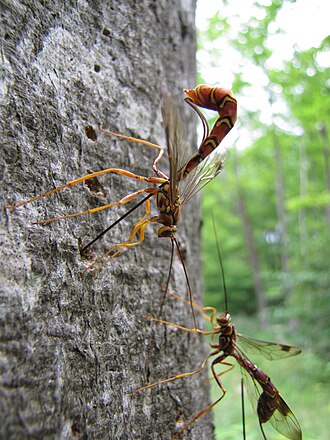
Key Facts
- Lethal Outcome: Unlike parasites, parasitoids always kill their host to complete their life cycle.
- Massive Diversity: Some groups are enormous, with Chalcidoidea estimated at 500,000 species and Ichneumonidae at 100,000.
- Agricultural Value: They are used commercially in biological pest control to reduce reliance on chemical pesticides.
- Evolutionary Origin: Parasitoidism evolved once during the Permian period, approximately 247 million years ago.
- Specialized Tools: The ovipositor is the specialized organ used to deposit eggs into or onto a host.
Parasitism Strategies and Life Cycles
Parasitoid wasps employ different strategies depending on the host's life stage—attacking eggs, larvae, pupae, or adults. These strategies are generally divided into two primary biological paths:
Endoparasitic Koinobionts
Endoparasites develop inside the host's body. Koinobionts are particularly sophisticated; they allow the host to continue feeding, growing, and moulting while the larva develops internally. Eventually, the wasp larvae fill the host's body, leading to its death.
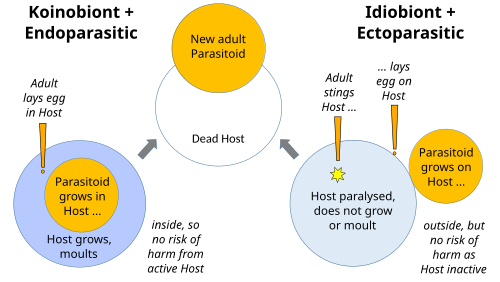
Ectoparasitic Idiobionts
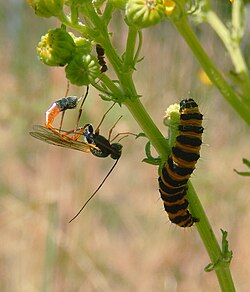
Ectoparasites develop outside the host's body. These are typically idiobionts, which paralyze the host immediately upon attack, preventing further development and ensuring a stable food source for the wasp larvae.
The Role of Polydnaviruses
Some wasps in the superfamily Ichneumonoidea have evolved a fascinating mutualistic relationship with polydnaviruses. These viruses are injected along with the egg to suppress the host's immune system, protecting the wasp larvae from being destroyed by the host's haemocytes (immune cells).
Evolution and Taxonomy
Genetic and fossil evidence indicates that parasitoidism evolved only once in Hymenoptera during the Permian. This led to the clade Euhymenoptera. While this trait was the foundation for many groups, it was secondarily lost in ants, bees, and vespid wasps.
A pivotal evolutionary development was the "wasp waist" (a constriction in the abdomen) found in the Apocrita. This anatomical change increased the maneuverability of the ovipositor, allowing wasps to target hosts more precisely and contributing to a rapid diversification of species.
| Group/Superfamily | Estimated Species | Key Characteristic |
|---|---|---|
| Chalcidoidea | 500,000 | Mainly small wasps |
| Ichneumonoidea | 150,000 | Often possess long ovipositors |
| Braconidae | 50,000 | Diverse host range |
| Orussoidea | 85 | Wood wasps (no waist) |
Host Defenses and Counter-Strategies
The battle between wasp and host is an evolutionary arms race. Hosts have developed various defenses, including camouflage, wriggling to avoid attacks, and encapsulation—a process where haemocytes surround and kill the wasp egg or larva.
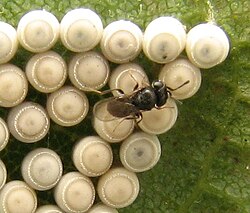
Some aphids utilize a symbiotic bacterium (γ-3 Pseudomonadota) to kill wasp eggs. In response, some wasps have evolved to lay a higher volume of eggs in these protected aphids to ensure at least one survives. Furthermore, some wasps can manipulate the behavior of their hosts, forcing them to build silk webs that protect the emerging wasp pupae from hyperparasitoids (wasps that parasitize other parasitoid wasps).
Human Interaction and Biological Control
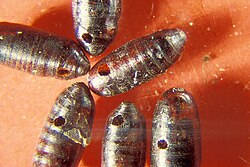
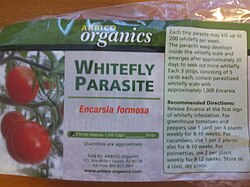
Because they naturally regulate insect populations, many parasitoid wasps are beneficial to humans. Since the 1920s, Encarsia formosa, an endoparasitic wasp, has been used commercially to control whiteflies in greenhouses. While chemical pesticides briefly displaced these biological agents in the 1940s, their use revived in the 1970s and remains a primary control method in countries like New Zealand, especially for tomato crops.
![Trioxys complanatus, (Aphidiinae) ovipositing into a spotted alfalfa aphid, a commercial pest in Australia.[a]](/images/ac/b5/acb5133c83a3feed0a0934280776c1a2e1cb3786b86862276d76b706ff6645a8.jpg)
Frequently Asked Questions
What is the difference between a parasite and a parasitoid?
A parasite typically does not kill its host, as it relies on the host for long-term survival. A parasitoid, however, always kills its host as a necessary part of its development process.
How do parasitoid wasps find their hosts?
They use specialized sensory organs to locate hosts, and females use an ovipositor to inject eggs either directly into the host's body or onto its surface.
Why are parasitoid wasps useful for farmers?
They act as natural predators for agricultural pests. By releasing specific species like Encarsia formosa, farmers can reduce pest populations without relying solely on chemical insecticides.
What is a polydnavirus?
It is a virus that exists in a mutualistic relationship with certain wasps. The wasp uses the virus to disable the host's immune system, ensuring the wasp larvae are not attacked by the host's internal defenses.
Do all wasps have a "wasp waist"?
No. While the majority of parasitoid wasps belong to the Apocrita (which have the waist), the Orussoidea (wood wasps) do not possess this constriction.