The Majestic Lion: A Comprehensive Guide to the King of Beasts
The lion, scientifically known as Panthera leo, is one of the most iconic and recognizable animals on the planet. Belonging to the order Carnivora (meat-eating mammals), these powerful predators have captured the human imagination for millennia. From the vast savannas of Africa to the forests of India, the lion remains a symbol of strength and majesty.
Key Facts
- Scientific Name: Panthera leo
- Conservation Status: Vulnerable (IUCN 3.1)
- Primary Habitat: African savannas and Indian forests
- Social Structure: Lives in groups called prides
- Diet: Carnivorous (predatory)
- CITES Status: Appendix II
Scientific Classification
To understand the lion's place in the natural world, it is helpful to look at its biological hierarchy. Lions are members of the Placentalia infraclass, which refers to mammals that give birth to live young nourished through a placenta.
| Rank | Taxon |
|---|---|
| Kingdom | Animalia |
| Phylum | Chordata |
| Class | Mammalia |
| Infraclass | Placentalia |
| Order | Carnivora |
| Family | Felidae |
| Genus | Panthera |
| Species | P. leo |
Physical Characteristics
Lions exhibit significant physical differences between males and females. One of the most striking features of the male is the mane, a thick growth of hair around the neck that serves various biological purposes.
Size and Weight
The physical dimensions of a lion can vary depending on their geographic location. Generally, males are larger and heavier than females. Below is a breakdown of average measurements:
| Measurement/Region | Female Lions | Male Lions |
|---|---|---|
| Head-and-body length | 160–184 cm | 184–208 cm |
| Tail length | 72–89.5 cm | 82.5–93.5 cm |
| Weight (Southern Africa) | 118.37–143.52 kg | 186.55–225 kg |
| Weight (East Africa) | ~119.5 kg | ~174.9 kg |
| Weight (India) | 110–120 kg | 160–190 kg |
Subspecies and Distribution
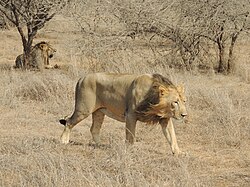
Modern lions are categorized into two primary subspecies: P. l. leo and P. l. melanochaita. While many lions reside in Africa, a specific population of Asiatic lions can be found in India.
In India, the Asiatic lion is a notable subspecies found within specific habitats like the Gir region.
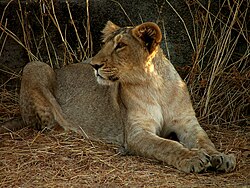
In their African habitats, lionesses play a vital role in the ecosystem and the pride structure.
Behavior and Ecology
Lions are highly social animals, often living in complex group organizations. Their habitat requirements vary, but they are frequently observed in environments that allow for both hunting and rest, such as trees near water sources.

Hunting and Diet
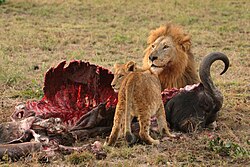
As apex predators, lions engage in cooperative hunting to take down large prey. Their diet typically consists of various herbivores, and they often compete with other predators like spotted hyenas and leopards for food resources.
: Male lion and cub with mostly eaten buffalo carcass in Sabi Sand Game ReserveCommunication
Lions use various methods to communicate, including scent marking to establish territory and vocalizations. The roar of a lion is a powerful tool used to signal presence and defend territory.
Conservation and Captive Breeding
The lion is currently listed as Vulnerable by the IUCN. Conservation efforts are critical to preventing further population declines. In the context of zoos, the Association of Zoos and Aquariums implemented a Species Survival Plan for Asiatic lions in 1982.
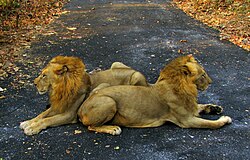
Managing captive populations is complex. In the late 1980s, it was discovered that many lions in North American zoos were hybrids of African and Asiatic subspecies. To maintain genetic integrity and conservation value, breeding programs must carefully track the origins of animals to avoid cross-breeding different subspecies.
Human Interaction and Cultural Significance
Throughout history, lions have had a profound impact on human culture. They have been depicted in ancient art and literature, sometimes as symbols of power and other times as fearsome predators.
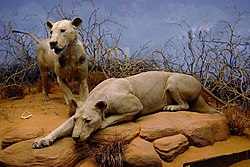
In some historical instances, lions became notorious for "man-eating" behavior, such as the famous Tsavo man-eaters of East Africa.
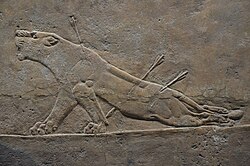
Ancient civilizations, such as those in Nineveh, captured the essence of the lion in stone carvings.
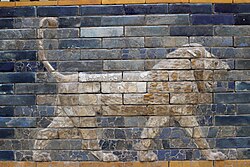
In Mesopotamia, the lion was a recurring motif in royal architecture, such as the Throne Room of Nebuchadnezzar II in Babylon.
Even in modern fiction, the lion remains a central figure, as seen in classic stories like The Wonderful Wizard of Oz.

Frequently Asked Questions
What is the current conservation status of the lion?
The lion is currently classified as Vulnerable by the IUCN Red List. They are also protected under CITES Appendix II.
How do male and female lions differ in size?
Male lions are generally larger and heavier than females. For example, in Southern Africa, males can weigh up to 225 kg, while females typically weigh between 118 and 143 kg.
Where are Asiatic lions found?
Asiatic lions are found in India, specifically within protected areas like the Gir forest.
What is a lion pride?
A pride is the social group that lions live in, characterized by complex group organization and cooperative behaviors.
Why is captive breeding managed so strictly?
Strict management is necessary to prevent the cross-breeding of different subspecies (such as African and Asiatic lions), which ensures that the genetic value of each subspecies is preserved for conservation purposes.