Outhouse Design and Sanitation Systems
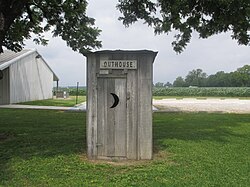
An outhouse is a standalone structure located outside a primary dwelling that provides a sheltered space for waste disposal. Unlike modern bathrooms, outhouses are not connected to plumbing, sewers, or septic systems. To balance the need for easy access with the necessity of managing odors, the World Health Organization recommends placing these structures a reasonable distance from the main house.
The primary purpose of the outhouse superstructure is to ensure privacy and human comfort. The walls and roof act as a visual screen and protect the user from the elements. Additionally, the structure prevents rainwater from flooding the toilet hole, which would otherwise flush untreated waste into the soil before it has a chance to decompose.
Most outhouses are utilitarian in design, typically constructed from lumber or plywood. This simple construction allows the building to be easily moved once the waste pit is full—a process that may occur annually depending on the pit size and frequency of use.
Key Facts
- Global Use: As of 2013, an estimated 1.77 billion people rely on pit latrines.
- Primary Function: Provides privacy and prevents rainwater from flooding waste pits.
- Construction: Usually rectangular or square, though hexagonal designs exist.
- Environmental Impact: Properly maintained pit latrines reduce disease spread compared to open defecation.
- Maintenance: Structures are often designed to be portable so they can be moved to new pits.
Common Design Features and Cultural Variations
While the basic purpose remains the same, the interior arrangements of outhouses vary significantly across different cultures:
- Western Societies: Often feature a seat with a hole positioned over a small pit. In some older rural European areas, the design consists of a simple hole with two indents for the user's feet.
- Eastern Societies: Typically utilize a hole in the floor where the user crouches.
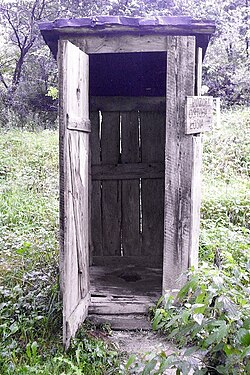
Materials for hygiene also vary; while toilet paper is common, historical or rural alternatives include leaves or corn cobs. Regarding aesthetics, the crescent moon often seen on American outhouse doors is largely a product of cartooning. While some claim it served as a gender marker (sun for men, moon for women) for illiterate populations, others view this as an urban legend. Regardless of the shape, the hole in the door serves the practical purpose of providing ventilation and light.
Types of Toilet Systems
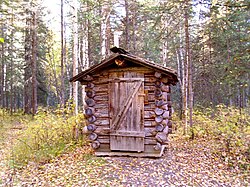
The outhouse superstructure can shelter several different types of waste management systems, ranging from primitive pits to high-tech incinerators.
Pit Latrines
A pit latrine collects human feces in a hole dug into the ground. These are common in the developing world, rural areas, and wilderness regions. When the pit fills, it must be emptied or the structure moved to a new location. The removal of fecal sludge is a complex process that carries health and environmental risks if not managed correctly.
Bucket Toilets and the Pail Closet
The bucket toilet uses a seat and a portable receptacle. Historically known as the pail closet, these were often serviced by "nightmen" who collected "night soil" (human waste) for disposal. This municipal collection system was notably used in Rochdale, England (the "Rochdale System"), parts of France, and Australia, where "dunny cans" remained in use well into the late 20th century.
Wilderness and National Park Solutions
High-traffic wilderness areas, such as those popular with mountaineers and kayakers, require specialized systems. In some regions, waste is collected in drums and transported via helicopter. On Mount Everest, "expedition barrels" or "bog barrels" are used under a "pack it in, pack it out" mandate; these containers are weighed to ensure waste is not dumped along the trail.
Composting and Specialized Toilets
Modern ecological alternatives include composting toilets, such as the Clivus Multrum. Some variations, like those used by Vermont's Green Mountain Club, are "worm hold privies" that utilize red worms to break down waste. Other specialized systems include:
- Pacto Toilet: A Swedish system using a continuous roll of plastic for waste collection.
- Incinerating Toilets: Common in Norwegian cabins, these use propane and 12-volt battery power to reduce waste to ash.
Summary of Outhouse Systems
| System Type | Mechanism | Primary Use Case | Waste Disposal Method |
|---|---|---|---|
| Pit Latrine | Hole in ground | Rural/Developing regions | Decomposition in soil |
| Bucket Toilet | Portable receptacle | Historical urban/Rural | Manual collection or composting |
| Composting | Biological breakdown | Eco-friendly/Wilderness | Worms or aerobic decomposition |
| Incinerating | Heat combustion | Remote cabins (e.g., Norway) | Reduction to ash |
| Expedition Barrel | Sealed container | High-altitude mountaineering | Packed out and removed |
Frequently Asked Questions
Why are outhouses often built to be portable?
Outhouses are frequently made of lightweight materials like plywood so they can be easily moved to a new location once the earthen pit beneath them has filled up.
What is the purpose of the moon cutout on some outhouse doors?
While some believe it was a gender sign for illiterate people, it is widely considered a cartoon trope. Practically, any hole in the door provides necessary light and ventilation.
How do incinerating toilets work in remote areas?
These toilets use propane and 12-volt battery electricity to burn human waste, converting it into a small amount of sterile ash.
What is the "Rochdale System"?
The Rochdale System refers to a historical sanitation method in England where municipal workers, known as nightmen, collected and replaced buckets from pail closets.
How are waste issues managed on Mount Everest?
Climbers use "bog barrels" or expedition barrels to collect waste, which are then weighed and carried off the mountain to ensure the environment remains clean.