Waste Containers: History, Design, and Global Management
Whether it is called a trash can, garbage can, or wastebasket in the Americas, or a bin or dustbin in Commonwealth English, the waste container is a fundamental tool for sanitation. These vessels, typically constructed from metal or plastic, serve the primary purpose of storing waste before it is transported for final disposal.
While the terms are often used interchangeably, some distinctions exist. In certain contexts, "garbage" specifically refers to food waste, whereas "trash" refers to non-food waste. In larger scales, a dumpster (a genericized trademark) refers to the large outdoor containers used by municipal collectors.
Key Facts
- Materials: Most bins are made of steel or plastic (specifically polyethylene), though wood and wicker are also used.
- French Origins: The French word for waste receptacle comes from Eugène Poubelle, who mandated household bins in Paris in 1883.
- UK Legislation: The Public Health Act 1875 first outlined the responsibilities of British local authorities regarding waste receptacles.
- Specialized Types: Roll-off dumpsters are designed for heavy-duty transport, often used in construction and renovation.
- Modern Tech: Contemporary bins may feature infrared sensors for touchless operation and integrated air fresheners.
Design and Evolution
The design of waste containers has evolved from simple buckets to engineered systems. One significant milestone was the invention of the pedal bin in the 1920s by Lillian Moller Gilbreth, an industrial engineer. This design allowed users to open the lid without using their hands, significantly improving kitchen hygiene.
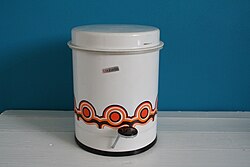
In recent years, automation has replaced the foot pedal in high-end models. Many modern stainless steel bins utilize battery-powered infrared detection to open the lid automatically. This prevents the lid from becoming clogged with trash and ensures a completely touchless experience.
Historical Origins
The French Influence
Modern waste management legislation began in France with an 1883 prefectural order signed by Eugène Poubelle. This order required every household in Paris to have waste bins with a handle and a lid, ranging from 80 to 120 liters in volume. Notably, households were allocated three separate bins to sort reclaimable fibers (paper and cloth) from other reusable materials like glass, ceramics, and oyster shells.
The British Approach
In Britain, the Public Health Act 1875 established the framework for local authorities to provide and collect receptacles for "dust ashes and rubbish." Unlike the French mandate, this act did not force the use of bins but left the decision to provide the service to local governments.
Household and Public Waste Collection
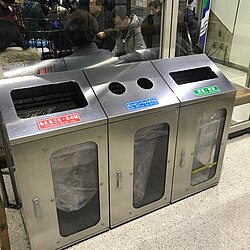
Most urban areas employ a public collection service where waste is gathered from outside buildings and transported via garbage trucks to landfills, incinerators, or crush facilities. To facilitate recycling, many municipalities provide multiple color-coded bins to separate materials before they are sent to recycling centers.
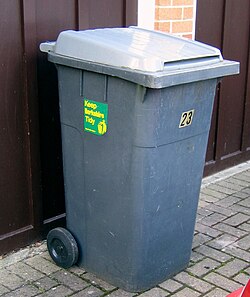
For larger volumes of waste, different containers are used depending on the region. In the US, dumpsters are typically stationary containers emptied on-site. In the UK, skips are used, which are designed to be loaded onto a vehicle and transported away. A specialized version, the roll-off dumpster, features a mechanism allowing it to be rolled onto and off a truck bed, making it ideal for construction and large-scale clean-ups.
Public Space Management
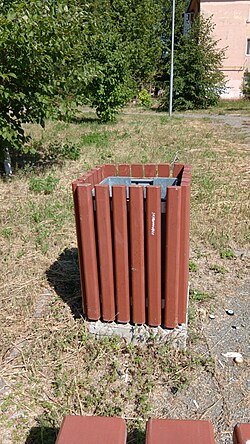
Litter bins in parks and public areas are designed to discourage littering and are often mounted to walls or the ground to prevent theft and vandalism. In dense cities, some systems store trash underground beneath the visible receptacle. To manage liquids and odors, many bins are lined with plastic or paper bags.
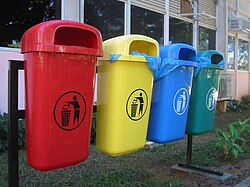
To encourage proper disposal, the "Tidyman" symbol is frequently used on packaging as a visual reminder to use a bin.

Summary of Waste Container Types
| Type | Primary Use | Key Feature | Common Region |
|---|---|---|---|
| Wastebasket/Bin | Indoor/Household | Small, plastic or metal | Global |
| Pedal Bin | Kitchen/Hygiene | Foot-operated lid | Global |
| Dumpster | Large-scale outdoor | Emptied on-site by truck | North America |
| Skip | Large-scale outdoor | Transported as a whole unit | UK/Commonwealth |
| Roll-off Dumpster | Construction/Renovation | Open-top, truck-roll mechanism | North America |
Metaphorical Uses of the Term
The concept of the waste container extends beyond physical objects into various professional and academic fields:
- Computing: The "trash can" or "recycle bin" is a desktop metaphor for files marked for deletion.
- Business: The "circular file" or "janitor's file" is a euphemism for a waste bin where worthless documents are placed.
- Decision Making: The "Garbage Can Model" describes decision-making processes under great uncertainty where outcomes may seem irrational.
- Taxonomy: A "wastebasket taxon" refers to a classification group used for organisms that do not fit neatly into other established categories.
Frequently Asked Questions
What is the difference between a dumpster and a skip?
A dumpster is generally a stationary container whose contents are emptied into a truck on-site. A skip is designed to be picked up, transported, and emptied elsewhere.
Who invented the pedal bin?
The pedal bin was invented in the 1920s by Lillian Moller Gilbreth, an industrial engineer and efficiency expert, to allow for hands-free disposal of kitchen waste.
Where does the French word for trash can come from?
It comes from the name of Eugène Poubelle, the official who signed the 1883 prefectural order mandating the use of waste bins for every household in Paris.
What is a roll-off dumpster?
A roll-off dumpster is a large, open-topped container equipped with a mechanism that allows it to be rolled onto and off a specialized truck, making it ideal for construction debris.
What is a wastebasket taxon in science?
In taxonomy, it is a less formal grouping used for species that are difficult to classify or do not fit into other established taxa, such as the proposed order Insectivora.