Oswaldo Guayasamín: The Voice of Latin American Suffering and Hope
Oswaldo Guayasamín was more than a painter and sculptor; he was a visual chronicler of the human condition. Born into a world of stark contrasts in Quito, Ecuador, Guayasamín dedicated his life to exposing the raw realities of social inequality, political oppression, and the enduring spirit of the indigenous peoples of the Americas. His work transcends mere aesthetics, serving as a powerful testament to the struggles of the marginalized.
Key Facts
- Heritage: Of Kichwa and Mestizo descent.
- Core Themes: Human suffering, racism, poverty, and class division in South America.
- Major Works: Los niños muertos and Manos de protesta.
- Legacy Project: La Capilla del Hombre (The Chapel of Man) in Quito.
- Major Award: Premio Eugenio Espejo (1991).
Early Life and Artistic Awakening
Born on July 6, 1919, in Quito, Oswaldo Guayasamín Calero grew up in a poor household. The eldest of ten children, he was the son of a native father and a Mestiza mother, both of Kichwa descent. While his father worked as a carpenter, young Oswaldo found solace and expression in art, drawing caricatures of his peers and teachers from the age of six.
His formal education took place at the School of Fine Arts in Quito, where he studied painting, sculpture, and architecture. However, his artistic vision was forged not just in the classroom, but through personal tragedy. During his college years, the death of his best friend during a demonstration in Quito profoundly impacted him. This event inspired one of his most poignant works, Los Niños Muertos (The Dead Children), and solidified his commitment to depicting the injustices of society.
The Evolution of a Pan-American Vision
Guayasamín's career began with early success, selling art even before he could read. His early exhibitions, including those at La Galería Caspicara, showcased his focus on the oppression of the lower social classes. A pivotal moment occurred with the painting El Silencio, which signaled a shift from narrative storytelling to using subjects as universal symbols of human suffering.
Between 1942 and 1943, Guayasamín traveled through the United States and Mexico, where he met the influential artist José Clemente Orozco. Together, they journeyed across South America, visiting countries such as Peru, Brazil, Chile, Argentina, and Uruguay. These travels allowed Guayasamín to observe the indigenous lifestyles and systemic poverty firsthand, which became the central pillars of his Pan-American art.
International Recognition and Political Engagement
Guayasamín's mastery earned him prestigious accolades across the globe. He won first prize at the Ecuadorian Salón Nacional de Acuarelistas y Dibujantes in 1948 and the Third Hispano-American Biennial of Art in Barcelona in 1955. By 1957, he was named the best South American painter at the Fourth Biennial of São Paulo.
His art was often intertwined with his political convictions. An ardent supporter of the Cuban Revolution and Fidel Castro, Guayasamín did not shy away from controversy. In 1988, he painted a mural of Ecuadorian history that drew criticism from the United States government for depicting a figure in a Nazi helmet labeled "CIA." Despite such tensions, UNESCO recognized his lifelong commitment to peace with a special prize.
Final Years and Lasting Legacy
The final chapter of Guayasamín's life was marked by both professional triumph and personal heartbreak. In 1995, he personally inaugurated exhibits in Paris and Buenos Aires. However, in August 1998, he suffered a devastating loss when his granddaughter, Maita Madriñan Guayasamín, and two great-grandchildren were killed in the crash of Cubana de Aviación Flight 389.
Oswaldo Guayasamín passed away on March 10, 1999, in Baltimore, Maryland, at the age of 79. His death coincided with a period of intense socioeconomic crisis and indigenous strikes in Ecuador, the very people he had championed throughout his career.
His crowning achievement, La Capilla del Hombre (The Chapel of Man), was completed in 2002. Co-designed by the artist and located in the hills of Quito, the chapel serves as a monument to both the cruelty humans inflict upon one another and the inherent potential for human greatness.
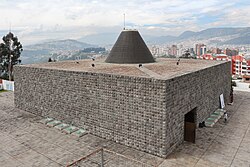
Summary of Oswaldo Guayasamín's Life
| Category | Details |
|---|---|
| Lifespan | July 6, 1919 – March 10, 1999 |
| Nationality | Ecuadorian |
| Education | School of Fine Arts in Quito |
| Key Movements | Pan-American Art / Social Realism |
| Notable Awards | Premio Eugenio Espejo, UNESCO Peace Prize |
| Major Installation | La Capilla del Hombre |
Frequently Asked Questions
What was the inspiration behind the painting Los Niños Muertos?
The painting was inspired by the death of Guayasamín's best friend, who was killed during a demonstration in Quito while the artist was attending college.
What is the purpose of La Capilla del Hombre?
Located in Quito, the chapel is designed to document the history of human cruelty while simultaneously highlighting the potential for greatness within humanity.
How did Guayasamín's heritage influence his work?
As a person of Kichwa and Mestizo heritage, Guayasamín focused his art on the indigenous lifestyle, poverty, and the social inequalities faced by the marginalized people of Latin America.
Why was his 1988 mural controversial?
The mural depicting the history of Ecuador included a figure wearing a Nazi helmet with the letters "CIA" on it, which led to criticism from the United States government.
Who compared Guayasamín to Michelangelo?
Spanish art historian José Camón Aznar likened Guayasamín to the "Michelangelo of Latin America" due to his immense contribution to art and his depiction of the human form.