Orleans Parish Prison: A History of New Orleans' City Jail
The Orleans Parish Prison serves as the primary city jail for New Orleans, Louisiana. Managed by the Orleans Parish Sheriff's Office, the facility has a long and tumultuous history dating back to 1837. While it houses a variety of offenders, the vast majority of its population consists of individuals awaiting trial.
Over nearly two centuries, the prison has moved through multiple locations, reflecting the evolving architectural and judicial needs of the city, while often becoming a focal point for discussions on human rights and correctional reform.
Key Facts
- Established: 1837
- Management: Orleans Parish Sheriff's Office
- Current Capacity: 1,438 beds
- Recent Population: 1,003 (as of September 2022)
- Current Warden: Captain Chaz Ruiz
- Primary Function: City jail for pre-trial detainees
Evolution of the Prison Facilities
The First Location (1837–1895)
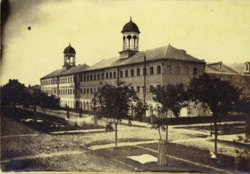
The original prison opened in 1837, designed by architects Joseph Pilié and A. Voilquin in an austere Franco-Spanish style. Located on the square bound by Orleans, Tremé, St. Ann, and Marais, the facility utilized segregated courtyards for daytime activity and crowded cells for nighttime confinement.
Historical records from The Times-Picayune highlight the brutal conditions of this era, noting the use of "dark cells" and the "cat o'nine tails" to punish enslaved people and other prisoners. The facility's tenure ended abruptly in 1891 after an angry mob breached the walls to lynch 11 Italian men who had been acquitted of murdering Police Chief David C. Hennessy. The prison officially closed in 1895.
The Second and Third Locations
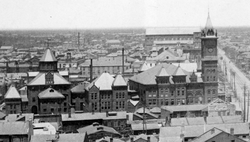
The second prison was situated behind the Criminal Courts Building at Elks Place (Tulane and Saratoga). Designed by Max A. Orlopp Jr. in the Richardson Romanesque style—a heavy, stone-based architectural movement common in Southern courthouses—the complex was intended to project judicial power and order in a challenging neighborhood.
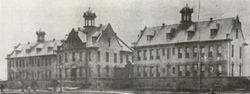
In 1901, the House of Detention opened at Tulane Avenue and Broad Street on the former site of the second New Orleans U.S. Marine Hospital. This facility operated until 1929, when it was demolished to make way for the current Orleans Parish Criminal Courts Building, which integrated its own prison facilities at the rear.

The House of Detention and Systemic Failures
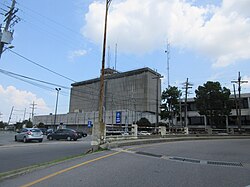
In 1967, a new House of Detention (HOD) complex opened at 2735 Perdido St, followed by the Community Corrections Center (CCC) in 1976. The 13-story high-rise HOD became infamous for severe mismanagement, understaffing, and violence. Inmates reported frequent stabbings, beatings, and the presence of contraband, including handguns and drugs, allegedly facilitated by guards.
The facility's reputation reached a nadir in May 2013, when Mother Jones magazine ranked it as one of the ten worst prisons in the United States. In 2012 alone, there were 600 ambulance runs to emergency rooms, with over half resulting from violence.
Hurricane Katrina and the 2005 Abandonment
One of the darkest chapters in the prison's history occurred on August 29, 2005, during Hurricane Katrina. Staff from the Orleans Parish Sheriff's Office abandoned the jail, leaving approximately 650 prisoners trapped in their cells without food, water, or ventilation for several days.
Following the storm, the American Civil Liberties Union (ACLU) collected over 400 testimonials from survivors who described exposure to floodwaters, hunger, and racially charged abuse. Human Rights Watch later registered 517 prisoners as "unaccounted for." In the years following the disaster, reports indicated a significant number of inmate deaths, with 49 fatalities recorded between April 2006 and 2014.
The Modern Era and Current Facility
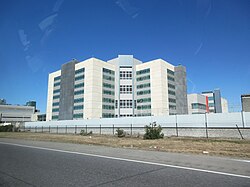
Following the devastation of Katrina, the Federal Emergency Management Agency (FEMA) provided $223 million for facility restoration. This led to a phased construction plan:
- Phase I: A 163,885 square foot kitchen and warehouse facility opened in 2015.
- Phase II: A $146 million facility with 1,438 beds.
- Phase III: A planned 750-bed expansion.
The Phase III expansion has been a point of intense political contention. The Orleans Parish Prison Reform Coalition and former Sheriff Susan Hutson opposed the expansion, advocating for the retrofitting of existing facilities to better serve special populations. However, a federal judge ordered the city to proceed with construction in 2023.
Recent Security Incidents
Security challenges persisted into the mid-2020s. On May 16, 2025, ten inmates escaped through a hole behind a toilet. While most were captured quickly, the final escapee, Derrick Groves, was not recaptured until October 8, 2025.
Summary of Facility History
| Facility/Phase | Period/Opened | Key Characteristics | Status |
|---|---|---|---|
| First Prison | 1837 | Franco-Spanish style; segregated courtyards | Closed 1895 |
| Second Prison | Late 19th C. | Richardson Romanesque style | Replaced |
| House of Detention (1st) | 1901 | Located at Tulane and Broad | Demolished 1929 |
| House of Detention (2nd) | 1967 | 13-story high-rise; known for violence | Closed 2012 |
| Current Facility (Ph II) | 2015 | 1,438 beds; FEMA funded | Operational |
Frequently Asked Questions
Who manages the Orleans Parish Prison?
The prison is operated and managed by the Orleans Parish Sheriff's Office.
What happened to prisoners during Hurricane Katrina?
Roughly 650 prisoners were abandoned in their cells without food, water, or ventilation for several days. Many suffered from exposure to floodwaters and abuse before being evacuated.
Why was the House of Detention considered one of the worst prisons in the U.S.?
It was cited for extreme understaffing, filth, and a lack of inmate monitoring, which led to frequent violence, stabbings, and the smuggling of weapons and drugs into the facility.
Is the prison currently expanding?
Yes. Despite opposition from reform coalitions and former Sheriff Susan Hutson, a federal judge ordered the city to begin construction on a Phase III expansion to add 750 beds.
What is the primary population of the jail?
The majority of the inmates are pre-trial detainees awaiting their court dates.