The Origins of Japanese Writing: Understanding Man'yōgana
Before the modern Japanese writing system existed, the Japanese language faced a unique challenge: it had no native script of its own. To record their history, poetry, and laws, early Japanese scholars adapted Chinese characters, known as kanji, to fit their own spoken tongue. This ancient system is called man'yōgana.
Used from approximately 650 CE through the Meiji era, man'yōgana served as the first known kana system. It allowed the Japanese to phonetically transcribe their language, bridging the gap between the logographic nature of Chinese characters—where a symbol represents a word or concept—and the polysyllabic sounds of Old Japanese.
The Origins of a Phonetic System
The introduction of the Chinese writing system to the Japanese archipelago is widely attributed to Sinicized scholars from the Korean kingdom of Baekje. This historical connection is noted in the Kojiki and the Nihon Shoki, two of Japan's oldest chronicles written in Classic Chinese.
One of the earliest physical examples of this phonetic adaptation is the Inariyama Sword. Excavated in 1968, this iron sword dates back to the Kofun period (likely 471 AD). X-ray analysis revealed a gold-inlaid inscription of at least 115 characters. Crucially, the text includes Japanese personal names written phonetically, suggesting that a version of the Chinese language used in Baekje may have influenced this early writing style.
How Man'yōgana Worked: Sound vs. Meaning
Unlike standard kanji, which are used for their semantic meaning, man'yōgana characters were primarily used for their sounds. This created a complex system where the writer often chose characters based on personal preference rather than a strict standard. By the end of the 8th century, roughly 970 kanji were used to represent the 90 morae (the basic units of sound in Japanese) of the language.
To achieve this, writers utilized two different types of readings for Chinese characters:
Shakuon Kana (Borrowed Sounds)
Shakuon kana are based on on'yomi, the Sino-Japanese pronunciations derived from Middle Chinese. In this system, one character typically represents one or two morae. For example, characters were borrowed simply because their Chinese sound approximated a Japanese syllable.
Shakkun Kana (Borrowed Meanings)
Shakkun kana utilize kun'yomi, the native Japanese readings of a character. In these cases, one to three characters might represent one to three morae. For instance, the character 木 (meaning "tree") could be used to represent the sounds /mo/, /ko/, or /kwi/ depending on the context.
This flexibility meant that a single sound could be written with multiple different characters. In the famous poetry anthology Man'yōshū—from which the system takes its name—the sounds "mo" and "shi" are frequently represented by various different characters within the same poem.
From Complexity to Simplicity: The Birth of Hiragana and Katakana
Writing in man'yōgana was cumbersome and time-consuming. The difficulty of distinguishing whether a character was being used for its meaning or its sound eventually led to the creation of two simplified scripts: hiragana and katakana.
Hiragana evolved from the highly cursive sōsho style of man'yōgana, a style of calligraphy that became particularly popular among women. Over time, these flowing characters were simplified into the curved script used today. The various alternative forms for a single syllable, known as hentaigana, were eventually standardized in 1900.
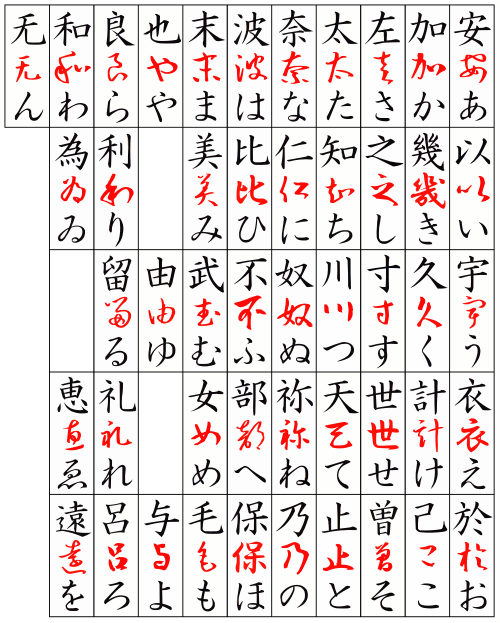
Katakana took a different path. It was developed by Buddhist monks as a form of shorthand. Instead of simplifying the whole character, they took fragments—often just the first or last few strokes—of man'yōgana characters to create a more angular, concise script.
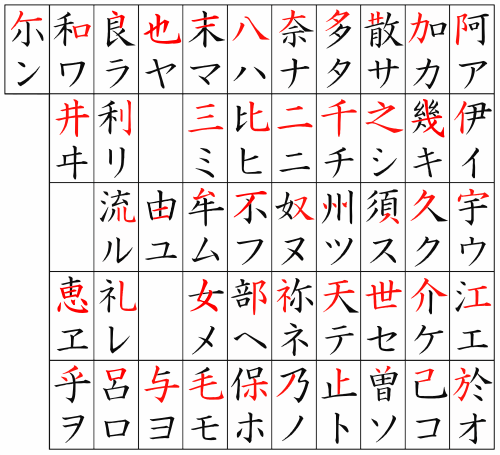
Interestingly, the hiragana and katakana versions of the same sound often come from different man'yōgana sources. For example, the hiragana character る (ru) is derived from the character 留, while the katakana ル (ru) comes from 流.
The Lasting Legacy of Man'yōgana
While man'yōgana is no longer used for daily writing, its influence persists. It can still be found in some regional place names, particularly in Kyūshū. Furthermore, the practice of ateji—using kanji for their phonetic value to spell out words—continues in modern Japanese.
Ateji is commonly used for loanwords. Examples include 倶楽部 (kurabu for "club"), 仏蘭西 (Furansu for "France"), and 亜米利加 (Amerika for "America").
| Feature | Details |
|---|---|
| Period of Use | c. 650 CE to Meiji era |
| Primary Function | Phonetic transcription of Old Japanese using Chinese characters |
| Key Sources | Man'yōshū (poetry anthology), Inariyama Sword |
| Reading Types | On'yomi (Sino-Japanese) and Kun'yomi (Native Japanese) |
| Descendant Scripts | Hiragana (from cursive style) and Katakana (from character fragments) |
| Modern Equivalent | Ateji (phonetic kanji for loanwords) |