Olive-backed Pipit
The Olive-backed pipit (Anthus hodgsoni) is a small passerine bird belonging to the genus Anthus. Known for its subtle coloration and wide migratory range, this species is also referred to as the Indian pipit, Hodgson's pipit, or the tree pipit due to its physical resemblance to the latter. However, it can be distinguished by its more olive-toned back, fewer streaks, and a more prominent supercilium (the stripe of feathers above the eye).
The genus name Anthus is derived from Latin, referring to small birds of the grasslands, while the specific name hodgsoni honors Brian Houghton Hodgson, an English collector and diplomat.
Key Facts
- Conservation Status: Least Concern (IUCN 3.1).
- Size: Approximately 15 cm (5.9 in), slightly larger than a sparrow.
- Diet: Primarily insects, supplemented by grass and weed seeds.
- Migration: Long-distance migrant moving from North/Central Asia to Southern Asia and Indonesia.
- Breeding Altitude: Can breed up to 4,500 m (14,800 ft) in eastern Nepal.
Distribution and Habitat
The Olive-backed pipit maintains a vast geographical presence across Asia and parts of Europe.
Summer Breeding Grounds
During the summer, these birds are found from Himalayan Pakistan and India, extending westward through Nepal and into China (as far north as Gansu province). Their range continues east through Korea to Japan and north through north-central Asia into north-eastern European Russia. While primarily Asian, they occasionally appear as rare vagrants in western Europe.
Wintering Grounds
As long-distance migrants, they spend the winter months across a broad southern region of Asia, stretching from peninsular India eastward to Southeast Asia and the Philippines.
Preferred Habitat
This species favors open country. During the winter, they are typically found in evergreen woodlands, while their summer habitats consist of groves and wooded biotopes.
Physical Description and Behavior
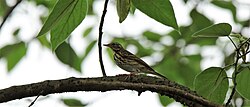
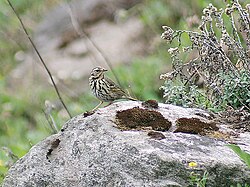
The Olive-backed pipit is characterized by a greenish-brown upper body streaked with darker brown. It features a whitish supercilium, a double wingbar, and whitish outer rectrices (tail feathers). Its underparts range from whitish to buff, with dark brown streaks appearing on the breast and flanks. There is no significant visual difference between the sexes.
In terms of behavior, they are usually seen alone or in pairs. They are ground-dwellers that run while searching for food but will fly into trees when disturbed. Their flight pattern is described as jerky and undulating.
Vocalizations
Their song is lark-like and is typically delivered while on the wing. While similar to the tree pipit, the Olive-backed pipit's song is faster and higher pitched. They also produce a single "tseep" or "spek" call.
Nesting and Reproduction
The breeding season occurs between May and July. The Olive-backed pipit builds its nest as a cup made of moss and grass, placed directly on the ground beneath a boulder or a tuft of grass within scrub or open woodland.
A typical clutch consists of 3 to 5 eggs (usually 4), which are dark brown with darker spots. The species generally raises two broods per season.
| Feature | Details |
|---|---|
| Scientific Name | Anthus hodgsoni |
| Family | Motacillidae |
| Average Length | 15 cm (5.9 in) |
| Primary Diet | Insects and seeds |
| Clutch Size | 3–5 eggs |
| Conservation Status | Least Concern |
Frequently Asked Questions
How can you tell an Olive-backed pipit apart from a tree pipit?
The Olive-backed pipit has a more olive-toned back with fewer streaks and a more distinct supercilium compared to the tree pipit. Additionally, its song is faster and higher pitched.
Where does the Olive-backed pipit migrate during winter?
They migrate to a broad southern region of Asia, including peninsular India, Southeast Asia, and the Philippines.
What is the diet of the Olive-backed pipit?
Their diet consists largely of insects, though they also consume seeds from grasses and weeds.
What are the nesting habits of this species?
They build cup-shaped nests from moss and grass on the ground, usually hidden under boulders or grass tufts in open woodland or scrub areas.
What is the maximum altitude at which they breed?
In eastern Nepal, the Olive-backed pipit has been known to breed at altitudes up to 4,500 meters (14,800 ft).