Oldenburg: A Journey Through the History and Culture of Lower Saxony
Nestled in the northwestern region of Germany, Oldenburg is a city of rich heritage and modern vitality. Situated on the rivers Hunte and Haaren, it serves as a key hub between the city of Bremen to the east and Groningen in the Netherlands to the west. As part of the Northwest Metropolitan Region—home to approximately 2.8 million people—Oldenburg blends its identity as a former capital with its current role as a center for education and culture.
With a population of 176,614 as of late 2024, the city is characterized by its manageable size, an elevation of just 4 meters, and a welcoming atmosphere that draws residents and visitors alike.
Key Facts
- Location: Lower Saxony, Germany, situated between Bremen and Groningen.
- Population: 176,614 (as of December 31, 2024).
- Administrative Status: An urban district within the state of Lower Saxony.
- Key Institutions: Carl von Ossietzky University and Jade University of Applied Sciences.
- Major Landmark: The EWE Arena, hosting sports and large-scale events.
A Deep Dive into Oldenburg's History
Archaeological evidence suggests that Oldenburg has been inhabited since the 8th century. However, the first written record appears in 1108, mentioning "Aldenburg" in connection with Elimar I, recognized as the first count of Oldenburg. The city's strategic location at a ford of the navigable Hunte river allowed it to grow in importance, eventually becoming the capital of the County of Oldenburg.
Over the centuries, the city's status evolved from a County to a Duchy (1774–1810), a Grand Duchy (1815–1918), and finally a Free State (1918–1946). During the Napoleonic Wars, specifically the French annexation from 1811 to 1813, the city was known as Le Vieux-Bourg.
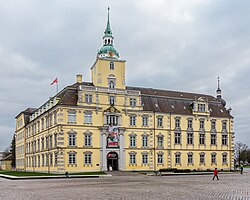
The 17th century brought both wealth and tragedy. While the town initially prospered, it was devastated by a plague epidemic in 1667 and a subsequent fire. Under the rule of Danish kings, who showed little interest in the city's recovery, Oldenburg stagnated until Danish rule ended in 1773. This sparked a period of reconstruction in the klassizistisch (neoclassicist) style, which still defines much of the city's aesthetic.
The 20th Century and Political Shifts
The end of World War I brought a seismic shift in governance. Following the abdication of Emperor Wilhelm II, Grand Duke Frederick Augustus II abdicated on November 11, 1918, transforming the region into the Free State of Oldenburg.
The 1930s marked a dark chapter as the Nazi Party gained rapid electoral traction. By May 1932, the party secured 48.4% of the vote, making Oldenburg the first German state to put the Nazis in power through electoral turnout. This era saw the beginning of Aryanization, the forced sale of Jewish-owned properties at steep discounts.
Following World War II, Oldenburg became part of the British zone of occupation. Despite the war, the city suffered only 1.4% destruction from bombing. The population surged to over 100,000 as 42,000 refugees migrated to the city. In 1946, the Free State was dissolved, and Oldenburg became part of the newly formed state of Lower Saxony.
Climate and Geography
Oldenburg experiences a temperate climate with moderate precipitation throughout the year. The warmest months are July and August, with mean daily maximums reaching around 23°C, while January and December are the coldest, often dipping near 0°C.
| Metric | Winter (Jan) | Spring (Apr) | Summer (Jul) | Autumn (Oct) | Annual Average |
|---|---|---|---|---|---|
| Mean Max Temp (°C) | 4.7 | 14.3 | 23.2 | 13.8 | 13.7 |
| Mean Min Temp (°C) | -0.1 | 4.4 | 13.4 | 6.2 | 5.9 |
| Avg Precipitation (mm) | 71.1 | 43.0 | 88.8 | 63.7 | 816.9 |
| Sunshine Hours | 45.3 | 172.8 | 209.1 | 110.0 | 1,562.1 |
Infrastructure and Urban Life
Oldenburg is well-connected to the rest of Europe. It is located approximately 50 km (31 miles) from Bremen Airport, with Hamburg and Hannover airports also within easy reach.
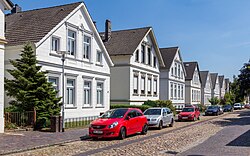
The city's layout includes 33 boroughs divided into nine census tracts. Its architecture is a mix of historical neoclassicism and unique local styles, such as the Hundehütten (dog houses), which are characteristic of the region's traditional building style.
Transport and Economy
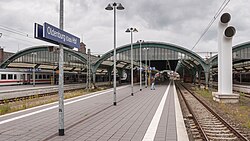
The city's infrastructure is supported by a robust transport network, including the Oldenburg Railway Station, which serves as a gateway for commuters and tourists.
Education and Research
Oldenburg is a prominent center for higher education, hosting two major public universities:
- Carl von Ossietzky University of Oldenburg: Founded in 1973, this university is renowned for its academic breadth. In 2012, it expanded its capabilities by establishing a faculty of medicine and health sciences in cooperation with the University of Groningen, forming the European Medical School Oldenburg-Groningen.
- Jade University of Applied Sciences (Jade-Hochschule): This institution focuses on practical application, with the Oldenburg branch specializing in architecture, construction engineering, geodesy, and audiology.
Culture and Points of Interest
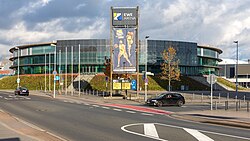
The city offers a diverse array of cultural experiences. The EWE Arena is a focal point for sports and entertainment, featuring both a small and large hall (the latter seating 6,852) and serving as the home for the EWE Baskets Oldenburg basketball team.
Other notable sites include the Castle Square, Lambert's Church, the Oldenburg State Theatre, and the Town Hall, built between 1886 and 1888. The city also hosts the CSD Nordwest (Christopher Street Day) parade every June, attracting up to 10,000 participants.
Jewish Heritage and Remembrance
The Jewish community in Oldenburg has a complex history. After the devastation of the Nazi era, a small community of survivors persisted until the 1970s. In the 1990s, Jewish emigration from the former USSR revitalized the community, which now consists of about 340 people with their own synagogue and cemetery.
Notable Figures
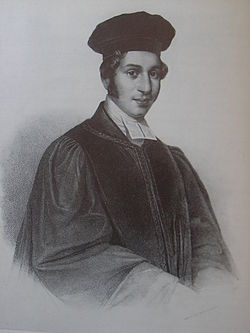
Oldenburg has been home to many influential individuals across various fields:
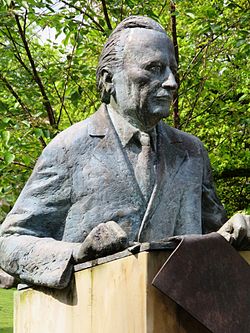
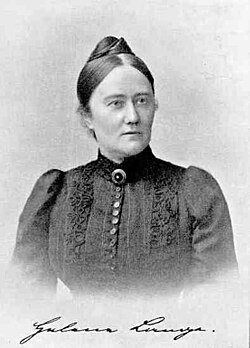
- Philosophy and Politics: Karl Jaspers, the renowned philosopher and psychiatrist, and Helene Lange, a pioneering educator and suffragist.
- Arts and Science: The organ builder Arp Schnitger and the chemist Lothar Meyer.
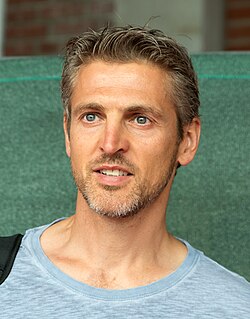
- Sports: Former German national team footballer Hans-Jörg Butt and Olympic sailor Thomas Plößel.
Frequently Asked Questions
What is the population of Oldenburg?
As of December 31, 2024, the population of Oldenburg is 176,614.
Which universities are located in Oldenburg?
The city is home to the Carl von Ossietzky University of Oldenburg and the Jade University of Applied Sciences (Jade-Hochschule).
What is the EWE Arena?
The EWE Arena consists of two event halls used for sports and entertainment; the larger hall is the home court for the EWE Baskets Oldenburg basketball team.
How did Oldenburg's political status change after WWI?
Following the abdication of Grand Duke Frederick Augustus II on November 11, 1918, the Grand Duchy became the Free State of Oldenburg.
What are "Hundehütten"?
Hundehütten are a type of traditional architecture typical to the city of Oldenburg.