Odin: The All-Father of Norse Mythology and Germanic Paganism
In the vast tapestry of Northern European history, few figures loom as large or as complex as Odin. A central deity in Norse mythology and Germanic paganism, Odin has been a subject of reverence, fear, and artistic inspiration for millennia. From the Roman occupation of Germania to the height of the Viking Age, his influence has permeated the cultural fabric of Northern Europe, leaving behind a legacy of hundreds of names, titles, and mythic tales.
Most of what we know about Odin today is preserved through the 13th-century Prose Edda, the collection of Old Norse poems known as the Poetic Edda, and the Ynglinga saga. These sources paint a picture of a god who is simultaneously a wise leader, a fierce warrior, and a seeker of profound, often painful, knowledge.
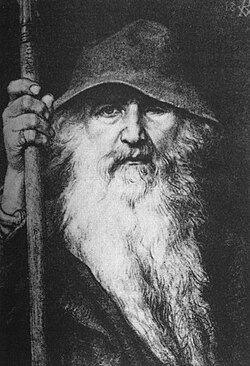
Odin, in his guise as a wanderer, as imagined by Georg von Rosen (1886)
The Etymology and Origins of Wōðanaz
The name Odin is derived from the Old Norse Óðinn. Scholars believe his identity stems from the reconstructed Proto-Germanic theonym Wōðanaz, which translates to "lord of frenzy" or "leader of the possessed." This linguistic root suggests a deep connection to divine inspiration, ecstasy, and the intense mental states associated with poetry and battle.
Historical records, such as the writings of Adam of Bremen in the 11th century, explicitly link the name Wodan to the Latin term furor, meaning rage, fury, or madness. This reinforces the concept of Odin as a deity of ecstatic divination and intense spiritual possession.
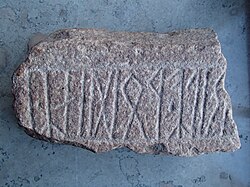
Woðinz (read from right to left), a probably authentic attestation of a pre-Viking Age form of Odin, on the Strängnäs stone
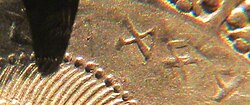
The name Wōđnas on a bracteate from the early 5th century AD, written as mirrored text

The Old English rune ós, which is described in the Old English rune poem
The Pantheon and Divine Lineage
Odin is recognized as the head of the Æsir, the primary group of gods in the Norse pantheon. He is the son of Borr and Bestla, and the brother of Vili and Vé. In his domestic life, he is the husband of the goddess Frigg, with whom he fathered the beloved god Baldr. Odin also sired Thor, the thunder god, with the earth-goddess Jörð.
He is often depicted as an older, long-bearded man, sometimes characterized by having only one eye. This physical trait is a testament to his pursuit of wisdom; according to myth, he sacrificed his other eye to gain profound insight. He is frequently accompanied by his animal familiars: the ravens Huginn and Muninn, and the wolves Geri and Freki.
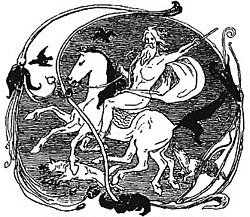
Odin sits atop his steed Sleipnir, his ravens Huginn and Muninn and wolves Geri and Freki nearby (1895) by Lorenz Frølich.
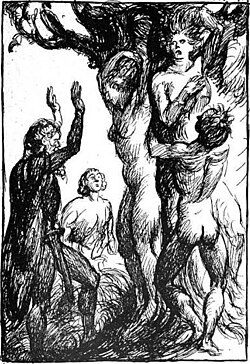
The trio of gods giving life to the first humans, Ask and Embla, by Robert Engels, 1919.

Odin sacrificing himself upon Yggdrasil as depicted by Lorenz Frølich, 1895
Creation and the World Order
The Prose Edda recounts that Odin and his brothers shaped the world by slaying the primordial being, Ymir. Beyond creation, Odin is credited with breathing life into the first human beings, Ask and Embla. His role as a provider of spirit and sense is echoed in Old English texts, where the rune ós is described as the foundation of all language and wisdom.
![One of the Torslunda plates. The figure to the left was cast with both eyes, but afterwards the right eye was removed.[22]](/images/8d/6a/8d6ac4fcbcc6d8dbd68d2154e8209511c581dcfe323c11f0ab508949d624b414.jpg)
One of the Torslunda plates. The figure to the left was cast with both eyes, but afterwards the right eye was removed.[22]
Warfare, Death, and the Fate of the Gods
Odin is a dualistic figure: a god of wisdom and a god of war and death. He presides over the einherjar—the slain warriors of battle—who are brought to Valhöll (the Hall of the Slain) in the realm of Asgard. He is closely associated with the Valkyries, the female figures who choose who lives and dies in combat.
This martial aspect extends to the end of the world. During Ragnarök, the twilight of the gods, Odin is destined to lead the einherjar into a final battle, where he will ultimately be killed by the monstrous wolf Fenrir.
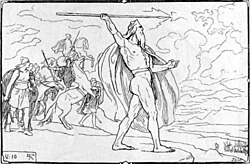
Óðinn throws his spear at the Vanir host in an illustration by Lorenz Frølich (1895)
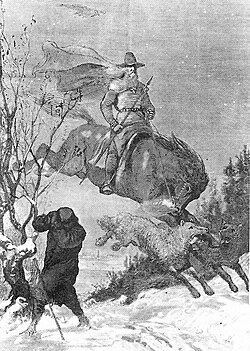
Odin's hunt (August Malmström)
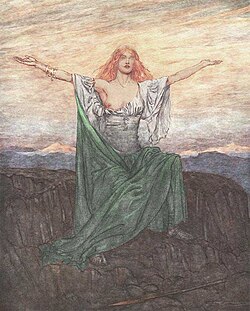
After being put to sleep by Odin and being awoken by the hero Sigurd, the valkyrie Sigrdrífa says a pagan prayer; illustration (1911) by Arthur Rackham.
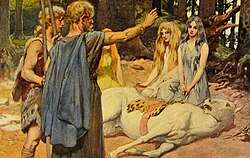
Odin Heals Balder's Horse by Emil Doepler, 1905
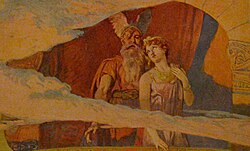
Odin and Frea look down from their window in the heavens to the Winnili women in an illustration by Emil Doepler, 1905.

Winnili women with their hair tied as beards look up at Godan and Frea in an illustration by Emil Doepler, 1905.
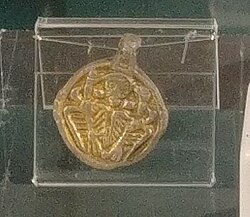
Pendant from Winteringham showing a man embracing two ravens
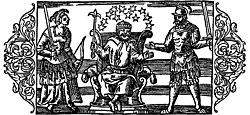
A 16th-century depiction of Norse gods by Olaus Magnus: from left to right, Frigg, Odin, and Thor
Summary of Odin's Attributes
| Attribute | Description |
|---|---|
| Primary Roles | God of wisdom, poetry, warfare, and the dead |
| Family | Husband of Frigg; father of Baldr and Thor |
| Companions | Ravens (Huginn and Muninn), Wolves (Geri and Freki), Steed (Sleipnir) |
| Key Symbols | Spear, ring, and a single eye |
| Final Fate | Slain by the wolf Fenrir during Ragnarök |
Key Facts
- Etymology: His name likely means "lord of frenzy" or "leader of the possessed."
- Wisdom: He sacrificed one eye to gain cosmic knowledge.
- The Einherjar: He receives fallen warriors in Valhöll to prepare for Ragnarök.
- The Runes: He famously attained the knowledge of runes through a nine-night self-sacrifice on a wind-swept tree.
- Cultural Impact: He has inspired countless works of art, from Wagner's operas to modern Marvel comics and video games.
Frequently Asked Questions
What is the meaning of Odin's name?
The name is believed to stem from the Proto-Germanic Wōðanaz, relating to divine possession, frenzy, or inspiration, which connects to his association with poetry and madness.
Why does Odin only have one eye?
According to Norse mythology, Odin sacrificed one of his eyes to gain immense wisdom and insight.
Who are Odin's animal companions?
Odin is accompanied by two ravens, Huginn and Muninn, and two wolves, Geri and Freki.
What happens to Odin during Ragnarök?
During the apocalyptic event known as Ragnarök, Odin leads the einherjar into battle but is ultimately killed by the wolf Fenrir.
How is Odin represented in modern media?
Odin appears in various forms, including Marvel Comics (portrayed by Anthony Hopkins), Neil Gaiman's American Gods, and video games like God of War and Assassin's Creed Valhalla.